

172
17 The Twin Paradox
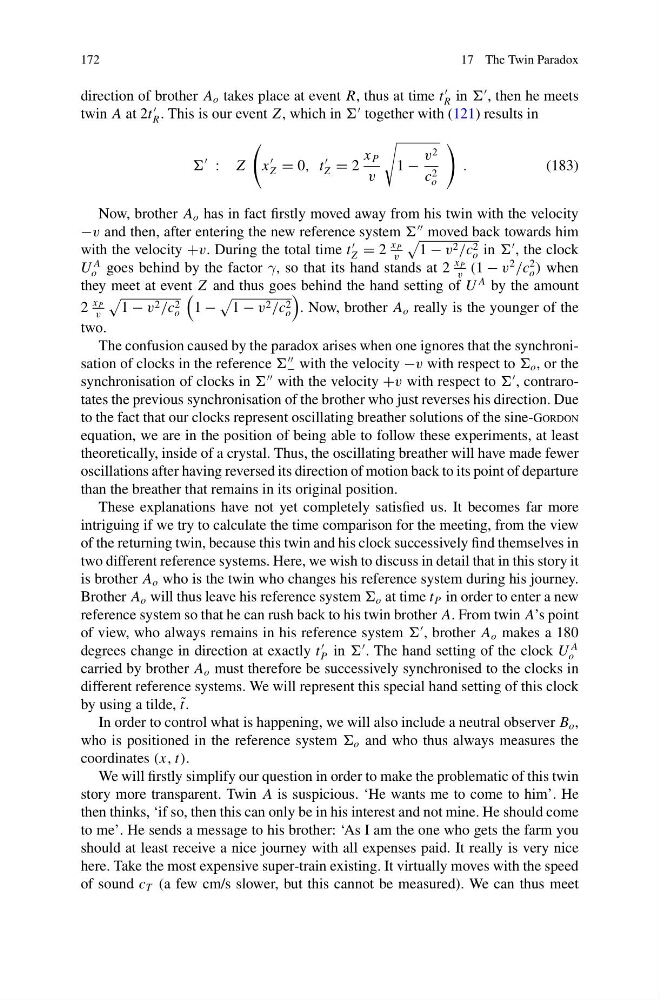
direction of brother A o takes place at event R, thus at time t
R in
, then he meets
twin A at 2t
R . This is our event Z , which in
together with (121) results in
: Z
x
Z = 0, t
Z = 2
x P
v
1 −
v 2
c 2
o
.
(183)
Now, brother A o has in fact firstly moved away from his twin with the velocity
−v and then, after entering the new reference system
moved back towards him
with the velocity +v. During the total time t
Z = 2
x P
v
1 − v 2 /c 2
o in
, the clock
U
A
o goes behind by the factor γ, so that its hand stands at 2
x P
v
(1 − v
2
/c
2
o ) when
they meet at event Z and thus goes behind the hand setting of U
A by the amount
2
x P
v
1 − v 2 /c 2
o
1 −
1 − v 2 /c 2
o
. Now, brother A o really is the younger of the
two.
The confusion caused by the paradox arises when one ignores that the synchronisation of clocks in the reference
− with the velocity −v with respect to o , or the
synchronisation of clocks in
with the velocity +v with respect to
, contrarotates the previous synchronisation of the brother who just reverses his direction. Due
to the fact that our clocks represent oscillating breather solutions of the sine-Gordon
equation, we are in the position of being able to follow these experiments, at least
theoretically, inside of a crystal. Thus, the oscillating breather will have made fewer
oscillations after having reversed its direction of motion back to its point of departure
than the breather that remains in its original position.
These explanations have not yet completely satisfied us. It becomes far more
intriguing if we try to calculate the time comparison for the meeting, from the view
of the returning twin, because this twin and his clock successively find themselves in
two different reference systems. Here, we wish to discuss in detail that in this story it
is brother A o who is the twin who changes his reference system during his journey.
Brother A o will thus leave his reference system o at time t P in order to enter a new
reference system so that he can rush back to his twin brother A. From twin A’s point
of view, who always remains in his reference system
, brother A o makes a 180
degrees change in direction at exactly t
P in
. The hand setting of the clock U
A
o
carried by brother A o must therefore be successively synchronised to the clocks in
different reference systems. We will represent this special hand setting of this clock
by using a tilde, ˜
t.
In order to control what is happening, we will also include a neutral observer B o ,
who is positioned in the reference system o and who thus always measures the
coordinates (x, t).
We will firstly simplify our question in order to make the problematic of this twin
story more transparent. Twin A is suspicious. ‘He wants me to come to him’. He
then thinks, ‘if so, then this can only be in his interest and not mine. He should come
to me’. He sends a message to his brother: ‘As I am the one who gets the farm you
should at least receive a nice journey with all expenses paid. It really is very nice
here. Take the most expensive super-train existing. It virtually moves with the speed
of sound c T (a few cm/s slower, but this cannot be measured). We can thus meet
17 The Twin Paradox
direction of brother A o takes place at event R, thus at time t
R in
, then he meets
twin A at 2t
R . This is our event Z , which in
together with (121) results in
: Z
x
Z = 0, t
Z = 2
x P
v
1 −
v 2
c 2
o
.
(183)
Now, brother A o has in fact firstly moved away from his twin with the velocity
−v and then, after entering the new reference system
moved back towards him
with the velocity +v. During the total time t
Z = 2
x P
v
1 − v 2 /c 2
o in
, the clock
U
A
o goes behind by the factor γ, so that its hand stands at 2
x P
v
(1 − v
2
/c
2
o ) when
they meet at event Z and thus goes behind the hand setting of U
A by the amount
2
x P
v
1 − v 2 /c 2
o
1 −
1 − v 2 /c 2
o
. Now, brother A o really is the younger of the
two.
The confusion caused by the paradox arises when one ignores that the synchronisation of clocks in the reference
− with the velocity −v with respect to o , or the
synchronisation of clocks in
with the velocity +v with respect to
, contrarotates the previous synchronisation of the brother who just reverses his direction. Due
to the fact that our clocks represent oscillating breather solutions of the sine-Gordon
equation, we are in the position of being able to follow these experiments, at least
theoretically, inside of a crystal. Thus, the oscillating breather will have made fewer
oscillations after having reversed its direction of motion back to its point of departure
than the breather that remains in its original position.
These explanations have not yet completely satisfied us. It becomes far more
intriguing if we try to calculate the time comparison for the meeting, from the view
of the returning twin, because this twin and his clock successively find themselves in
two different reference systems. Here, we wish to discuss in detail that in this story it
is brother A o who is the twin who changes his reference system during his journey.
Brother A o will thus leave his reference system o at time t P in order to enter a new
reference system so that he can rush back to his twin brother A. From twin A’s point
of view, who always remains in his reference system
, brother A o makes a 180
degrees change in direction at exactly t
P in
. The hand setting of the clock U
A
o
carried by brother A o must therefore be successively synchronised to the clocks in
different reference systems. We will represent this special hand setting of this clock
by using a tilde, ˜
t.
In order to control what is happening, we will also include a neutral observer B o ,
who is positioned in the reference system o and who thus always measures the
coordinates (x, t).
We will firstly simplify our question in order to make the problematic of this twin
story more transparent. Twin A is suspicious. ‘He wants me to come to him’. He
then thinks, ‘if so, then this can only be in his interest and not mine. He should come
to me’. He sends a message to his brother: ‘As I am the one who gets the farm you
should at least receive a nice journey with all expenses paid. It really is very nice
here. Take the most expensive super-train existing. It virtually moves with the speed
of sound c T (a few cm/s slower, but this cannot be measured). We can thus meet