

16 Two Axiomatic Systems for Special Relativity
163
x
=
x − vt
γ
, x = γ x
+
v
γ
t
,
t
= γ t ,
t =
1
γ
t
.
⎫
⎪ ⎬
⎪ ⎭
Absolute simultaneity
Reichenbach transformation
(143)
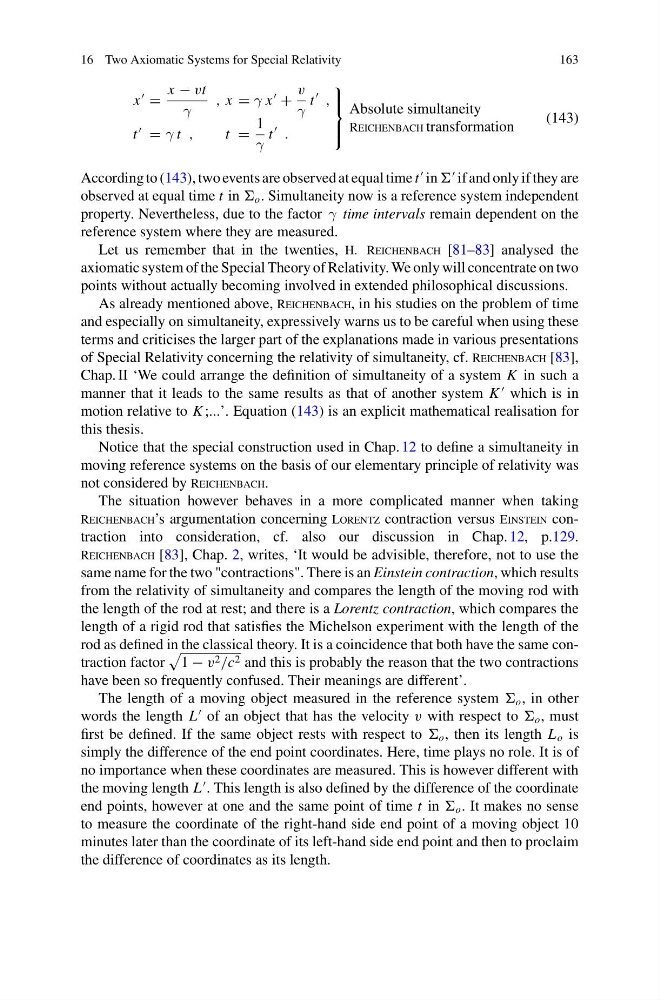
According to (143), two events are observed at equal time t
in
if and only if they are
observed at equal time t in o . Simultaneity now is a reference system independent
property. Nevertheless, due to the factor γ time intervals remain dependent on the
reference system where they are measured.
Let us remember that in the twenties, H. Reichenbach [81–83] analysed the
axiomatic system of the Special Theory of Relativity. We only will concentrate on two
points without actually becoming involved in extended philosophical discussions.
As already mentioned above, Reichenbach, in his studies on the problem of time
and especially on simultaneity, expressively warns us to be careful when using these
terms and criticises the larger part of the explanations made in various presentations
of Special Relativity concerning the relativity of simultaneity, cf. Reichenbach [83],
Chap. II ‘We could arrange the definition of simultaneity of a system K in such a
manner that it leads to the same results as that of another system K
which is in
motion relative to K ;...’. Equation (143) is an explicit mathematical realisation for
this thesis.
Notice that the special construction used in Chap. 12 to define a simultaneity in
moving reference systems on the basis of our elementary principle of relativity was
not considered by Reichenbach.
The situation however behaves in a more complicated manner when taking
Reichenbach’s argumentation concerning Lorentz contraction versus Einstein contraction into consideration, cf. also our discussion in Chap. 12, p.129.
Reichenbach [83], Chap. 2, writes, ‘It would be advisible, therefore, not to use the
same name for the two "contractions". There is an Einstein contraction, which results
from the relativity of simultaneity and compares the length of the moving rod with
the length of the rod at rest; and there is a Lorentz contraction, which compares the
length of a rigid rod that satisfies the Michelson experiment with the length of the
rod as defined in the classical theory. It is a coincidence that both have the same contraction factor
1 − v 2 /c 2 and this is probably the reason that the two contractions
have been so frequently confused. Their meanings are different’.
The length of a moving object measured in the reference system o , in other
words the length L
of an object that has the velocity v with respect to o , must
first be defined. If the same object rests with respect to o , then its length L o is
simply the difference of the end point coordinates. Here, time plays no role. It is of
no importance when these coordinates are measured. This is however different with
the moving length L
. This length is also defined by the difference of the coordinate
end points, however at one and the same point of time t in o . It makes no sense
to measure the coordinate of the right-hand side end point of a moving object 10
minutes later than the coordinate of its left-hand side end point and then to proclaim
the difference of coordinates as its length.
163
x
=
x − vt
γ
, x = γ x
+
v
γ
t
,
t
= γ t ,
t =
1
γ
t
.
⎫
⎪ ⎬
⎪ ⎭
Absolute simultaneity
Reichenbach transformation
(143)
According to (143), two events are observed at equal time t
in
if and only if they are
observed at equal time t in o . Simultaneity now is a reference system independent
property. Nevertheless, due to the factor γ time intervals remain dependent on the
reference system where they are measured.
Let us remember that in the twenties, H. Reichenbach [81–83] analysed the
axiomatic system of the Special Theory of Relativity. We only will concentrate on two
points without actually becoming involved in extended philosophical discussions.
As already mentioned above, Reichenbach, in his studies on the problem of time
and especially on simultaneity, expressively warns us to be careful when using these
terms and criticises the larger part of the explanations made in various presentations
of Special Relativity concerning the relativity of simultaneity, cf. Reichenbach [83],
Chap. II ‘We could arrange the definition of simultaneity of a system K in such a
manner that it leads to the same results as that of another system K
which is in
motion relative to K ;...’. Equation (143) is an explicit mathematical realisation for
this thesis.
Notice that the special construction used in Chap. 12 to define a simultaneity in
moving reference systems on the basis of our elementary principle of relativity was
not considered by Reichenbach.
The situation however behaves in a more complicated manner when taking
Reichenbach’s argumentation concerning Lorentz contraction versus Einstein contraction into consideration, cf. also our discussion in Chap. 12, p.129.
Reichenbach [83], Chap. 2, writes, ‘It would be advisible, therefore, not to use the
same name for the two "contractions". There is an Einstein contraction, which results
from the relativity of simultaneity and compares the length of the moving rod with
the length of the rod at rest; and there is a Lorentz contraction, which compares the
length of a rigid rod that satisfies the Michelson experiment with the length of the
rod as defined in the classical theory. It is a coincidence that both have the same contraction factor
1 − v 2 /c 2 and this is probably the reason that the two contractions
have been so frequently confused. Their meanings are different’.
The length of a moving object measured in the reference system o , in other
words the length L
of an object that has the velocity v with respect to o , must
first be defined. If the same object rests with respect to o , then its length L o is
simply the difference of the end point coordinates. Here, time plays no role. It is of
no importance when these coordinates are measured. This is however different with
the moving length L
. This length is also defined by the difference of the coordinate
end points, however at one and the same point of time t in o . It makes no sense
to measure the coordinate of the right-hand side end point of a moving object 10
minutes later than the coordinate of its left-hand side end point and then to proclaim
the difference of coordinates as its length.