

16 Two Axiomatic Systems for Special Relativity
161
and a stationary clock, we shall have continually .... t
=
1
k
t ’. (Notice that here the
definition is k = 1/
1 − v 2 /c 2 ).
These postulates for the measuring-rods and clocks in a preferred frame o can
be extended to an independent and complete axiomatic system for spacetime if we
add a definition for synchronisation of clocks for every single inertial system. Notice
that we are now completely free to do this. It makes sense here to use a symmetry
principle:
2. In order to define simultaneity in every single inertial system, we assume that the
elementary principle of relativity should be valid as formulated in Chap. 12, p.118,
cf. Günther [30]:
After an observer resting in o has measured that possesses the velocity v with respect
to o , all clocks in should be set such that an observer resting in , measures that the
reference system o possesses the velocity −v with respect to .
With the help of these two postulates 1. and 2., we found in Chap. 13 (cf. also
Günther [36]) the coordinates (x
, t
) of an event E for the reference system
,
which in the reference system o has the coordinates (x, t). Hence, we get simply
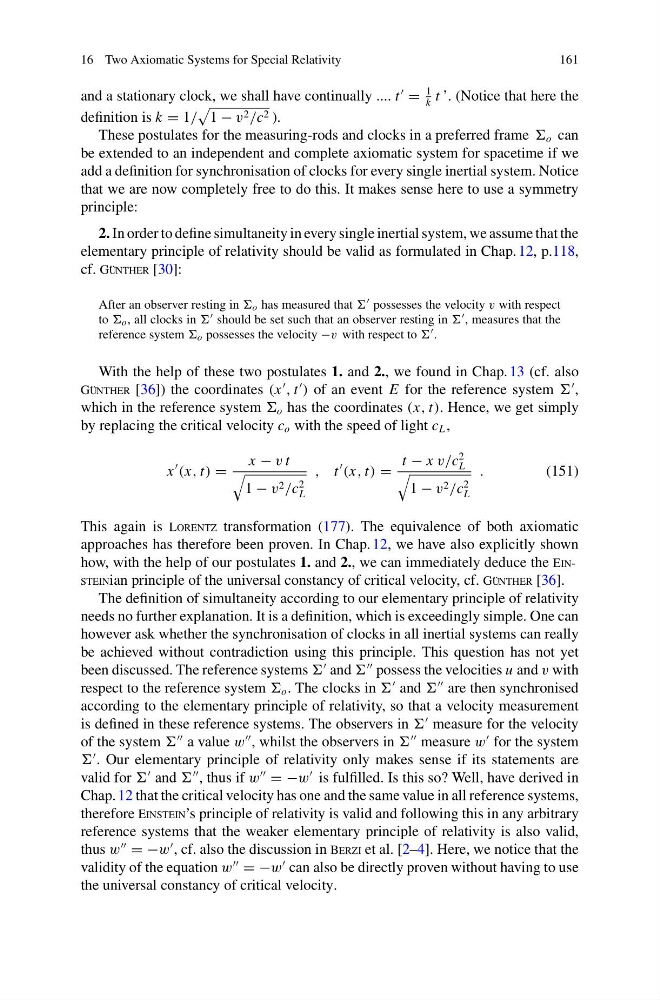
by replacing the critical velocity c o with the speed of light c L ,
x
(x, t) =
x − v t
1 − v 2 /c
2
L
, t
(x, t) =
t − x v/c
2
L
1 − v 2 /c
2
L
.
(151)
This again is Lorentz transformation (177). The equivalence of both axiomatic
approaches has therefore been proven. In Chap. 12, we have also explicitly shown
how, with the help of our postulates 1. and 2., we can immediately deduce the Einsteinian principle of the universal constancy of critical velocity, cf. Günther [36].
The definition of simultaneity according to our elementary principle of relativity
needs no further explanation. It is a definition, which is exceedingly simple. One can
however ask whether the synchronisation of clocks in all inertial systems can really
be achieved without contradiction using this principle. This question has not yet
been discussed. The reference systems
and
possess the velocities u and v with
respect to the reference system o . The clocks in
and
are then synchronised
according to the elementary principle of relativity, so that a velocity measurement
is defined in these reference systems. The observers in
measure for the velocity
of the system
a value w
, whilst the observers in
measure w
for the system
. Our elementary principle of relativity only makes sense if its statements are
valid for
and
, thus if w
= −w
is fulfilled. Is this so? Well, have derived in
Chap. 12 that the critical velocity has one and the same value in all reference systems,
therefore Einstein’s principle of relativity is valid and following this in any arbitrary
reference systems that the weaker elementary principle of relativity is also valid,
thus w
= −w
, cf. also the discussion in Berzi et al. [2–4]. Here, we notice that the
validity of the equation w
= −w
can also be directly proven without having to use
the universal constancy of critical velocity.
161
and a stationary clock, we shall have continually .... t
=
1
k
t ’. (Notice that here the
definition is k = 1/
1 − v 2 /c 2 ).
These postulates for the measuring-rods and clocks in a preferred frame o can
be extended to an independent and complete axiomatic system for spacetime if we
add a definition for synchronisation of clocks for every single inertial system. Notice
that we are now completely free to do this. It makes sense here to use a symmetry
principle:
2. In order to define simultaneity in every single inertial system, we assume that the
elementary principle of relativity should be valid as formulated in Chap. 12, p.118,
cf. Günther [30]:
After an observer resting in o has measured that possesses the velocity v with respect
to o , all clocks in should be set such that an observer resting in , measures that the
reference system o possesses the velocity −v with respect to .
With the help of these two postulates 1. and 2., we found in Chap. 13 (cf. also
Günther [36]) the coordinates (x
, t
) of an event E for the reference system
,
which in the reference system o has the coordinates (x, t). Hence, we get simply
by replacing the critical velocity c o with the speed of light c L ,
x
(x, t) =
x − v t
1 − v 2 /c
2
L
, t
(x, t) =
t − x v/c
2
L
1 − v 2 /c
2
L
.
(151)
This again is Lorentz transformation (177). The equivalence of both axiomatic
approaches has therefore been proven. In Chap. 12, we have also explicitly shown
how, with the help of our postulates 1. and 2., we can immediately deduce the Einsteinian principle of the universal constancy of critical velocity, cf. Günther [36].
The definition of simultaneity according to our elementary principle of relativity
needs no further explanation. It is a definition, which is exceedingly simple. One can
however ask whether the synchronisation of clocks in all inertial systems can really
be achieved without contradiction using this principle. This question has not yet
been discussed. The reference systems
and
possess the velocities u and v with
respect to the reference system o . The clocks in
and
are then synchronised
according to the elementary principle of relativity, so that a velocity measurement
is defined in these reference systems. The observers in
measure for the velocity
of the system
a value w
, whilst the observers in
measure w
for the system
. Our elementary principle of relativity only makes sense if its statements are
valid for
and
, thus if w
= −w
is fulfilled. Is this so? Well, have derived in
Chap. 12 that the critical velocity has one and the same value in all reference systems,
therefore Einstein’s principle of relativity is valid and following this in any arbitrary
reference systems that the weaker elementary principle of relativity is also valid,
thus w
= −w
, cf. also the discussion in Berzi et al. [2–4]. Here, we notice that the
validity of the equation w
= −w
can also be directly proven without having to use
the universal constancy of critical velocity.