

150
15 The Principle of Relativity: The Lost Crystal
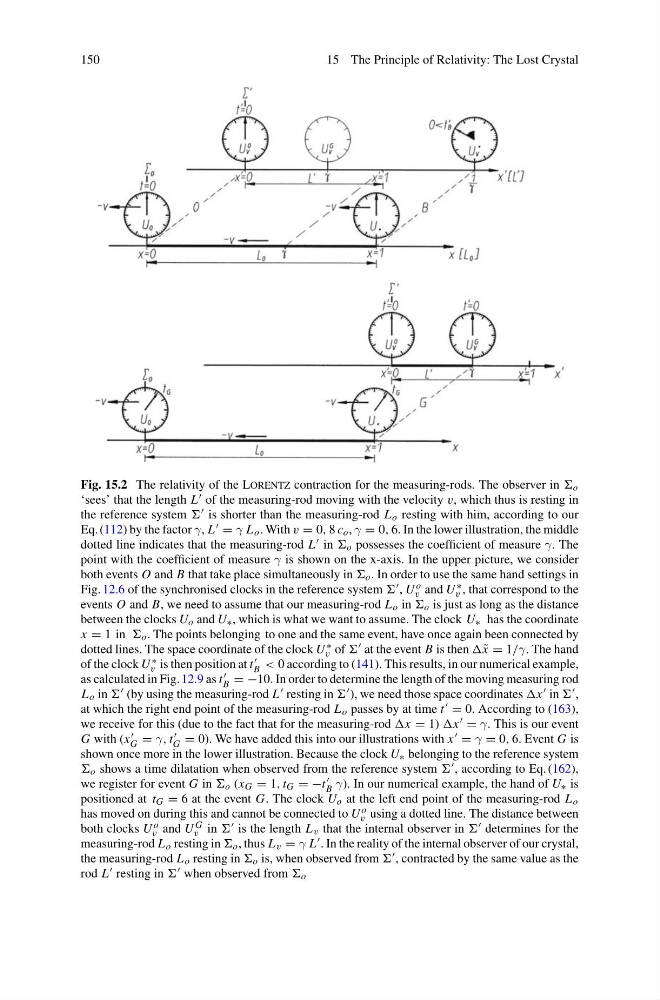
Fig. 15.2 The relativity of the Lorentz contraction for the measuring-rods. The observer in o
‘sees’ that the length L of the measuring-rod moving with the velocity v, which thus is resting in
the reference system is shorter than the measuring-rod L o resting with him, according to our
Eq. (112) by the factor γ, L = γ L o . With v = 0, 8 c o , γ = 0, 6. In the lower illustration, the middle
dotted line indicates that the measuring-rod L in o possesses the coefficient of measure γ. The
point with the coefficient of measure γ is shown on the x-axis. In the upper picture, we consider
both events O and B that take place simultaneously in o . In order to use the same hand settings in
Fig. 12.6 of the synchronised clocks in the reference system , U o
v and U ∗
v , that correspond to the
events O and B, we need to assume that our measuring-rod L o in o is just as long as the distance
between the clocks U o and U ∗ , which is what we want to assume. The clock U ∗ has the coordinate
x = 1 in o . The points belonging to one and the same event, have once again been connected by
dotted lines. The space coordinate of the clock U ∗
v of at the event B is then ˜
x = 1/γ. The hand
of the clock U ∗
v is then position at t
B < 0 according to (141). This results, in our numerical example,
as calculated in Fig. 12.9 as t
B = −10. In order to determine the length of the moving measuring rod
L o in (by using the measuring-rod L resting in ), we need those space coordinates x in ,
at which the right end point of the measuring-rod L o passes by at time t = 0. According to (163),
we receive for this (due to the fact that for the measuring-rod x = 1) x = γ. This is our event
G with (x
G = γ, t
G = 0). We have added this into our illustrations with x = γ = 0, 6. Event G is
shown once more in the lower illustration. Because the clock U ∗ belonging to the reference system
o shows a time dilatation when observed from the reference system , according to Eq. (162),
we register for event G in o (x G = 1, t G = −t
B γ). In our numerical example, the hand of U ∗ is
positioned at t G = 6 at the event G. The clock U o at the left end point of the measuring-rod L o
has moved on during this and cannot be connected to U o
v using a dotted line. The distance between
both clocks U o
v and U G
v in is the length L v that the internal observer in determines for the
measuring-rod L o resting in o , thus L v = γ L . In the reality of the internal observer of our crystal,
the measuring-rod L o resting in o is, when observed from , contracted by the same value as the
rod L resting in when observed from o
15 The Principle of Relativity: The Lost Crystal
Fig. 15.2 The relativity of the Lorentz contraction for the measuring-rods. The observer in o
‘sees’ that the length L of the measuring-rod moving with the velocity v, which thus is resting in
the reference system is shorter than the measuring-rod L o resting with him, according to our
Eq. (112) by the factor γ, L = γ L o . With v = 0, 8 c o , γ = 0, 6. In the lower illustration, the middle
dotted line indicates that the measuring-rod L in o possesses the coefficient of measure γ. The
point with the coefficient of measure γ is shown on the x-axis. In the upper picture, we consider
both events O and B that take place simultaneously in o . In order to use the same hand settings in
Fig. 12.6 of the synchronised clocks in the reference system , U o
v and U ∗
v , that correspond to the
events O and B, we need to assume that our measuring-rod L o in o is just as long as the distance
between the clocks U o and U ∗ , which is what we want to assume. The clock U ∗ has the coordinate
x = 1 in o . The points belonging to one and the same event, have once again been connected by
dotted lines. The space coordinate of the clock U ∗
v of at the event B is then ˜
x = 1/γ. The hand
of the clock U ∗
v is then position at t
B < 0 according to (141). This results, in our numerical example,
as calculated in Fig. 12.9 as t
B = −10. In order to determine the length of the moving measuring rod
L o in (by using the measuring-rod L resting in ), we need those space coordinates x in ,
at which the right end point of the measuring-rod L o passes by at time t = 0. According to (163),
we receive for this (due to the fact that for the measuring-rod x = 1) x = γ. This is our event
G with (x
G = γ, t
G = 0). We have added this into our illustrations with x = γ = 0, 6. Event G is
shown once more in the lower illustration. Because the clock U ∗ belonging to the reference system
o shows a time dilatation when observed from the reference system , according to Eq. (162),
we register for event G in o (x G = 1, t G = −t
B γ). In our numerical example, the hand of U ∗ is
positioned at t G = 6 at the event G. The clock U o at the left end point of the measuring-rod L o
has moved on during this and cannot be connected to U o
v using a dotted line. The distance between
both clocks U o
v and U G
v in is the length L v that the internal observer in determines for the
measuring-rod L o resting in o , thus L v = γ L . In the reality of the internal observer of our crystal,
the measuring-rod L o resting in o is, when observed from , contracted by the same value as the
rod L resting in when observed from o