

148
15 The Principle of Relativity: The Lost Crystal
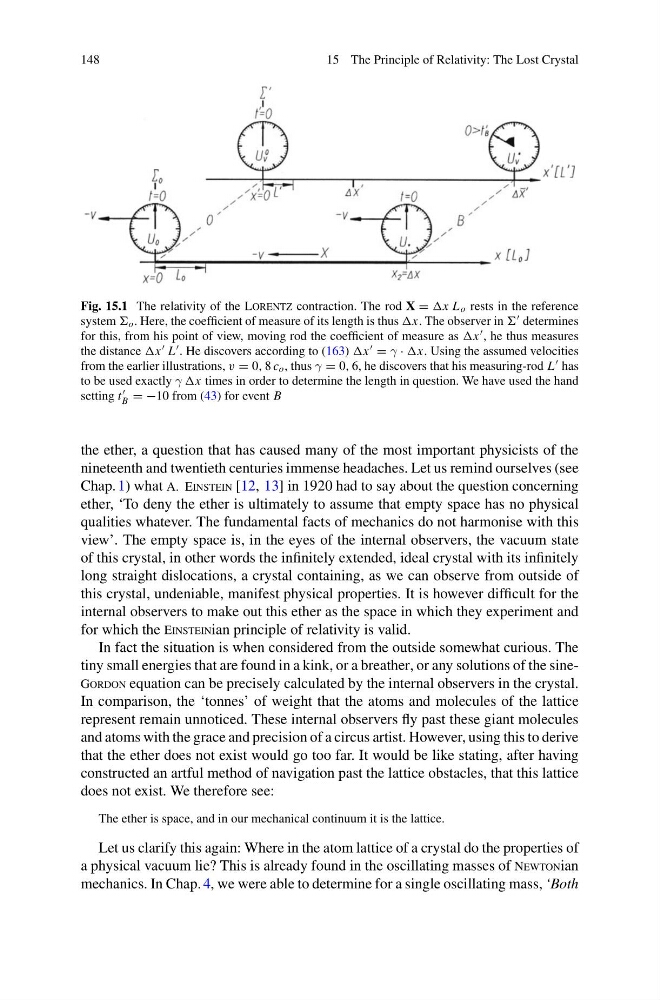
Fig. 15.1 The relativity of the Lorentz contraction. The rod X = x L o rests in the reference
system o . Here, the coefficient of measure of its length is thus x. The observer in determines
for this, from his point of view, moving rod the coefficient of measure as x , he thus measures
the distance x L . He discovers according to (163) x = γ · x. Using the assumed velocities
from the earlier illustrations, v = 0, 8 c o , thus γ = 0, 6, he discovers that his measuring-rod L has
to be used exactly γ x times in order to determine the length in question. We have used the hand
setting t
B = −10 from (43) for event B
the ether, a question that has caused many of the most important physicists of the
nineteenth and twentieth centuries immense headaches. Let us remind ourselves (see
Chap. 1) what A. Einstein [12, 13] in 1920 had to say about the question concerning
ether, ‘To deny the ether is ultimately to assume that empty space has no physical
qualities whatever. The fundamental facts of mechanics do not harmonise with this
view’. The empty space is, in the eyes of the internal observers, the vacuum state
of this crystal, in other words the infinitely extended, ideal crystal with its infinitely
long straight dislocations, a crystal containing, as we can observe from outside of
this crystal, undeniable, manifest physical properties. It is however difficult for the
internal observers to make out this ether as the space in which they experiment and
for which the Einsteinian principle of relativity is valid.
In fact the situation is when considered from the outside somewhat curious. The
tiny small energies that are found in a kink, or a breather, or any solutions of the sineGordon equation can be precisely calculated by the internal observers in the crystal.
In comparison, the ‘tonnes’ of weight that the atoms and molecules of the lattice
represent remain unnoticed. These internal observers fly past these giant molecules
and atoms with the grace and precision of a circus artist. However, using this to derive
that the ether does not exist would go too far. It would be like stating, after having
constructed an artful method of navigation past the lattice obstacles, that this lattice
does not exist. We therefore see:
The ether is space, and in our mechanical continuum it is the lattice.
Let us clarify this again: Where in the atom lattice of a crystal do the properties of
a physical vacuum lie? This is already found in the oscillating masses of Newtonian
mechanics. In Chap. 4, we were able to determine for a single oscillating mass, ‘Both
15 The Principle of Relativity: The Lost Crystal
Fig. 15.1 The relativity of the Lorentz contraction. The rod X = x L o rests in the reference
system o . Here, the coefficient of measure of its length is thus x. The observer in determines
for this, from his point of view, moving rod the coefficient of measure as x , he thus measures
the distance x L . He discovers according to (163) x = γ · x. Using the assumed velocities
from the earlier illustrations, v = 0, 8 c o , thus γ = 0, 6, he discovers that his measuring-rod L has
to be used exactly γ x times in order to determine the length in question. We have used the hand
setting t
B = −10 from (43) for event B
the ether, a question that has caused many of the most important physicists of the
nineteenth and twentieth centuries immense headaches. Let us remind ourselves (see
Chap. 1) what A. Einstein [12, 13] in 1920 had to say about the question concerning
ether, ‘To deny the ether is ultimately to assume that empty space has no physical
qualities whatever. The fundamental facts of mechanics do not harmonise with this
view’. The empty space is, in the eyes of the internal observers, the vacuum state
of this crystal, in other words the infinitely extended, ideal crystal with its infinitely
long straight dislocations, a crystal containing, as we can observe from outside of
this crystal, undeniable, manifest physical properties. It is however difficult for the
internal observers to make out this ether as the space in which they experiment and
for which the Einsteinian principle of relativity is valid.
In fact the situation is when considered from the outside somewhat curious. The
tiny small energies that are found in a kink, or a breather, or any solutions of the sineGordon equation can be precisely calculated by the internal observers in the crystal.
In comparison, the ‘tonnes’ of weight that the atoms and molecules of the lattice
represent remain unnoticed. These internal observers fly past these giant molecules
and atoms with the grace and precision of a circus artist. However, using this to derive
that the ether does not exist would go too far. It would be like stating, after having
constructed an artful method of navigation past the lattice obstacles, that this lattice
does not exist. We therefore see:
The ether is space, and in our mechanical continuum it is the lattice.
Let us clarify this again: Where in the atom lattice of a crystal do the properties of
a physical vacuum lie? This is already found in the oscillating masses of Newtonian
mechanics. In Chap. 4, we were able to determine for a single oscillating mass, ‘Both