

142
15 The Principle of Relativity: The Lost Crystal
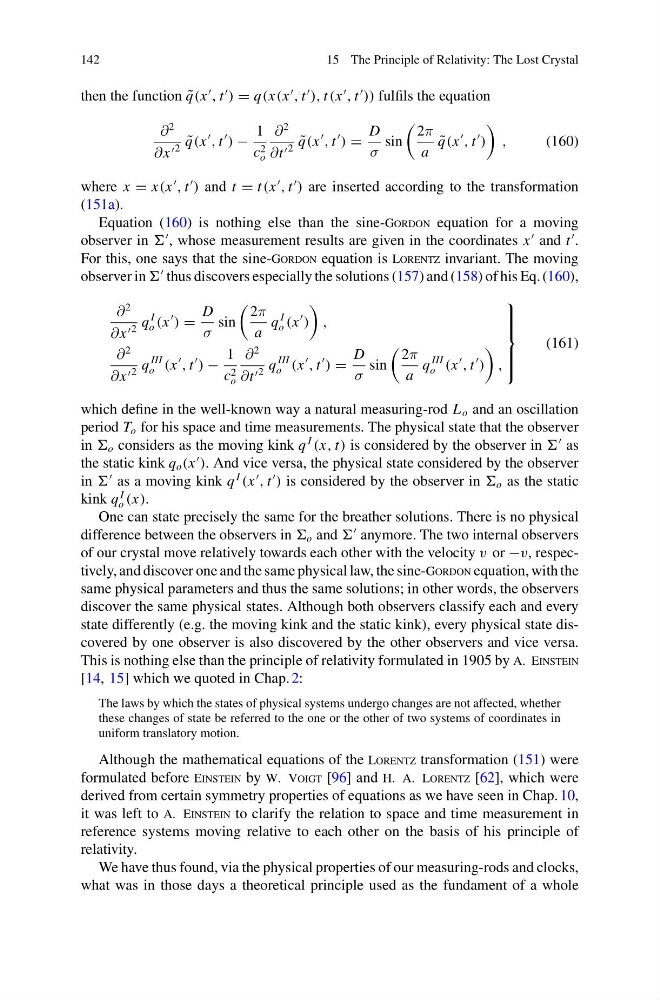
then the function ˜
q(x
, t
) = q(x(x
, t
), t (x
, t
)) fulfils the equation
∂
2
∂x 2 ˜
q(x
, t
) −
1
c 2
o
∂
2
∂t 2 ˜
q(x
, t
) =
D
σ
sin
2π
a
˜
q(x
, t
)
,
(160)
where x = x(x
, t
) and t = t (x
, t
) are inserted according to the transformation
(151a).
Equation (160) is nothing else than the sine-Gordon equation for a moving
observer in
, whose measurement results are given in the coordinates x
and t
.
For this, one says that the sine-Gordon equation is Lorentz invariant. The moving
observer in
thus discovers especially the solutions (157) and (158) of his Eq. (160),
∂
2
∂x 2 q
I
o (x
) =
D
σ
sin
2π
a
q
I
o (x
)
,
∂
2
∂x 2 q
III
o (x
, t
) −
1
c 2
o
∂
2
∂t 2 q
III
o (x
, t
) =
D
σ
sin
2π
a
q
III
o (x
, t
)
,
⎫
⎪ ⎪ ⎪ ⎬
⎪ ⎪ ⎪ ⎭
(161)
which define in the well-known way a natural measuring-rod L o and an oscillation
period T o for his space and time measurements. The physical state that the observer
in o considers as the moving kink q
I
(x, t) is considered by the observer in
as
the static kink q o (x
). And vice versa, the physical state considered by the observer
in
as a moving kink q
I
(x
, t
) is considered by the observer in o as the static
kink q
I
o (x).
One can state precisely the same for the breather solutions. There is no physical
difference between the observers in o and
anymore. The two internal observers
of our crystal move relatively towards each other with the velocity v or −v, respectively, and discover one and the same physical law, the sine-Gordon equation, with the
same physical parameters and thus the same solutions; in other words, the observers
discover the same physical states. Although both observers classify each and every
state differently (e.g. the moving kink and the static kink), every physical state discovered by one observer is also discovered by the other observers and vice versa.
This is nothing else than the principle of relativity formulated in 1905 by A. Einstein
[14, 15] which we quoted in Chap. 2:
The laws by which the states of physical systems undergo changes are not affected, whether
these changes of state be referred to the one or the other of two systems of coordinates in
uniform translatory motion.
Although the mathematical equations of the Lorentz transformation (151) were
formulated before Einstein by W. Voigt [96] and H. A. Lorentz [62], which were
derived from certain symmetry properties of equations as we have seen in Chap. 10,
it was left to A. Einstein to clarify the relation to space and time measurement in
reference systems moving relative to each other on the basis of his principle of
relativity.
We have thus found, via the physical properties of our measuring-rods and clocks,
what was in those days a theoretical principle used as the fundament of a whole
15 The Principle of Relativity: The Lost Crystal
then the function ˜
q(x
, t
) = q(x(x
, t
), t (x
, t
)) fulfils the equation
∂
2
∂x 2 ˜
q(x
, t
) −
1
c 2
o
∂
2
∂t 2 ˜
q(x
, t
) =
D
σ
sin
2π
a
˜
q(x
, t
)
,
(160)
where x = x(x
, t
) and t = t (x
, t
) are inserted according to the transformation
(151a).
Equation (160) is nothing else than the sine-Gordon equation for a moving
observer in
, whose measurement results are given in the coordinates x
and t
.
For this, one says that the sine-Gordon equation is Lorentz invariant. The moving
observer in
thus discovers especially the solutions (157) and (158) of his Eq. (160),
∂
2
∂x 2 q
I
o (x
) =
D
σ
sin
2π
a
q
I
o (x
)
,
∂
2
∂x 2 q
III
o (x
, t
) −
1
c 2
o
∂
2
∂t 2 q
III
o (x
, t
) =
D
σ
sin
2π
a
q
III
o (x
, t
)
,
⎫
⎪ ⎪ ⎪ ⎬
⎪ ⎪ ⎪ ⎭
(161)
which define in the well-known way a natural measuring-rod L o and an oscillation
period T o for his space and time measurements. The physical state that the observer
in o considers as the moving kink q
I
(x, t) is considered by the observer in
as
the static kink q o (x
). And vice versa, the physical state considered by the observer
in
as a moving kink q
I
(x
, t
) is considered by the observer in o as the static
kink q
I
o (x).
One can state precisely the same for the breather solutions. There is no physical
difference between the observers in o and
anymore. The two internal observers
of our crystal move relatively towards each other with the velocity v or −v, respectively, and discover one and the same physical law, the sine-Gordon equation, with the
same physical parameters and thus the same solutions; in other words, the observers
discover the same physical states. Although both observers classify each and every
state differently (e.g. the moving kink and the static kink), every physical state discovered by one observer is also discovered by the other observers and vice versa.
This is nothing else than the principle of relativity formulated in 1905 by A. Einstein
[14, 15] which we quoted in Chap. 2:
The laws by which the states of physical systems undergo changes are not affected, whether
these changes of state be referred to the one or the other of two systems of coordinates in
uniform translatory motion.
Although the mathematical equations of the Lorentz transformation (151) were
formulated before Einstein by W. Voigt [96] and H. A. Lorentz [62], which were
derived from certain symmetry properties of equations as we have seen in Chap. 10,
it was left to A. Einstein to clarify the relation to space and time measurement in
reference systems moving relative to each other on the basis of his principle of
relativity.
We have thus found, via the physical properties of our measuring-rods and clocks,
what was in those days a theoretical principle used as the fundament of a whole