

138
14 The Linear Approximation of Special Relativity
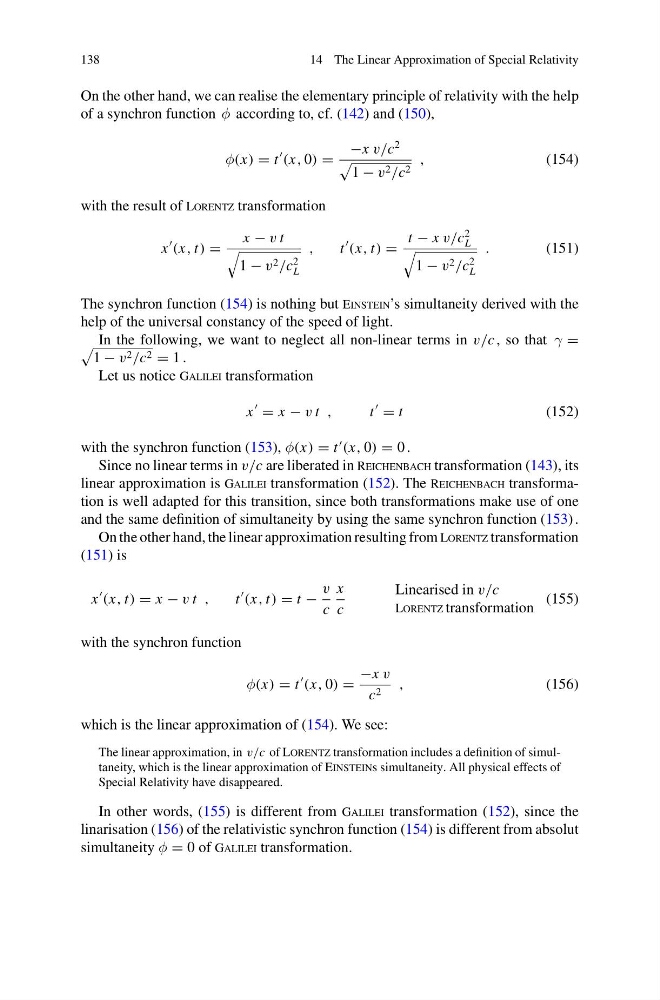
On the other hand, we can realise the elementary principle of relativity with the help
of a synchron function φ according to, cf. (142) and (150),
φ(x) = t
(x, 0) =
−x v/c
2
1 − v 2 /c 2
,
(154)
with the result of Lorentz transformation
x
(x, t) =
x − v t
1 − v 2 /c
2
L
,
t
(x, t) =
t − x v/c
2
L
1 − v 2 /c
2
L
.
(151)
The synchron function (154) is nothing but Einstein’s simultaneity derived with the
help of the universal constancy of the speed of light.
In the following, we want to neglect all non-linear terms in v/c , so that γ =
1 − v 2 /c 2 = 1 .
Let us notice Galilei transformation
x
= x − v t ,
t
= t
(152)
with the synchron function (153), φ(x) = t
(x, 0) = 0 .
Since no linear terms in v/c are liberated in Reichenbach transformation (143), its
linear approximation is Galilei transformation (152). The Reichenbach transformation is well adapted for this transition, since both transformations make use of one
and the same definition of simultaneity by using the same synchron function (153) .
On the other hand, the linear approximation resulting from Lorentz transformation
(151) is
x
(x, t) = x − v t ,
t
(x, t) = t −
v
c
x
c
Linearised in v/c
Lorentz transformation
(155)
with the synchron function
φ(x) = t
(x, 0) =
−x v
c 2 ,
(156)
which is the linear approximation of (154). We see:
The linear approximation, in v/c of Lorentz transformation includes a definition of simultaneity, which is the linear approximation of Einsteins simultaneity. All physical effects of
Special Relativity have disappeared.
In other words, (155) is different from Galilei transformation (152), since the
linarisation (156) of the relativistic synchron function (154) is different from absolut
simultaneity φ = 0 of Galilei transformation.
14 The Linear Approximation of Special Relativity
On the other hand, we can realise the elementary principle of relativity with the help
of a synchron function φ according to, cf. (142) and (150),
φ(x) = t
(x, 0) =
−x v/c
2
1 − v 2 /c 2
,
(154)
with the result of Lorentz transformation
x
(x, t) =
x − v t
1 − v 2 /c
2
L
,
t
(x, t) =
t − x v/c
2
L
1 − v 2 /c
2
L
.
(151)
The synchron function (154) is nothing but Einstein’s simultaneity derived with the
help of the universal constancy of the speed of light.
In the following, we want to neglect all non-linear terms in v/c , so that γ =
1 − v 2 /c 2 = 1 .
Let us notice Galilei transformation
x
= x − v t ,
t
= t
(152)
with the synchron function (153), φ(x) = t
(x, 0) = 0 .
Since no linear terms in v/c are liberated in Reichenbach transformation (143), its
linear approximation is Galilei transformation (152). The Reichenbach transformation is well adapted for this transition, since both transformations make use of one
and the same definition of simultaneity by using the same synchron function (153) .
On the other hand, the linear approximation resulting from Lorentz transformation
(151) is
x
(x, t) = x − v t ,
t
(x, t) = t −
v
c
x
c
Linearised in v/c
Lorentz transformation
(155)
with the synchron function
φ(x) = t
(x, 0) =
−x v
c 2 ,
(156)
which is the linear approximation of (154). We see:
The linear approximation, in v/c of Lorentz transformation includes a definition of simultaneity, which is the linear approximation of Einsteins simultaneity. All physical effects of
Special Relativity have disappeared.
In other words, (155) is different from Galilei transformation (152), since the
linarisation (156) of the relativistic synchron function (154) is different from absolut
simultaneity φ = 0 of Galilei transformation.