

134
13 The Lorentz Transformation
t
(x + v t, t) =
−x v/c
2
o
1 − v
2
/c
2
o
+ t
1 −
v 2
c 2
o
=
−x v/c
2
o +t (1−v
2
/c
2
o )
1 − v
2
/c
2
o
=
t −(x +v t) v/c
2
o
1 − v
2
/c
2
o
.
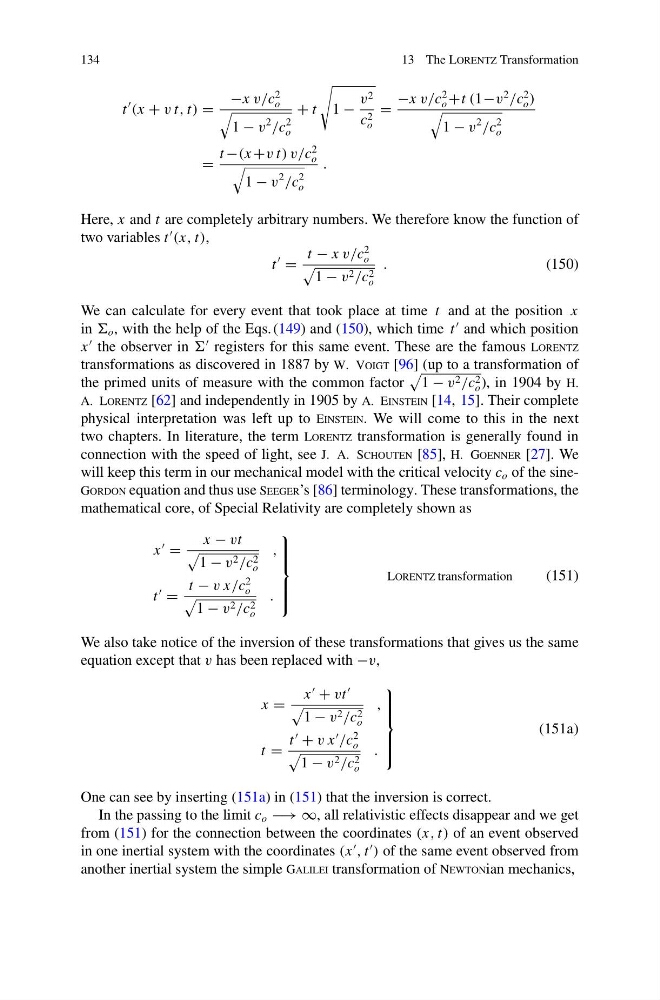
Here, x and t are completely arbitrary numbers. We therefore know the function of
two variables t
(x, t),
t
=
t − x v/c
2
o
1 − v 2 /c 2
o
.
(150)
We can calculate for every event that took place at time t and at the position x
in o , with the help of the Eqs. (149) and (150), which time t
and which position
x
the observer in
registers for this same event. These are the famous Lorentz
transformations as discovered in 1887 by W. Voigt [96] (up to a transformation of
the primed units of measure with the common factor
1 − v 2 /c 2
o ), in 1904 by H.
A. Lorentz [62] and independently in 1905 by A. Einstein [14, 15]. Their complete
physical interpretation was left up to Einstein. We will come to this in the next
two chapters. In literature, the term Lorentz transformation is generally found in
connection with the speed of light, see J. A. Schouten [85], H. Goenner [27]. We
will keep this term in our mechanical model with the critical velocity c o of the sineGordon equation and thus use Seeger’s [86] terminology. These transformations, the
mathematical core, of Special Relativity are completely shown as
x
=
x − vt
1 − v 2 /c 2
o
,
t
=
t − v x/c
2
o
1 − v 2 /c 2
o
.
⎫
⎪ ⎪ ⎪ ⎬
⎪ ⎪ ⎪ ⎭
Lorentz transformation
(151)
We also take notice of the inversion of these transformations that gives us the same
equation except that v has been replaced with −v,
x =
x
+ vt
1 − v 2 /c 2
o
,
t =
t
+ v x
/c
2
o
1 − v 2 /c 2
o
.
⎫
⎪ ⎪ ⎪ ⎬
⎪ ⎪ ⎪ ⎭
(151a)
One can see by inserting (151a) in (151) that the inversion is correct.
In the passing to the limit c o −→ ∞, all relativistic effects disappear and we get
from (151) for the connection between the coordinates (x, t) of an event observed
in one inertial system with the coordinates (x
, t
) of the same event observed from
another inertial system the simple Galilei transformation of Newtonian mechanics,
13 The Lorentz Transformation
t
(x + v t, t) =
−x v/c
2
o
1 − v
2
/c
2
o
+ t
1 −
v 2
c 2
o
=
−x v/c
2
o +t (1−v
2
/c
2
o )
1 − v
2
/c
2
o
=
t −(x +v t) v/c
2
o
1 − v
2
/c
2
o
.
Here, x and t are completely arbitrary numbers. We therefore know the function of
two variables t
(x, t),
t
=
t − x v/c
2
o
1 − v 2 /c 2
o
.
(150)
We can calculate for every event that took place at time t and at the position x
in o , with the help of the Eqs. (149) and (150), which time t
and which position
x
the observer in
registers for this same event. These are the famous Lorentz
transformations as discovered in 1887 by W. Voigt [96] (up to a transformation of
the primed units of measure with the common factor
1 − v 2 /c 2
o ), in 1904 by H.
A. Lorentz [62] and independently in 1905 by A. Einstein [14, 15]. Their complete
physical interpretation was left up to Einstein. We will come to this in the next
two chapters. In literature, the term Lorentz transformation is generally found in
connection with the speed of light, see J. A. Schouten [85], H. Goenner [27]. We
will keep this term in our mechanical model with the critical velocity c o of the sineGordon equation and thus use Seeger’s [86] terminology. These transformations, the
mathematical core, of Special Relativity are completely shown as
x
=
x − vt
1 − v 2 /c 2
o
,
t
=
t − v x/c
2
o
1 − v 2 /c 2
o
.
⎫
⎪ ⎪ ⎪ ⎬
⎪ ⎪ ⎪ ⎭
Lorentz transformation
(151)
We also take notice of the inversion of these transformations that gives us the same
equation except that v has been replaced with −v,
x =
x
+ vt
1 − v 2 /c 2
o
,
t =
t
+ v x
/c
2
o
1 − v 2 /c 2
o
.
⎫
⎪ ⎪ ⎪ ⎬
⎪ ⎪ ⎪ ⎭
(151a)
One can see by inserting (151a) in (151) that the inversion is correct.
In the passing to the limit c o −→ ∞, all relativistic effects disappear and we get
from (151) for the connection between the coordinates (x, t) of an event observed
in one inertial system with the coordinates (x
, t
) of the same event observed from
another inertial system the simple Galilei transformation of Newtonian mechanics,