

130
12 The Measurement of the Critical Velocity
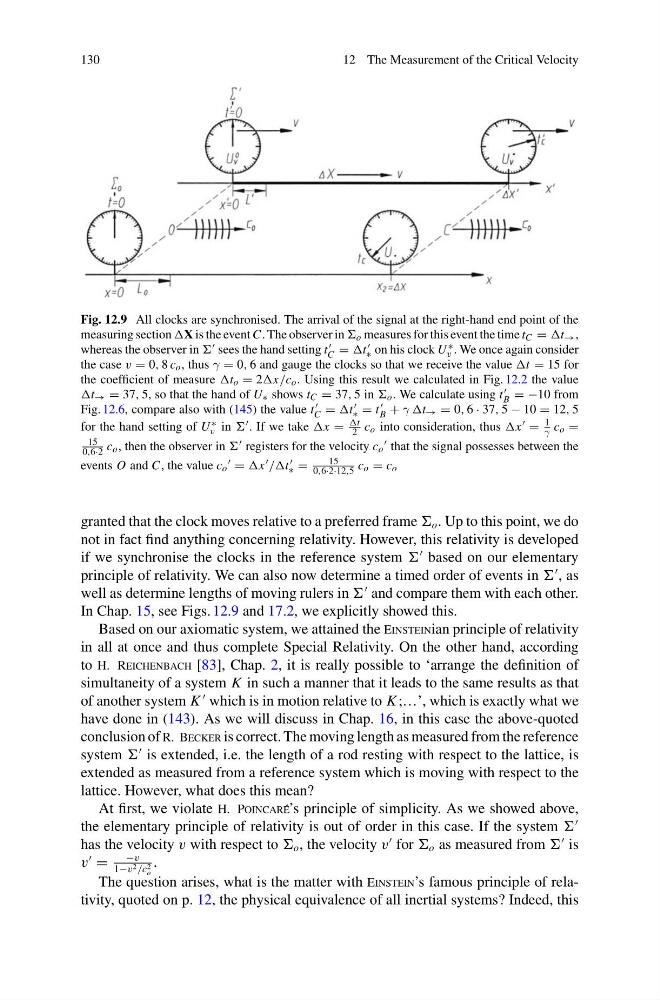
Fig. 12.9 All clocks are synchronised. The arrival of the signal at the right-hand end point of the
measuring section X is the event C. The observer in o measures for this event the time t C = t → ,
whereas the observer in sees the hand setting t
C = t
∗ on his clock U ∗
v . We once again consider
the case v = 0, 8 c o , thus γ = 0, 6 and gauge the clocks so that we receive the value t = 15 for
the coefficient of measure t o = 2x/c o . Using this result we calculated in Fig. 12.2 the value
t → = 37, 5, so that the hand of U ∗ shows t C = 37, 5 in o . We calculate using t
B = −10 from
Fig. 12.6, compare also with (145) the value t
C = t
∗ = t
B + γ t → = 0, 6 · 37, 5 − 10 = 12, 5
for the hand setting of U ∗
v in . If we take x =
t
2 c o into consideration, thus x =
1
γ c o =
15
0,6·2 c o , then the observer in registers for the velocity c o
that the signal possesses between the
events O and C, the value c o
= x //t
∗ =
15
0,6·2·12,5 c o = c o
granted that the clock moves relative to a preferred frame o . Up to this point, we do
not in fact find anything concerning relativity. However, this relativity is developed
if we synchronise the clocks in the reference system
based on our elementary
principle of relativity. We can also now determine a timed order of events in
, as
well as determine lengths of moving rulers in
and compare them with each other.
In Chap. 15, see Figs. 12.9 and 17.2, we explicitly showed this.
Based on our axiomatic system, we attained the Einsteinian principle of relativity
in all at once and thus complete Special Relativity. On the other hand, according
to H. Reichenbach [83], Chap. 2, it is really possible to ‘arrange the definition of
simultaneity of a system K in such a manner that it leads to the same results as that
of another system K
which is in motion relative to K ;…’, which is exactly what we
have done in (143). As we will discuss in Chap. 16, in this case the above-quoted
conclusion of R. Becker is correct. The moving length as measured from the reference
system
is extended, i.e. the length of a rod resting with respect to the lattice, is
extended as measured from a reference system which is moving with respect to the
lattice. However, what does this mean?
At first, we violate H. Poincaré’s principle of simplicity. As we showed above,
the elementary principle of relativity is out of order in this case. If the system
has the velocity v with respect to o , the velocity v
for o as measured from
is
v
=
−v
1−v 2 /c 2
o
.
The question arises, what is the matter with Einstein’s famous principle of relativity, quoted on p. 12, the physical equivalence of all inertial systems? Indeed, this
12 The Measurement of the Critical Velocity
Fig. 12.9 All clocks are synchronised. The arrival of the signal at the right-hand end point of the
measuring section X is the event C. The observer in o measures for this event the time t C = t → ,
whereas the observer in sees the hand setting t
C = t
∗ on his clock U ∗
v . We once again consider
the case v = 0, 8 c o , thus γ = 0, 6 and gauge the clocks so that we receive the value t = 15 for
the coefficient of measure t o = 2x/c o . Using this result we calculated in Fig. 12.2 the value
t → = 37, 5, so that the hand of U ∗ shows t C = 37, 5 in o . We calculate using t
B = −10 from
Fig. 12.6, compare also with (145) the value t
C = t
∗ = t
B + γ t → = 0, 6 · 37, 5 − 10 = 12, 5
for the hand setting of U ∗
v in . If we take x =
t
2 c o into consideration, thus x =
1
γ c o =
15
0,6·2 c o , then the observer in registers for the velocity c o
that the signal possesses between the
events O and C, the value c o
= x //t
∗ =
15
0,6·2·12,5 c o = c o
granted that the clock moves relative to a preferred frame o . Up to this point, we do
not in fact find anything concerning relativity. However, this relativity is developed
if we synchronise the clocks in the reference system
based on our elementary
principle of relativity. We can also now determine a timed order of events in
, as
well as determine lengths of moving rulers in
and compare them with each other.
In Chap. 15, see Figs. 12.9 and 17.2, we explicitly showed this.
Based on our axiomatic system, we attained the Einsteinian principle of relativity
in all at once and thus complete Special Relativity. On the other hand, according
to H. Reichenbach [83], Chap. 2, it is really possible to ‘arrange the definition of
simultaneity of a system K in such a manner that it leads to the same results as that
of another system K
which is in motion relative to K ;…’, which is exactly what we
have done in (143). As we will discuss in Chap. 16, in this case the above-quoted
conclusion of R. Becker is correct. The moving length as measured from the reference
system
is extended, i.e. the length of a rod resting with respect to the lattice, is
extended as measured from a reference system which is moving with respect to the
lattice. However, what does this mean?
At first, we violate H. Poincaré’s principle of simplicity. As we showed above,
the elementary principle of relativity is out of order in this case. If the system
has the velocity v with respect to o , the velocity v
for o as measured from
is
v
=
−v
1−v 2 /c 2
o
.
The question arises, what is the matter with Einstein’s famous principle of relativity, quoted on p. 12, the physical equivalence of all inertial systems? Indeed, this