

118
12 The Measurement of the Critical Velocity
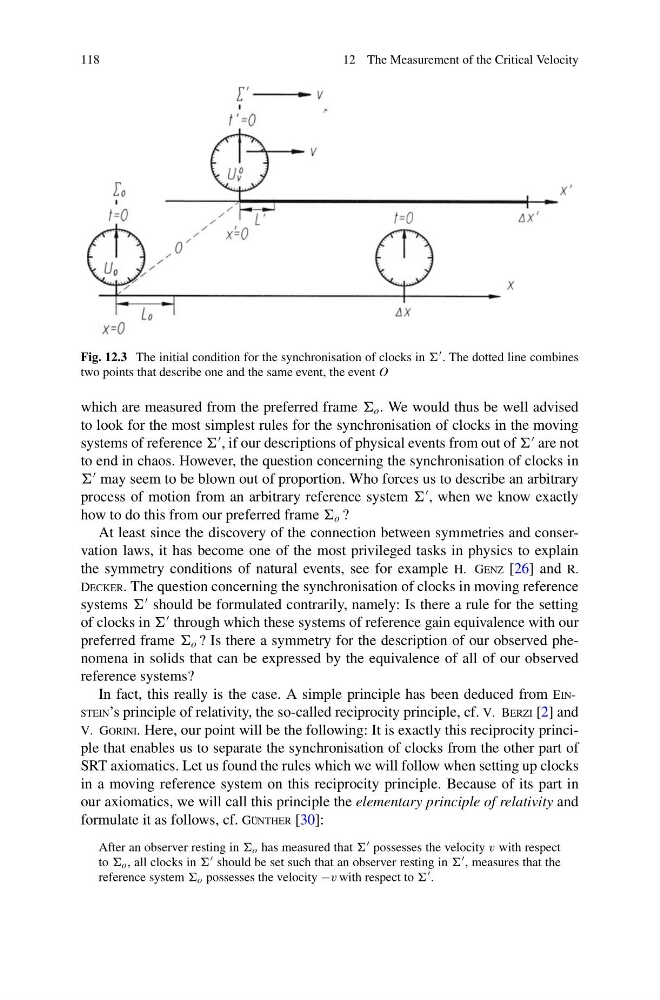
Fig. 12.3 The initial condition for the synchronisation of clocks in . The dotted line combines
two points that describe one and the same event, the event O
which are measured from the preferred frame o . We would thus be well advised
to look for the most simplest rules for the synchronisation of clocks in the moving
systems of reference
, if our descriptions of physical events from out of
are not
to end in chaos. However, the question concerning the synchronisation of clocks in
may seem to be blown out of proportion. Who forces us to describe an arbitrary
process of motion from an arbitrary reference system
, when we know exactly
how to do this from our preferred frame o ?
At least since the discovery of the connection between symmetries and conservation laws, it has become one of the most privileged tasks in physics to explain
the symmetry conditions of natural events, see for example H. Genz [26] and R.
Decker. The question concerning the synchronisation of clocks in moving reference
systems
should be formulated contrarily, namely: Is there a rule for the setting
of clocks in
through which these systems of reference gain equivalence with our
preferred frame o ? Is there a symmetry for the description of our observed phenomena in solids that can be expressed by the equivalence of all of our observed
reference systems?
In fact, this really is the case. A simple principle has been deduced from Einstein’s principle of relativity, the so-called reciprocity principle, cf. V. Berzi [2] and
V. Gorini. Here, our point will be the following: It is exactly this reciprocity principle that enables us to separate the synchronisation of clocks from the other part of
SRT axiomatics. Let us found the rules which we will follow when setting up clocks
in a moving reference system on this reciprocity principle. Because of its part in
our axiomatics, we will call this principle the elementary principle of relativity and
formulate it as follows, cf. Günther [30]:
After an observer resting in o has measured that possesses the velocity v with respect
to o , all clocks in should be set such that an observer resting in , measures that the
reference system o possesses the velocity −v with respect to .
12 The Measurement of the Critical Velocity
Fig. 12.3 The initial condition for the synchronisation of clocks in . The dotted line combines
two points that describe one and the same event, the event O
which are measured from the preferred frame o . We would thus be well advised
to look for the most simplest rules for the synchronisation of clocks in the moving
systems of reference
, if our descriptions of physical events from out of
are not
to end in chaos. However, the question concerning the synchronisation of clocks in
may seem to be blown out of proportion. Who forces us to describe an arbitrary
process of motion from an arbitrary reference system
, when we know exactly
how to do this from our preferred frame o ?
At least since the discovery of the connection between symmetries and conservation laws, it has become one of the most privileged tasks in physics to explain
the symmetry conditions of natural events, see for example H. Genz [26] and R.
Decker. The question concerning the synchronisation of clocks in moving reference
systems
should be formulated contrarily, namely: Is there a rule for the setting
of clocks in
through which these systems of reference gain equivalence with our
preferred frame o ? Is there a symmetry for the description of our observed phenomena in solids that can be expressed by the equivalence of all of our observed
reference systems?
In fact, this really is the case. A simple principle has been deduced from Einstein’s principle of relativity, the so-called reciprocity principle, cf. V. Berzi [2] and
V. Gorini. Here, our point will be the following: It is exactly this reciprocity principle that enables us to separate the synchronisation of clocks from the other part of
SRT axiomatics. Let us found the rules which we will follow when setting up clocks
in a moving reference system on this reciprocity principle. Because of its part in
our axiomatics, we will call this principle the elementary principle of relativity and
formulate it as follows, cf. Günther [30]:
After an observer resting in o has measured that possesses the velocity v with respect
to o , all clocks in should be set such that an observer resting in , measures that the
reference system o possesses the velocity −v with respect to .