

114
12 The Measurement of the Critical Velocity
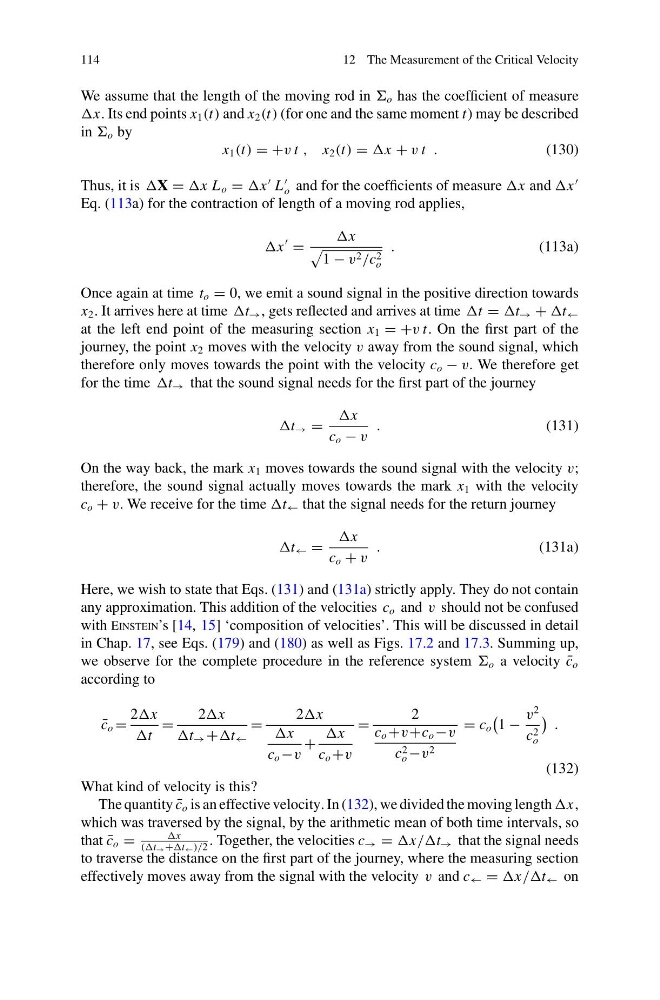
We assume that the length of the moving rod in o has the coefficient of measure
x. Its end points x 1 (t) and x 2 (t) (for one and the same moment t) may be described
in o by
x 1 (t) = +v t , x 2 (t) = x + v t .
(130)
Thus, it is X = x L o = x
L
o and for the coefficients of measure x and x
Eq. (113a) for the contraction of length of a moving rod applies,
x
=
x
1 − v 2 /c 2
o
.
(113a)
Once again at time t o = 0, we emit a sound signal in the positive direction towards
x 2 . It arrives here at time t → , gets reflected and arrives at time t = t → + t ←
at the left end point of the measuring section x 1 = +v t. On the first part of the
journey, the point x 2 moves with the velocity v away from the sound signal, which
therefore only moves towards the point with the velocity c o − v. We therefore get
for the time t → that the sound signal needs for the first part of the journey
t → =
x
c o − v
.
(131)
On the way back, the mark x 1 moves towards the sound signal with the velocity v;
therefore, the sound signal actually moves towards the mark x 1 with the velocity
c o + v. We receive for the time t ← that the signal needs for the return journey
t ← =
x
c o + v
.
(131a)
Here, we wish to state that Eqs. (131) and (131a) strictly apply. They do not contain
any approximation. This addition of the velocities c o and v should not be confused
with Einstein’s [14, 15] ‘composition of velocities’. This will be discussed in detail
in Chap. 17, see Eqs. (179) and (180) as well as Figs. 17.2 and 17.3. Summing up,
we observe for the complete procedure in the reference system o a velocity ¯
c o
according to
¯
c o =
2x
t
=
2x
t → +t ←
=
2x
x
c o −v
+
x
c o +v
=
2
c o +v+c o −v
c 2
o −v 2
= c o
1 −
v
2
c 2
o
.
(132)
What kind of velocity is this?
The quantity ¯
c o is an effective velocity. In (132), we divided the moving length x,
which was traversed by the signal, by the arithmetic mean of both time intervals, so
that ¯
c o =
x
((t → +t ← )/2
. Together, the velocities c → = x//t → that the signal needs
to traverse the distance on the first part of the journey, where the measuring section
effectively moves away from the signal with the velocity v and c ← = x//t ← on
12 The Measurement of the Critical Velocity
We assume that the length of the moving rod in o has the coefficient of measure
x. Its end points x 1 (t) and x 2 (t) (for one and the same moment t) may be described
in o by
x 1 (t) = +v t , x 2 (t) = x + v t .
(130)
Thus, it is X = x L o = x
L
o and for the coefficients of measure x and x
Eq. (113a) for the contraction of length of a moving rod applies,
x
=
x
1 − v 2 /c 2
o
.
(113a)
Once again at time t o = 0, we emit a sound signal in the positive direction towards
x 2 . It arrives here at time t → , gets reflected and arrives at time t = t → + t ←
at the left end point of the measuring section x 1 = +v t. On the first part of the
journey, the point x 2 moves with the velocity v away from the sound signal, which
therefore only moves towards the point with the velocity c o − v. We therefore get
for the time t → that the sound signal needs for the first part of the journey
t → =
x
c o − v
.
(131)
On the way back, the mark x 1 moves towards the sound signal with the velocity v;
therefore, the sound signal actually moves towards the mark x 1 with the velocity
c o + v. We receive for the time t ← that the signal needs for the return journey
t ← =
x
c o + v
.
(131a)
Here, we wish to state that Eqs. (131) and (131a) strictly apply. They do not contain
any approximation. This addition of the velocities c o and v should not be confused
with Einstein’s [14, 15] ‘composition of velocities’. This will be discussed in detail
in Chap. 17, see Eqs. (179) and (180) as well as Figs. 17.2 and 17.3. Summing up,
we observe for the complete procedure in the reference system o a velocity ¯
c o
according to
¯
c o =
2x
t
=
2x
t → +t ←
=
2x
x
c o −v
+
x
c o +v
=
2
c o +v+c o −v
c 2
o −v 2
= c o
1 −
v
2
c 2
o
.
(132)
What kind of velocity is this?
The quantity ¯
c o is an effective velocity. In (132), we divided the moving length x,
which was traversed by the signal, by the arithmetic mean of both time intervals, so
that ¯
c o =
x
((t → +t ← )/2
. Together, the velocities c → = x//t → that the signal needs
to traverse the distance on the first part of the journey, where the measuring section
effectively moves away from the signal with the velocity v and c ← = x//t ← on