

96
10 Measuring-Rods and Clocks in Motion
E
'
E
'
¨ ¨
¨ ¨
¨ ¨ ¨ ¨
¨
¨ ¨
¨
¨ ¨
¨
¨ ¨
¨ ¨
-
6
x
q
a
α α
L o
L
q
I
oλo (x)
q
I
(x,
λo
v )
x − vt = 0
λ o
2λ o
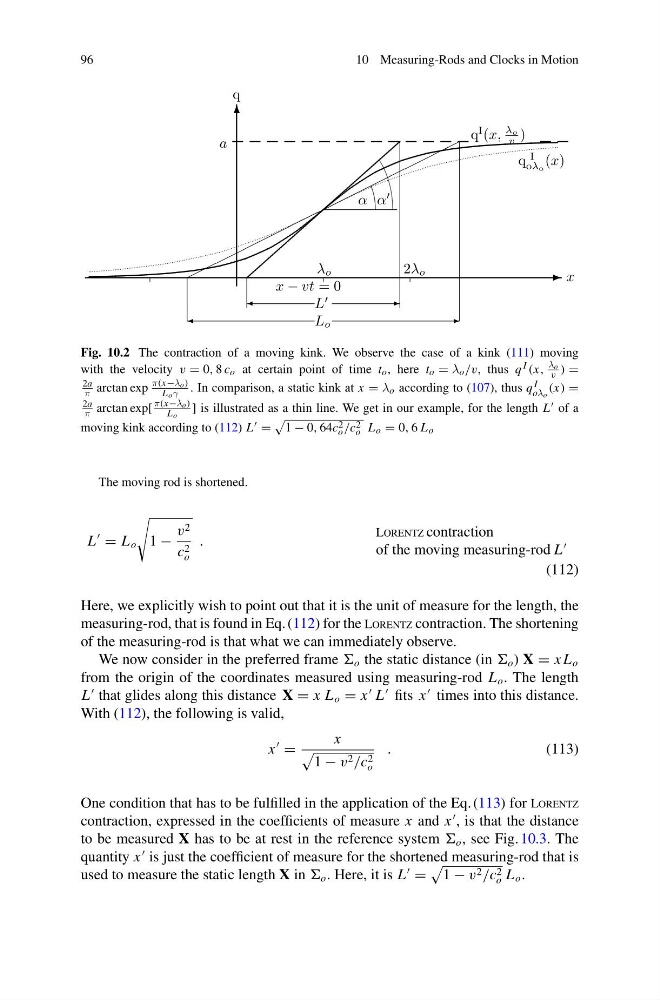
Fig. 10.2 The contraction of a moving kink. We observe the case of a kink (111) moving
with the velocity v = 0, 8 c o at certain point of time t o , here t o = λ o /v, thus q I (x,
λo
v ) =
2a
π arctan exp
π(x−λo)
Loγ . In comparison, a static kink at x = λ o according to (107), thus q I
oλo (x) =
2a
π arctan exp[
π(x−λo)
Lo
] is illustrated as a thin line. We get in our example, for the length L of a
moving kink according to (112) L =
1 − 0, 64c 2
o /c 2
o L o = 0, 6 L o
The moving rod is shortened.
L
= L o
1 −
v 2
c 2
o
.
Lorentz contraction
of the moving measuring-rod L
(112)
Here, we explicitly wish to point out that it is the unit of measure for the length, the
measuring-rod, that is found in Eq. (112) for the Lorentz contraction. The shortening
of the measuring-rod is that what we can immediately observe.
We now consider in the preferred frame o the static distance (in o ) X = x L o
from the origin of the coordinates measured using measuring-rod L o . The length
L
that glides along this distance X = x L o = x
L
fits x
times into this distance.
With (112), the following is valid,
x
=
x
1 − v 2 /c 2
o
.
(113)
One condition that has to be fulfilled in the application of the Eq. (113) for Lorentz
contraction, expressed in the coefficients of measure x and x
, is that the distance
to be measured X has to be at rest in the reference system o , see Fig. 10.3. The
quantity x
is just the coefficient of measure for the shortened measuring-rod that is
used to measure the static length X in o . Here, it is L
=
1 − v 2 /c 2
o L o .
10 Measuring-Rods and Clocks in Motion
E
'
E
'
¨ ¨
¨ ¨
¨ ¨ ¨ ¨
¨
¨ ¨
¨
¨ ¨
¨
¨ ¨
¨ ¨
-
6
x
q
a
α α
L o
L
q
I
oλo (x)
q
I
(x,
λo
v )
x − vt = 0
λ o
2λ o
Fig. 10.2 The contraction of a moving kink. We observe the case of a kink (111) moving
with the velocity v = 0, 8 c o at certain point of time t o , here t o = λ o /v, thus q I (x,
λo
v ) =
2a
π arctan exp
π(x−λo)
Loγ . In comparison, a static kink at x = λ o according to (107), thus q I
oλo (x) =
2a
π arctan exp[
π(x−λo)
Lo
] is illustrated as a thin line. We get in our example, for the length L of a
moving kink according to (112) L =
1 − 0, 64c 2
o /c 2
o L o = 0, 6 L o
The moving rod is shortened.
L
= L o
1 −
v 2
c 2
o
.
Lorentz contraction
of the moving measuring-rod L
(112)
Here, we explicitly wish to point out that it is the unit of measure for the length, the
measuring-rod, that is found in Eq. (112) for the Lorentz contraction. The shortening
of the measuring-rod is that what we can immediately observe.
We now consider in the preferred frame o the static distance (in o ) X = x L o
from the origin of the coordinates measured using measuring-rod L o . The length
L
that glides along this distance X = x L o = x
L
fits x
times into this distance.
With (112), the following is valid,
x
=
x
1 − v 2 /c 2
o
.
(113)
One condition that has to be fulfilled in the application of the Eq. (113) for Lorentz
contraction, expressed in the coefficients of measure x and x
, is that the distance
to be measured X has to be at rest in the reference system o , see Fig. 10.3. The
quantity x
is just the coefficient of measure for the shortened measuring-rod that is
used to measure the static length X in o . Here, it is L
=
1 − v 2 /c 2
o L o .