

57
Fundamentals of Electrochemical Double-Layer Supercapacitors
M
II
M
III
M
I
M
I
V
V
S
S – Electrolyte solution
M
I – Metal I
M
II – Metal II
M
III – Metal III
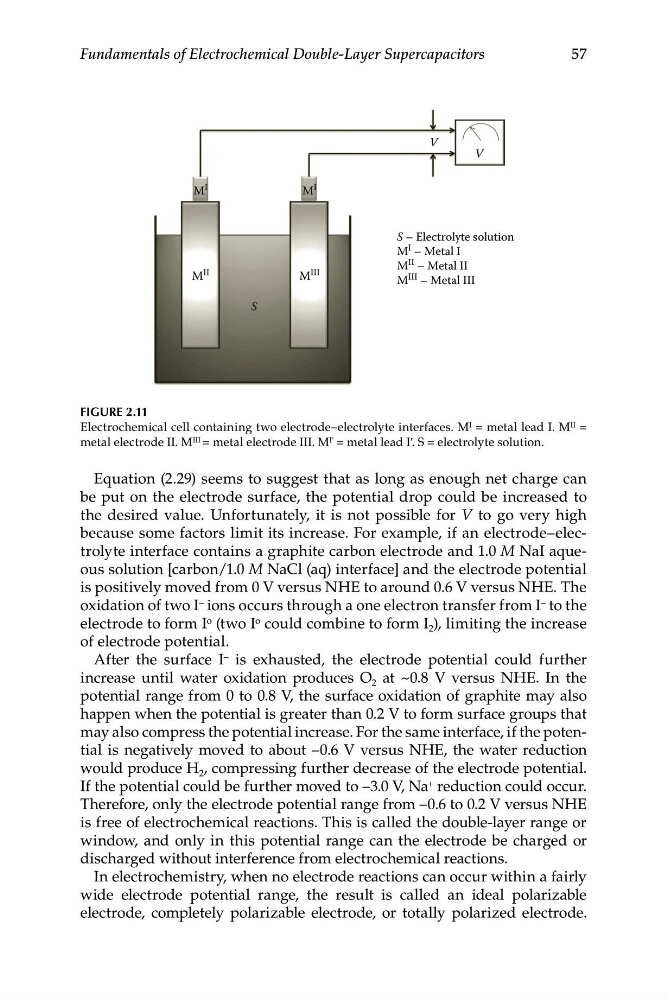
FIGURE 2.11
Electrochemical cell containing two electrode–electrolyte interfaces. M I = metal lead I. M II =
metal electrode II. M III = metal electrode III. M Iʹ = metal lead Iʹ. S = electrolyte solution.
Equation (2.29) seems to suggest that as long as enough net charge can
be put on the electrode surface, the potential drop could be increased to
the desired value. Unfortunately, it is not possible for V to go very high
because some factors limit its increase. For example, if an electrode–electrolyte interface contains a graphite carbon electrode and 1.0 M NaI aqueous solution [carbon/1.0 M NaCl (aq) interface] and the electrode potential
is positively moved from 0 V versus NHE to around 0.6 V versus NHE. The
oxidation of two I – ions occurs through a one electron transfer from I – to the
electrode to form I o (two I o could combine to form I 2 ), limiting the increase
of electrode potential.
After the surface I – is exhausted, the electrode potential could further
increase until water oxidation produces O 2 at ~0.8 V versus NHE. In the
potential range from 0 to 0.8 V, the surface oxidation of graphite may also
happen when the potential is greater than 0.2 V to form surface groups that
may also compress the potential increase. For the same interface, if the potential is negatively moved to about –0.6 V versus NHE, the water reduction
would produce H 2 , compressing further decrease of the electrode potential.
If the potential could be further moved to –3.0 V, Na + reduction could occur.
Therefore, only the electrode potential range from –0.6 to 0.2 V versus NHE
is free of electrochemical reactions. This is called the double-layer range or
window, and only in this potential range can the electrode be charged or
discharged without interference from electrochemical reactions.
In electrochemistry, when no electrode reactions can occur within a fairly
wide electrode potential range, the result is called an ideal polarizable
electrode, completely polarizable electrode, or totally polarized electrode.
Fundamentals of Electrochemical Double-Layer Supercapacitors
M
II
M
III
M
I
M
I
V
V
S
S – Electrolyte solution
M
I – Metal I
M
II – Metal II
M
III – Metal III
FIGURE 2.11
Electrochemical cell containing two electrode–electrolyte interfaces. M I = metal lead I. M II =
metal electrode II. M III = metal electrode III. M Iʹ = metal lead Iʹ. S = electrolyte solution.
Equation (2.29) seems to suggest that as long as enough net charge can
be put on the electrode surface, the potential drop could be increased to
the desired value. Unfortunately, it is not possible for V to go very high
because some factors limit its increase. For example, if an electrode–electrolyte interface contains a graphite carbon electrode and 1.0 M NaI aqueous solution [carbon/1.0 M NaCl (aq) interface] and the electrode potential
is positively moved from 0 V versus NHE to around 0.6 V versus NHE. The
oxidation of two I – ions occurs through a one electron transfer from I – to the
electrode to form I o (two I o could combine to form I 2 ), limiting the increase
of electrode potential.
After the surface I – is exhausted, the electrode potential could further
increase until water oxidation produces O 2 at ~0.8 V versus NHE. In the
potential range from 0 to 0.8 V, the surface oxidation of graphite may also
happen when the potential is greater than 0.2 V to form surface groups that
may also compress the potential increase. For the same interface, if the potential is negatively moved to about –0.6 V versus NHE, the water reduction
would produce H 2 , compressing further decrease of the electrode potential.
If the potential could be further moved to –3.0 V, Na + reduction could occur.
Therefore, only the electrode potential range from –0.6 to 0.2 V versus NHE
is free of electrochemical reactions. This is called the double-layer range or
window, and only in this potential range can the electrode be charged or
discharged without interference from electrochemical reactions.
In electrochemistry, when no electrode reactions can occur within a fairly
wide electrode potential range, the result is called an ideal polarizable
electrode, completely polarizable electrode, or totally polarized electrode.