

54
Electrochemical Supercapacitors for Energy Storage and Delivery
and its adsorbed counter ions, and the capacitance of OHP (C OHP ) is induced
by the rest of the net charge layer outside the IHP. In this case, the differential
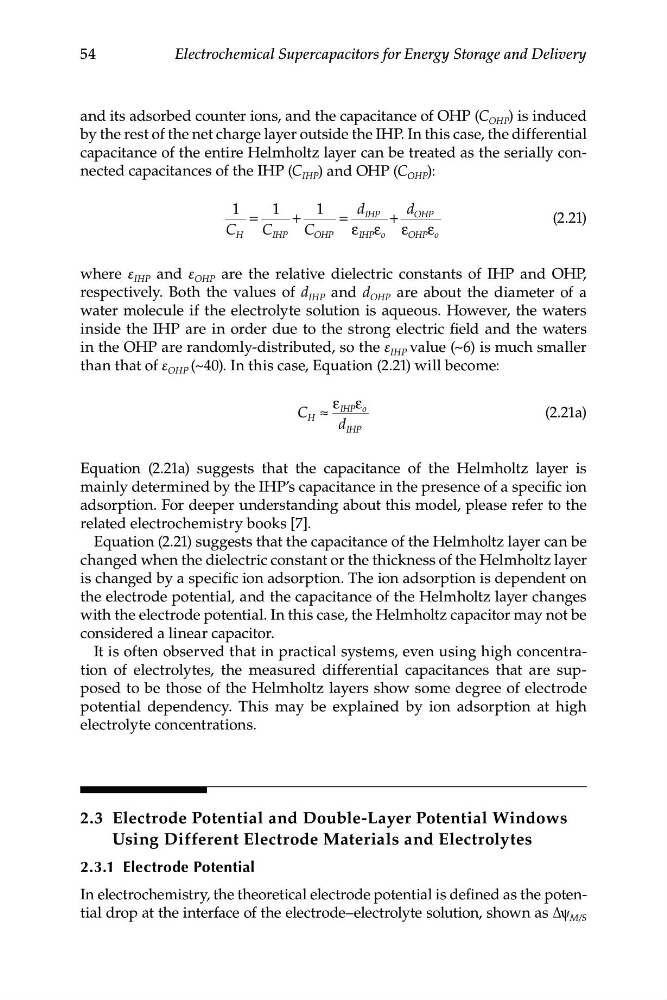
capacitance of the entire Helmholtz layer can be treated as the serially connected capacitances of the IHP (C IHP ) and OHP (C OHP ):
1
1
1
d
d
IHP
OHP
=
+
=
+
(2.21)
C
C
C
ε ε ε ε
H
IHP
OHP
IHP o
OHP o
where ε IHP and ε OHP are the relative dielectric constants of IHP and OHP,
respectively. Both the values of d IHP and d OHP are about the diameter of a
water molecule if the electrolyte solution is aqueous. However, the waters
inside the IHP are in order due to the strong electric field and the waters
in the OHP are randomly-distributed, so the ε IHP value (~6) is much smaller
than that of ε OHP (~40). In this case, Equation (2.21) will become:
ε ε
IHP o
C H ≈
(2.21a)
d IHP
Equation (2.21a) suggests that the capacitance of the Helmholtz layer is
mainly determined by the IHP’s capacitance in the presence of a specific ion
adsorption. For deeper understanding about this model, please refer to the
related electrochemistry books [7].
Equation (2.21) suggests that the capacitance of the Helmholtz layer can be
changed when the dielectric constant or the thickness of the Helmholtz layer
is changed by a specific ion adsorption. The ion adsorption is dependent on
the electrode potential, and the capacitance of the Helmholtz layer changes
with the electrode potential. In this case, the Helmholtz capacitor may not be
considered a linear capacitor.
It is often observed that in practical systems, even using high concentration of electrolytes, the measured differential capacitances that are supposed to be those of the Helmholtz layers show some degree of electrode
potential dependency. This may be explained by ion adsorption at high
electrolyte concentrations.
2.3 Electrode Potential and Double-Layer Potential Windows
Using Different Electrode Materials and Electrolytes
2.3.1 Electrode Potential
In electrochemistry, the theoretical electrode potential is defined as the potential drop at the interface of the electrode–electrolyte solution, shown as Δψ M/S
Electrochemical Supercapacitors for Energy Storage and Delivery
and its adsorbed counter ions, and the capacitance of OHP (C OHP ) is induced
by the rest of the net charge layer outside the IHP. In this case, the differential
capacitance of the entire Helmholtz layer can be treated as the serially connected capacitances of the IHP (C IHP ) and OHP (C OHP ):
1
1
1
d
d
IHP
OHP
=
+
=
+
(2.21)
C
C
C
ε ε ε ε
H
IHP
OHP
IHP o
OHP o
where ε IHP and ε OHP are the relative dielectric constants of IHP and OHP,
respectively. Both the values of d IHP and d OHP are about the diameter of a
water molecule if the electrolyte solution is aqueous. However, the waters
inside the IHP are in order due to the strong electric field and the waters
in the OHP are randomly-distributed, so the ε IHP value (~6) is much smaller
than that of ε OHP (~40). In this case, Equation (2.21) will become:
ε ε
IHP o
C H ≈
(2.21a)
d IHP
Equation (2.21a) suggests that the capacitance of the Helmholtz layer is
mainly determined by the IHP’s capacitance in the presence of a specific ion
adsorption. For deeper understanding about this model, please refer to the
related electrochemistry books [7].
Equation (2.21) suggests that the capacitance of the Helmholtz layer can be
changed when the dielectric constant or the thickness of the Helmholtz layer
is changed by a specific ion adsorption. The ion adsorption is dependent on
the electrode potential, and the capacitance of the Helmholtz layer changes
with the electrode potential. In this case, the Helmholtz capacitor may not be
considered a linear capacitor.
It is often observed that in practical systems, even using high concentration of electrolytes, the measured differential capacitances that are supposed to be those of the Helmholtz layers show some degree of electrode
potential dependency. This may be explained by ion adsorption at high
electrolyte concentrations.
2.3 Electrode Potential and Double-Layer Potential Windows
Using Different Electrode Materials and Electrolytes
2.3.1 Electrode Potential
In electrochemistry, the theoretical electrode potential is defined as the potential drop at the interface of the electrode–electrolyte solution, shown as Δψ M/S