

43
Fundamentals of Electrochemical Double-Layer Supercapacitors
Vacuum
Δχ O/M
Δχ M/O Δχ O/H Δχ H/O Δχ O/S
Δχ S/O
M
M – Metal electrode
H – The Helmholtz layer
S – The Diffuse layer
H
S
Δψ M/S
Δψ H/S
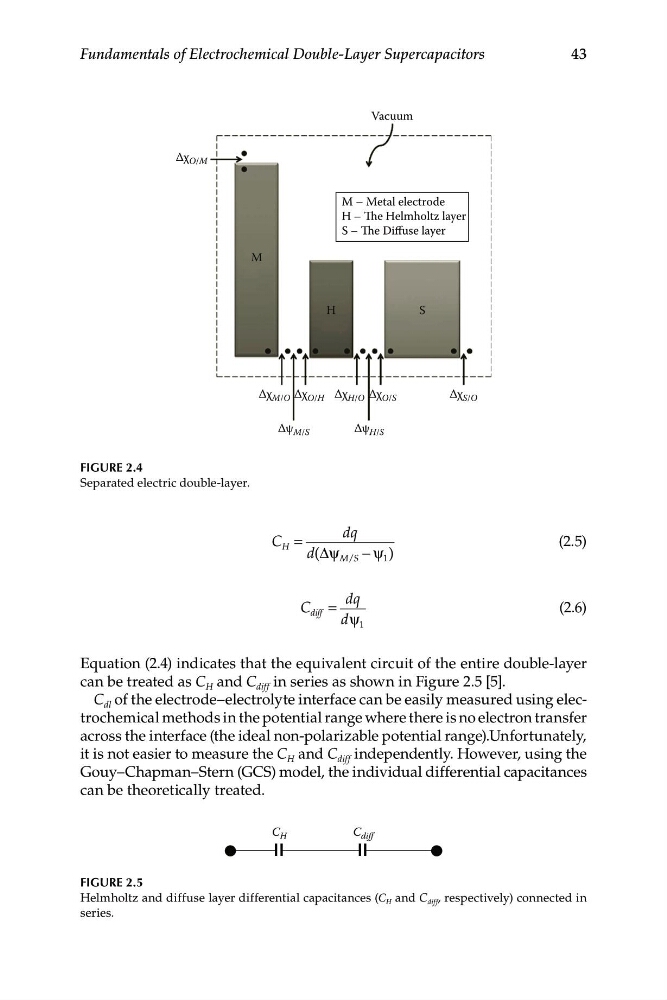
FIGURE 2.4
Separated electric double-layer.
dq
C H =
(2.5)
d( Δψ M S
/ − ψ 1 )
dq
C diff =
(2.6)
dψ 1
Equation (2.4) indicates that the equivalent circuit of the entire double-layer
can be treated as C H and C diff in series as shown in Figure 2.5 [5].
C dl of the electrode–electrolyte interface can be easily measured using electrochemical methods in the potential range where there is no electron transfer
across the interface (the ideal non-polarizable potential range).Unfortunately,
it is not easier to measure the C H and C diff independently. However, using the
Gouy–Chapman–Stern (GCS) model, the individual differential capacitances
can be theoretically treated.
C H
C diff
FIGURE 2.5
Helmholtz and diffuse layer differential capacitances (C H and C diff , respectively) connected in
series.
Fundamentals of Electrochemical Double-Layer Supercapacitors
Vacuum
Δχ O/M
Δχ M/O Δχ O/H Δχ H/O Δχ O/S
Δχ S/O
M
M – Metal electrode
H – The Helmholtz layer
S – The Diffuse layer
H
S
Δψ M/S
Δψ H/S
FIGURE 2.4
Separated electric double-layer.
dq
C H =
(2.5)
d( Δψ M S
/ − ψ 1 )
dq
C diff =
(2.6)
dψ 1
Equation (2.4) indicates that the equivalent circuit of the entire double-layer
can be treated as C H and C diff in series as shown in Figure 2.5 [5].
C dl of the electrode–electrolyte interface can be easily measured using electrochemical methods in the potential range where there is no electron transfer
across the interface (the ideal non-polarizable potential range).Unfortunately,
it is not easier to measure the C H and C diff independently. However, using the
Gouy–Chapman–Stern (GCS) model, the individual differential capacitances
can be theoretically treated.
C H
C diff
FIGURE 2.5
Helmholtz and diffuse layer differential capacitances (C H and C diff , respectively) connected in
series.