

32
Electrochemical Supercapacitors for Energy Storage and Delivery
R
2
ω d L(1− ω
2
d LC C) − ω
2
d R C
Z
2
( R L
− )/ C = (
2
2
2
) (
+
2
2
2
)
(1.72)
(1 − ω d LC) + (ω d RC)
(1− ω d LC ) + (ω d RC)
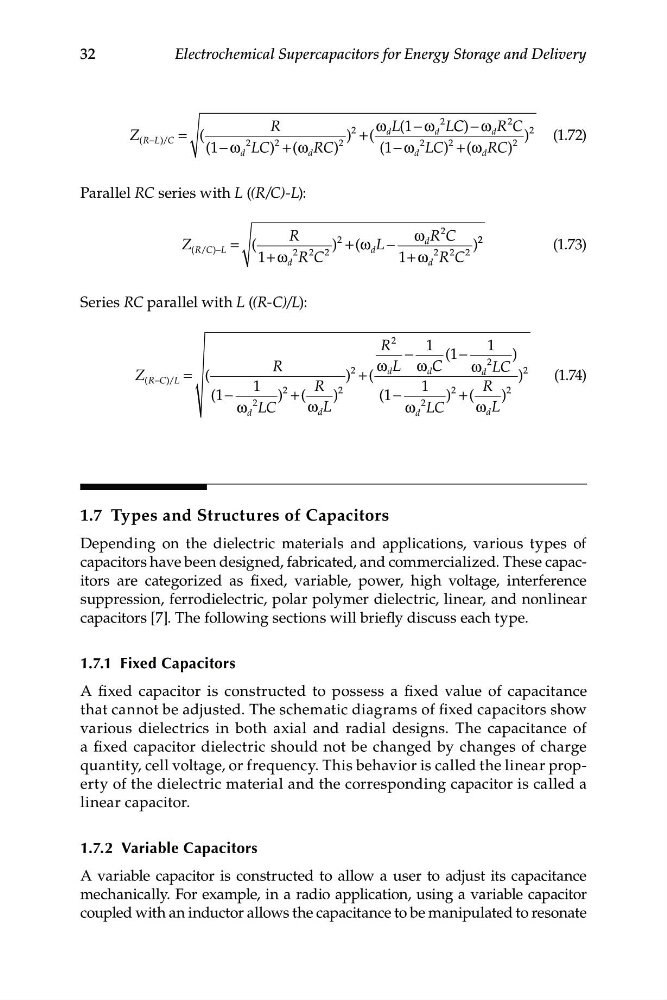
Parallel RC series with L ((R/C)-L):
R
ω d R C
2
Z
2
2 2
( /
R C)− L = (
) + (ω
1+ ω R C
d L −
2 2 2
1+ ω
2 R C
2 2
)
(1.73)
d
d
Series RC parallel with L ((R-C)/L):
R
2
1
1
−
(1−
ω L ω C C
ω
2
)
R
LC
Z
d
d
(R C / L = (
) (
2
d
)
2
− )
+
(1.74)
1
(1 −
)
2
R
+
)
2
1
R
2
(
(1−
)
2
+ (
)
2
ω d LC
ω d L
ω
2
d LC
ω d L
1.7 Types and Structures of Capacitors
Depending on the dielectric materials and applications, various types of
capacitors have been designed, fabricated, and commercialized. These capacitors are categorized as fixed, variable, power, high voltage, interference
suppression, ferrodielectric, polar polymer dielectric, linear, and nonlinear
capacitors [7]. The following sections will briefly discuss each type.
1.7.1 Fixed Capacitors
A fixed capacitor is constructed to possess a fixed value of capacitance
that cannot be adjusted. The schematic diagrams of fixed capacitors show
various dielectrics in both axial and radial designs. The capacitance of
a fixed capacitor dielectric should not be changed by changes of charge
quantity, cell voltage, or frequency. This behavior is called the linear property of the dielectric material and the corresponding capacitor is called a
linear capacitor.
1.7.2 Variable Capacitors
A variable capacitor is constructed to allow a user to adjust its capacitance
mechanically. For example, in a radio application, using a variable capacitor
coupled with an inductor allows the capacitance to be manipulated to resonate
Electrochemical Supercapacitors for Energy Storage and Delivery
R
2
ω d L(1− ω
2
d LC C) − ω
2
d R C
Z
2
( R L
− )/ C = (
2
2
2
) (
+
2
2
2
)
(1.72)
(1 − ω d LC) + (ω d RC)
(1− ω d LC ) + (ω d RC)
Parallel RC series with L ((R/C)-L):
R
ω d R C
2
Z
2
2 2
( /
R C)− L = (
) + (ω
1+ ω R C
d L −
2 2 2
1+ ω
2 R C
2 2
)
(1.73)
d
d
Series RC parallel with L ((R-C)/L):
R
2
1
1
−
(1−
ω L ω C C
ω
2
)
R
LC
Z
d
d
(R C / L = (
) (
2
d
)
2
− )
+
(1.74)
1
(1 −
)
2
R
+
)
2
1
R
2
(
(1−
)
2
+ (
)
2
ω d LC
ω d L
ω
2
d LC
ω d L
1.7 Types and Structures of Capacitors
Depending on the dielectric materials and applications, various types of
capacitors have been designed, fabricated, and commercialized. These capacitors are categorized as fixed, variable, power, high voltage, interference
suppression, ferrodielectric, polar polymer dielectric, linear, and nonlinear
capacitors [7]. The following sections will briefly discuss each type.
1.7.1 Fixed Capacitors
A fixed capacitor is constructed to possess a fixed value of capacitance
that cannot be adjusted. The schematic diagrams of fixed capacitors show
various dielectrics in both axial and radial designs. The capacitance of
a fixed capacitor dielectric should not be changed by changes of charge
quantity, cell voltage, or frequency. This behavior is called the linear property of the dielectric material and the corresponding capacitor is called a
linear capacitor.
1.7.2 Variable Capacitors
A variable capacitor is constructed to allow a user to adjust its capacitance
mechanically. For example, in a radio application, using a variable capacitor
coupled with an inductor allows the capacitance to be manipulated to resonate