

Ba tte ry ru n tim e
Volts (V)
4.6
4.4
4.2
4.0
3.8
3.6
3.4
3.2
3.0
2.8
2.6
Run time extension
due to conecting ES
0.0
0.5
1.0
1.5
2.0
2.5
3.0
Time (h)
323
Applications of Electrochemical Supercapacitors
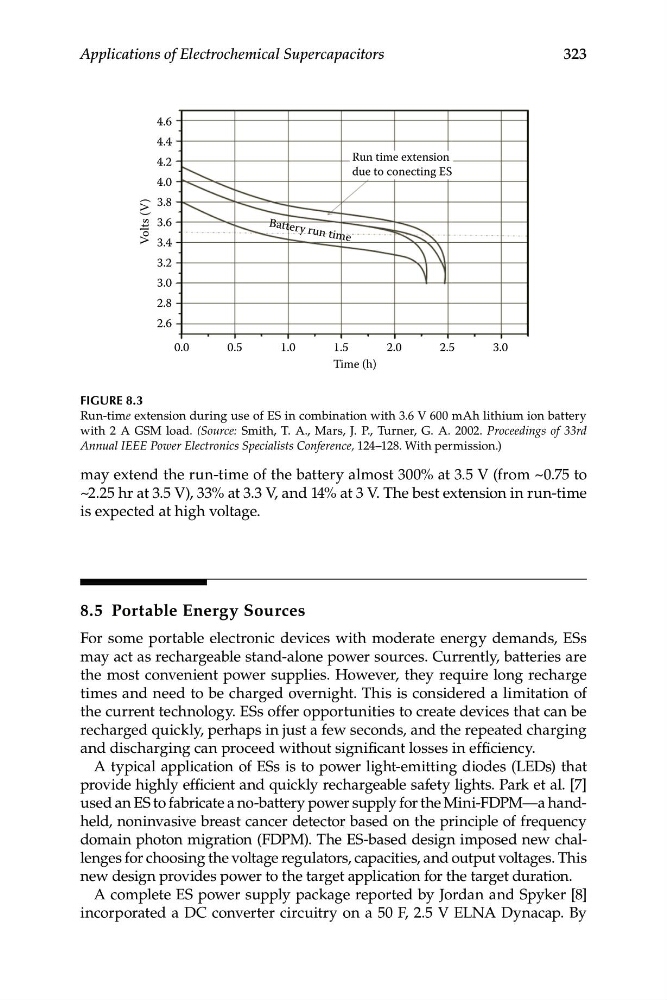
FIGURE 8.3
Run-time extension during use of ES in combination with 3.6 V 600 mAh lithium ion battery
with 2 A GSM load. (Source: Smith, T. A., Mars, J. P., Turner, G. A. 2002. Proceedings of 33rd
Annual IEEE Power Electronics Specialists Conference, 124–128. With permission.)
may extend the run-time of the battery almost 300% at 3.5 V (from ~0.75 to
~2.25 hr at 3.5 V), 33% at 3.3 V, and 14% at 3 V. The best extension in run-time
is expected at high voltage.
8.5 Portable Energy Sources
For some portable electronic devices with moderate energy demands, ESs
may act as rechargeable stand-alone power sources. Currently, batteries are
the most convenient power supplies. However, they require long recharge
times and need to be charged overnight. This is considered a limitation of
the current technology. ESs offer opportunities to create devices that can be
recharged quickly, perhaps in just a few seconds, and the repeated charging
and discharging can proceed without significant losses in efficiency.
A typical application of ESs is to power light-emitting diodes (LEDs) that
provide highly efficient and quickly rechargeable safety lights. Park et al. [7]
used an ES to fabricate a no-battery power supply for the Mini-FDPM—a handheld, noninvasive breast cancer detector based on the principle of frequency
domain photon migration (FDPM). The ES-based design imposed new challenges for choosing the voltage regulators, capacities, and output voltages. This
new design provides power to the target application for the target duration.
A complete ES power supply package reported by Jordan and Spyker [8]
incorporated a DC converter circuitry on a 50 F, 2.5 V ELNA Dynacap. By
Volts (V)
4.6
4.4
4.2
4.0
3.8
3.6
3.4
3.2
3.0
2.8
2.6
Run time extension
due to conecting ES
0.0
0.5
1.0
1.5
2.0
2.5
3.0
Time (h)
323
Applications of Electrochemical Supercapacitors
FIGURE 8.3
Run-time extension during use of ES in combination with 3.6 V 600 mAh lithium ion battery
with 2 A GSM load. (Source: Smith, T. A., Mars, J. P., Turner, G. A. 2002. Proceedings of 33rd
Annual IEEE Power Electronics Specialists Conference, 124–128. With permission.)
may extend the run-time of the battery almost 300% at 3.5 V (from ~0.75 to
~2.25 hr at 3.5 V), 33% at 3.3 V, and 14% at 3 V. The best extension in run-time
is expected at high voltage.
8.5 Portable Energy Sources
For some portable electronic devices with moderate energy demands, ESs
may act as rechargeable stand-alone power sources. Currently, batteries are
the most convenient power supplies. However, they require long recharge
times and need to be charged overnight. This is considered a limitation of
the current technology. ESs offer opportunities to create devices that can be
recharged quickly, perhaps in just a few seconds, and the repeated charging
and discharging can proceed without significant losses in efficiency.
A typical application of ESs is to power light-emitting diodes (LEDs) that
provide highly efficient and quickly rechargeable safety lights. Park et al. [7]
used an ES to fabricate a no-battery power supply for the Mini-FDPM—a handheld, noninvasive breast cancer detector based on the principle of frequency
domain photon migration (FDPM). The ES-based design imposed new challenges for choosing the voltage regulators, capacities, and output voltages. This
new design provides power to the target application for the target duration.
A complete ES power supply package reported by Jordan and Spyker [8]
incorporated a DC converter circuitry on a 50 F, 2.5 V ELNA Dynacap. By