

Polymer
Advantages
Disadvantages
Paper
Inexpensive, applicable for high
Hygroscopic, degradation of
voltage use
insulation and quality factor
over time
Polyester
Low moisture absorption,
Low operating temperature
inexpensive, high operating
(125°C) and poor stability;
voltage (60,000 V)
dielectric heats quickly, thus
limiting use to low frequency
AC applications
Polyimide
Similar advantages to polyester,
Less temperature stability than
with increased operating
paper yielding an increase in
temperature (250°C)
power factor, higher cost than
polyester
Polystyrene
Excellent stability and low
Low operating temperature
moisture absorption
limited to 85°C
Polycarbonate
Higher stability, lower
Limited operating temperature
dissipation factor, and less
(125°C)
moisture absorption than
polystyrene, operating voltage
available across temperature
range of –55 to 125°C
Polypropylene
Lower dissipation factor,
Susceptible to damage from
moisture absorption, and
over or reverse potential for
power factor, with higher
pulse power applications
dielectric strength than
polyester and polycarbonate;
self-healing possible after minor
breakdown
Polysulfone
Operates at full voltage at
High cost and limited
~125°C
production
Polytetrafluoroethylene
Lowest power factor for solid
High cost and limited
dielectric and good stability at
production
high operating temperature
(250°C)
Polyamide
Low dissipation factor, good
High cost
stability, and high operating
temperature of 200°C
14
Electrochemical Supercapacitors for Energy Storage and Delivery
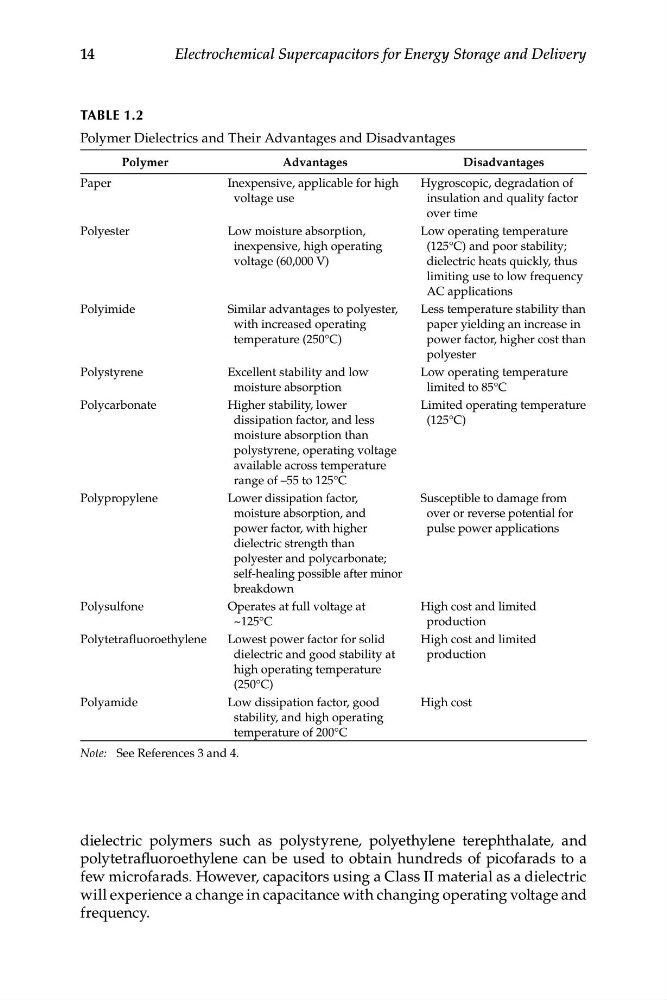
TABLE 1.2
Polymer Dielectrics and Their Advantages and Disadvantages
Note: See References 3 and 4.
dielectric polymers such as polystyrene, polyethylene terephthalate, and
polytetrafluoroethylene can be used to obtain hundreds of picofarads to a
few microfarads. However, capacitors using a Class II material as a dielectric
will experience a change in capacitance with changing operating voltage and
frequency.
Advantages
Disadvantages
Paper
Inexpensive, applicable for high
Hygroscopic, degradation of
voltage use
insulation and quality factor
over time
Polyester
Low moisture absorption,
Low operating temperature
inexpensive, high operating
(125°C) and poor stability;
voltage (60,000 V)
dielectric heats quickly, thus
limiting use to low frequency
AC applications
Polyimide
Similar advantages to polyester,
Less temperature stability than
with increased operating
paper yielding an increase in
temperature (250°C)
power factor, higher cost than
polyester
Polystyrene
Excellent stability and low
Low operating temperature
moisture absorption
limited to 85°C
Polycarbonate
Higher stability, lower
Limited operating temperature
dissipation factor, and less
(125°C)
moisture absorption than
polystyrene, operating voltage
available across temperature
range of –55 to 125°C
Polypropylene
Lower dissipation factor,
Susceptible to damage from
moisture absorption, and
over or reverse potential for
power factor, with higher
pulse power applications
dielectric strength than
polyester and polycarbonate;
self-healing possible after minor
breakdown
Polysulfone
Operates at full voltage at
High cost and limited
~125°C
production
Polytetrafluoroethylene
Lowest power factor for solid
High cost and limited
dielectric and good stability at
production
high operating temperature
(250°C)
Polyamide
Low dissipation factor, good
High cost
stability, and high operating
temperature of 200°C
14
Electrochemical Supercapacitors for Energy Storage and Delivery
TABLE 1.2
Polymer Dielectrics and Their Advantages and Disadvantages
Note: See References 3 and 4.
dielectric polymers such as polystyrene, polyethylene terephthalate, and
polytetrafluoroethylene can be used to obtain hundreds of picofarads to a
few microfarads. However, capacitors using a Class II material as a dielectric
will experience a change in capacitance with changing operating voltage and
frequency.