

Passive Hybrid
Active Hybrid
Discharge cycle time (sec)
8969
8105
Battery delivered energy (kJ)
38.11
38.69
Heat generation in battery (kJ)
3.63
2.07
Battery final temperature (K)
311
305
Energy loss in supercapacitor (kJ)
0.62
1.97
Energy received by load (kJ)
37.49
33.87
Energy loss in converter (kJ)
n/a
2.85
Power source efficiency
89.80%
83.10%
254
Electrochemical Supercapacitors for Energy Storage and Delivery
TABLE 6.2
Energy Distribution within Passive and Active Hybridized
Battery–Supercapacitor Systems
Source: Dougal, R. A., S. Liu, and R. White. 2002. IEEE Transactions on
Power Electronics, 25, 120–131. With permission.
Energy Loss (J/J)
0.25
0.2
0.15
0.1
0.05
0
0.05
0.1
0.15
0.2
0.25
0.3
0.35
0.4
0.45
Converter (Active)
Ultracapacitor (Active)
Battery (Active)
Active total
Ultracapacitor (Passive)
Battery (Passive)
Passive total
Duty Ratio
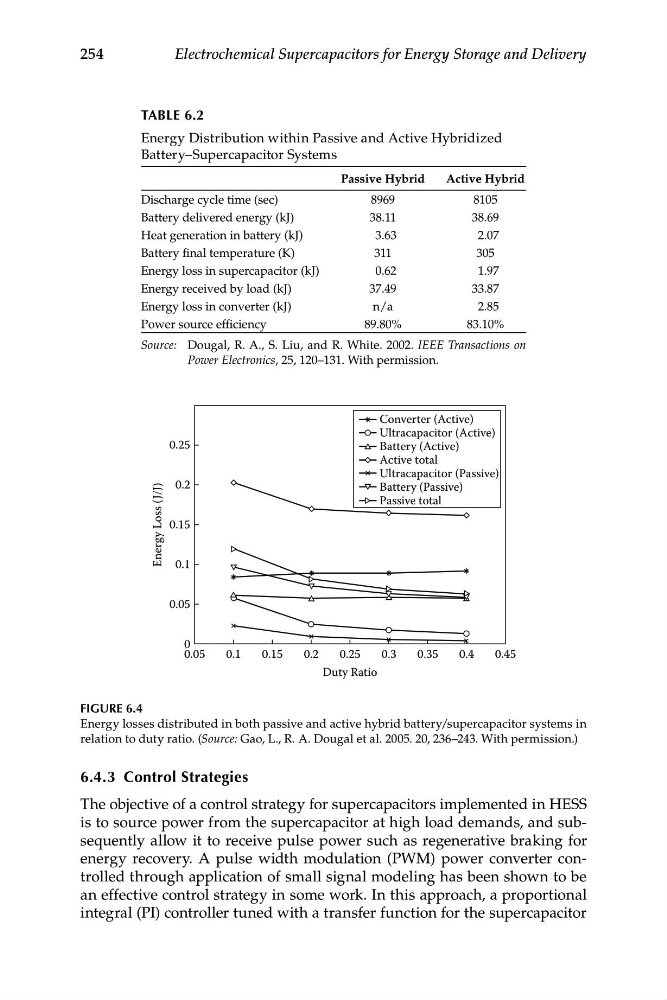
FIGURE 6.4
Energy losses distributed in both passive and active hybrid battery/supercapacitor systems in
relation to duty ratio. (Source: Gao, L., R. A. Dougal et al. 2005. 20, 236–243. With permission.)
6.4.3 Control Strategies
The objective of a control strategy for supercapacitors implemented in HESS
is to source power from the supercapacitor at high load demands, and subsequently allow it to receive pulse power such as regenerative braking for
energy recovery. A pulse width modulation (PWM) power converter controlled through application of small signal modeling has been shown to be
an effective control strategy in some work. In this approach, a proportional
integral (PI) controller tuned with a transfer function for the supercapacitor
Active Hybrid
Discharge cycle time (sec)
8969
8105
Battery delivered energy (kJ)
38.11
38.69
Heat generation in battery (kJ)
3.63
2.07
Battery final temperature (K)
311
305
Energy loss in supercapacitor (kJ)
0.62
1.97
Energy received by load (kJ)
37.49
33.87
Energy loss in converter (kJ)
n/a
2.85
Power source efficiency
89.80%
83.10%
254
Electrochemical Supercapacitors for Energy Storage and Delivery
TABLE 6.2
Energy Distribution within Passive and Active Hybridized
Battery–Supercapacitor Systems
Source: Dougal, R. A., S. Liu, and R. White. 2002. IEEE Transactions on
Power Electronics, 25, 120–131. With permission.
Energy Loss (J/J)
0.25
0.2
0.15
0.1
0.05
0
0.05
0.1
0.15
0.2
0.25
0.3
0.35
0.4
0.45
Converter (Active)
Ultracapacitor (Active)
Battery (Active)
Active total
Ultracapacitor (Passive)
Battery (Passive)
Passive total
Duty Ratio
FIGURE 6.4
Energy losses distributed in both passive and active hybrid battery/supercapacitor systems in
relation to duty ratio. (Source: Gao, L., R. A. Dougal et al. 2005. 20, 236–243. With permission.)
6.4.3 Control Strategies
The objective of a control strategy for supercapacitors implemented in HESS
is to source power from the supercapacitor at high load demands, and subsequently allow it to receive pulse power such as regenerative braking for
energy recovery. A pulse width modulation (PWM) power converter controlled through application of small signal modeling has been shown to be
an effective control strategy in some work. In this approach, a proportional
integral (PI) controller tuned with a transfer function for the supercapacitor