

Carbon electrodes
coated onto Al foil
Separator
Continuous tab design
Extended Foil
(a)
(b)
216
Electrochemical Supercapacitors for Energy Storage and Delivery
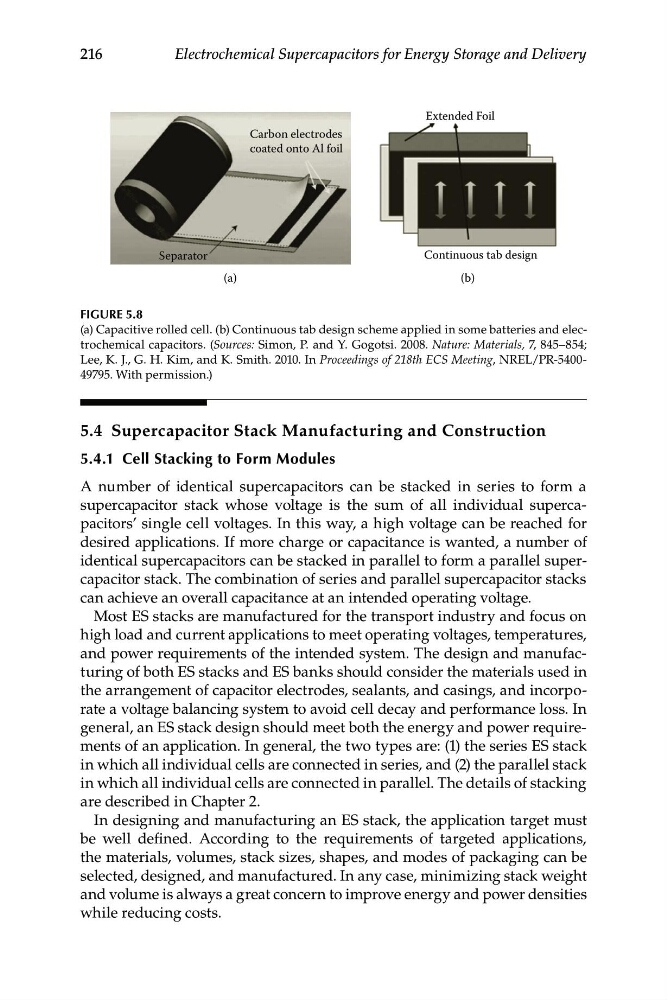
FIGURE 5.8
(a) Capacitive rolled cell. (b) Continuous tab design scheme applied in some batteries and electrochemical capacitors. (Sources: Simon, P. and Y. Gogotsi. 2008. Nature: Materials, 7, 845–854;
Lee, K. J., G. H. Kim, and K. Smith. 2010. In Proceedings of 218th ECS Meeting, NREL/PR-540049795. With permission.)
5.4 Supercapacitor Stack Manufacturing and Construction
5.4.1 Cell Stacking to Form Modules
A number of identical supercapacitors can be stacked in series to form a
supercapacitor stack whose voltage is the sum of all individual supercapacitors’ single cell voltages. In this way, a high voltage can be reached for
desired applications. If more charge or capacitance is wanted, a number of
identical supercapacitors can be stacked in parallel to form a parallel supercapacitor stack. The combination of series and parallel supercapacitor stacks
can achieve an overall capacitance at an intended operating voltage.
Most ES stacks are manufactured for the transport industry and focus on
high load and current applications to meet operating voltages, temperatures,
and power requirements of the intended system. The design and manufacturing of both ES stacks and ES banks should consider the materials used in
the arrangement of capacitor electrodes, sealants, and casings, and incorporate a voltage balancing system to avoid cell decay and performance loss. In
general, an ES stack design should meet both the energy and power requirements of an application. In general, the two types are: (1) the series ES stack
in which all individual cells are connected in series, and (2) the parallel stack
in which all individual cells are connected in parallel. The details of stacking
are described in Chapter 2.
In designing and manufacturing an ES stack, the application target must
be well defined. According to the requirements of targeted applications,
the materials, volumes, stack sizes, shapes, and modes of packaging can be
selected, designed, and manufactured. In any case, minimizing stack weight
and volume is always a great concern to improve energy and power densities
while reducing costs.
coated onto Al foil
Separator
Continuous tab design
Extended Foil
(a)
(b)
216
Electrochemical Supercapacitors for Energy Storage and Delivery
FIGURE 5.8
(a) Capacitive rolled cell. (b) Continuous tab design scheme applied in some batteries and electrochemical capacitors. (Sources: Simon, P. and Y. Gogotsi. 2008. Nature: Materials, 7, 845–854;
Lee, K. J., G. H. Kim, and K. Smith. 2010. In Proceedings of 218th ECS Meeting, NREL/PR-540049795. With permission.)
5.4 Supercapacitor Stack Manufacturing and Construction
5.4.1 Cell Stacking to Form Modules
A number of identical supercapacitors can be stacked in series to form a
supercapacitor stack whose voltage is the sum of all individual supercapacitors’ single cell voltages. In this way, a high voltage can be reached for
desired applications. If more charge or capacitance is wanted, a number of
identical supercapacitors can be stacked in parallel to form a parallel supercapacitor stack. The combination of series and parallel supercapacitor stacks
can achieve an overall capacitance at an intended operating voltage.
Most ES stacks are manufactured for the transport industry and focus on
high load and current applications to meet operating voltages, temperatures,
and power requirements of the intended system. The design and manufacturing of both ES stacks and ES banks should consider the materials used in
the arrangement of capacitor electrodes, sealants, and casings, and incorporate a voltage balancing system to avoid cell decay and performance loss. In
general, an ES stack design should meet both the energy and power requirements of an application. In general, the two types are: (1) the series ES stack
in which all individual cells are connected in series, and (2) the parallel stack
in which all individual cells are connected in parallel. The details of stacking
are described in Chapter 2.
In designing and manufacturing an ES stack, the application target must
be well defined. According to the requirements of targeted applications,
the materials, volumes, stack sizes, shapes, and modes of packaging can be
selected, designed, and manufactured. In any case, minimizing stack weight
and volume is always a great concern to improve energy and power densities
while reducing costs.