

110
100
90
80
70
60
50
110
100
90
80
70
60
50
Capacitance [%C
nominal ]
Time
206
Electrochemical Supercapacitors for Energy Storage and Delivery
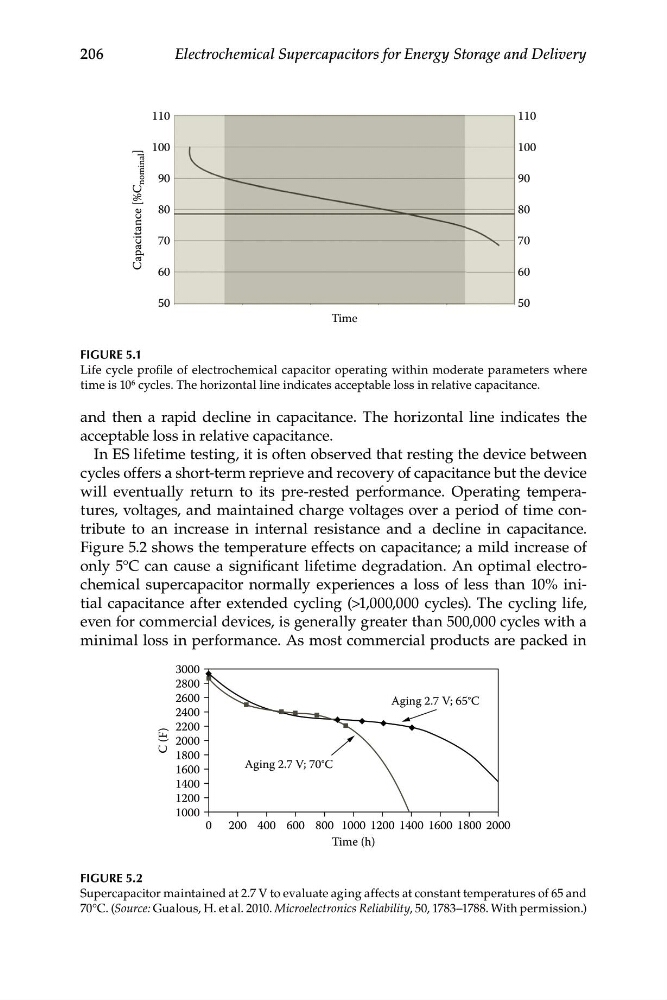
FIGURE 5.1
Life cycle profile of electrochemical capacitor operating within moderate parameters where
time is 10 6 cycles. The horizontal line indicates acceptable loss in relative capacitance.
and then a rapid decline in capacitance. The horizontal line indicates the
acceptable loss in relative capacitance.
In ES lifetime testing, it is often observed that resting the device between
cycles offers a short-term reprieve and recovery of capacitance but the device
will eventually return to its pre-rested performance. Operating temperatures, voltages, and maintained charge voltages over a period of time contribute to an increase in internal resistance and a decline in capacitance.
Figure 5.2 shows the temperature effects on capacitance; a mild increase of
only 5°C can cause a significant lifetime degradation. An optimal electrochemical supercapacitor normally experiences a loss of less than 10% initial capacitance after extended cycling (>1,000,000 cycles). The cycling life,
even for commercial devices, is generally greater than 500,000 cycles with a
minimal loss in performance. As most commercial products are packed in
1000
1200
1400
1600
1800
2000
2200
2400
2600
2800
3000
Aging 2.7 V; 70°C
Aging 2.7 V; 65°C
C (F)
0 200 400 600 800 1000 1200 1400 1600 1800 2000
Time (h)
FIGURE 5.2
Supercapacitor maintained at 2.7 V to evaluate aging affects at constant temperatures of 65 and
70°C. (Source: Gualous, H. et al. 2010. Microelectronics Reliability, 50, 1783–1788. With permission.)
100
90
80
70
60
50
110
100
90
80
70
60
50
Capacitance [%C
nominal ]
Time
206
Electrochemical Supercapacitors for Energy Storage and Delivery
FIGURE 5.1
Life cycle profile of electrochemical capacitor operating within moderate parameters where
time is 10 6 cycles. The horizontal line indicates acceptable loss in relative capacitance.
and then a rapid decline in capacitance. The horizontal line indicates the
acceptable loss in relative capacitance.
In ES lifetime testing, it is often observed that resting the device between
cycles offers a short-term reprieve and recovery of capacitance but the device
will eventually return to its pre-rested performance. Operating temperatures, voltages, and maintained charge voltages over a period of time contribute to an increase in internal resistance and a decline in capacitance.
Figure 5.2 shows the temperature effects on capacitance; a mild increase of
only 5°C can cause a significant lifetime degradation. An optimal electrochemical supercapacitor normally experiences a loss of less than 10% initial capacitance after extended cycling (>1,000,000 cycles). The cycling life,
even for commercial devices, is generally greater than 500,000 cycles with a
minimal loss in performance. As most commercial products are packed in
1000
1200
1400
1600
1800
2000
2200
2400
2600
2800
3000
Aging 2.7 V; 70°C
Aging 2.7 V; 65°C
C (F)
0 200 400 600 800 1000 1200 1400 1600 1800 2000
Time (h)
FIGURE 5.2
Supercapacitor maintained at 2.7 V to evaluate aging affects at constant temperatures of 65 and
70°C. (Source: Gualous, H. et al. 2010. Microelectronics Reliability, 50, 1783–1788. With permission.)