

Capacitance/Area [F/cm
2
]
0.25
0.20
Liquid electrolyte
(1M H 2 SO 4 )
0.15
0.10
Polymer electrolyte
(PVA/H 3 PO 4 )
0.05
0.00
0
5
10
15
20
25
30
35
40
Electrode Thickness [μm]
188
Electrochemical Supercapacitors for Energy Storage and Delivery
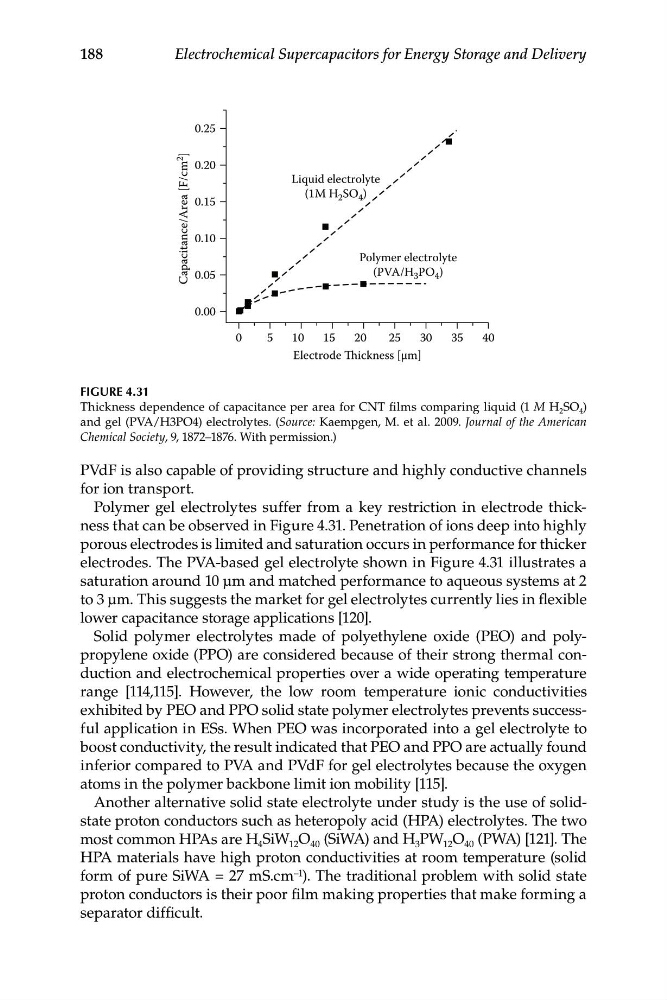
FIGURE 4.31
Thickness dependence of capacitance per area for CNT films comparing liquid (1 M H 2 SO 4 )
and gel (PVA/H3PO4) electrolytes. (Source: Kaempgen, M. et al. 2009. Journal of the American
Chemical Society, 9, 1872–1876. With permission.)
PVdF is also capable of providing structure and highly conductive channels
for ion transport.
Polymer gel electrolytes suffer from a key restriction in electrode thickness that can be observed in Figure 4.31. Penetration of ions deep into highly
porous electrodes is limited and saturation occurs in performance for thicker
electrodes. The PVA-based gel electrolyte shown in Figure 4.31 illustrates a
saturation around 10 μm and matched performance to aqueous systems at 2
to 3 μm. This suggests the market for gel electrolytes currently lies in flexible
lower capacitance storage applications [120].
Solid polymer electrolytes made of polyethylene oxide (PEO) and polypropylene oxide (PPO) are considered because of their strong thermal conduction and electrochemical properties over a wide operating temperature
range [114,115]. However, the low room temperature ionic conductivities
exhibited by PEO and PPO solid state polymer electrolytes prevents successful application in ESs. When PEO was incorporated into a gel electrolyte to
boost conductivity, the result indicated that PEO and PPO are actually found
inferior compared to PVA and PVdF for gel electrolytes because the oxygen
atoms in the polymer backbone limit ion mobility [115].
Another alternative solid state electrolyte under study is the use of solidstate proton conductors such as heteropoly acid (HPA) electrolytes. The two
most common HPAs are H 4 SiW 12 O 40 (SiWA) and H 3 PW 12 O 40 (PWA) [121]. The
HPA materials have high proton conductivities at room temperature (solid
form of pure SiWA = 27 mS.cm –1 ). The traditional problem with solid state
proton conductors is their poor film making properties that make forming a
separator difficult.
2
]
0.25
0.20
Liquid electrolyte
(1M H 2 SO 4 )
0.15
0.10
Polymer electrolyte
(PVA/H 3 PO 4 )
0.05
0.00
0
5
10
15
20
25
30
35
40
Electrode Thickness [μm]
188
Electrochemical Supercapacitors for Energy Storage and Delivery
FIGURE 4.31
Thickness dependence of capacitance per area for CNT films comparing liquid (1 M H 2 SO 4 )
and gel (PVA/H3PO4) electrolytes. (Source: Kaempgen, M. et al. 2009. Journal of the American
Chemical Society, 9, 1872–1876. With permission.)
PVdF is also capable of providing structure and highly conductive channels
for ion transport.
Polymer gel electrolytes suffer from a key restriction in electrode thickness that can be observed in Figure 4.31. Penetration of ions deep into highly
porous electrodes is limited and saturation occurs in performance for thicker
electrodes. The PVA-based gel electrolyte shown in Figure 4.31 illustrates a
saturation around 10 μm and matched performance to aqueous systems at 2
to 3 μm. This suggests the market for gel electrolytes currently lies in flexible
lower capacitance storage applications [120].
Solid polymer electrolytes made of polyethylene oxide (PEO) and polypropylene oxide (PPO) are considered because of their strong thermal conduction and electrochemical properties over a wide operating temperature
range [114,115]. However, the low room temperature ionic conductivities
exhibited by PEO and PPO solid state polymer electrolytes prevents successful application in ESs. When PEO was incorporated into a gel electrolyte to
boost conductivity, the result indicated that PEO and PPO are actually found
inferior compared to PVA and PVdF for gel electrolytes because the oxygen
atoms in the polymer backbone limit ion mobility [115].
Another alternative solid state electrolyte under study is the use of solidstate proton conductors such as heteropoly acid (HPA) electrolytes. The two
most common HPAs are H 4 SiW 12 O 40 (SiWA) and H 3 PW 12 O 40 (PWA) [121]. The
HPA materials have high proton conductivities at room temperature (solid
form of pure SiWA = 27 mS.cm –1 ). The traditional problem with solid state
proton conductors is their poor film making properties that make forming a
separator difficult.