

184
Electrochemical Supercapacitors for Energy Storage and Delivery
TABLE 4.8
Evaluation of Capacitance and Resistance with Variations of Carbon A and
Carbon B
Negative
Positive
Volumetric Capacity
Internal Resistance
Capacitor
Electrode
Electrode
(F/cm 3 )
(mΩ)
1
A
B
26.6
24
2
A
A
20.8
23
3
B
B
27.5
257
4
B
A
18.8
243
Source: Okamura, M. 1999. Electric double-layer capacitors and storage systems. U.S. Patent
6064562. With permission.
Note: Average pore diameters for carbon A and carbon B were 1.6 and 1.2 nm, respectively.
Solvent used was tetraethylammonium tetrafluoroborate in acetonitrile.
As our understanding of pore and electrolyte ion interactions grows, it
is clear that electrode materials should be developed with the intended
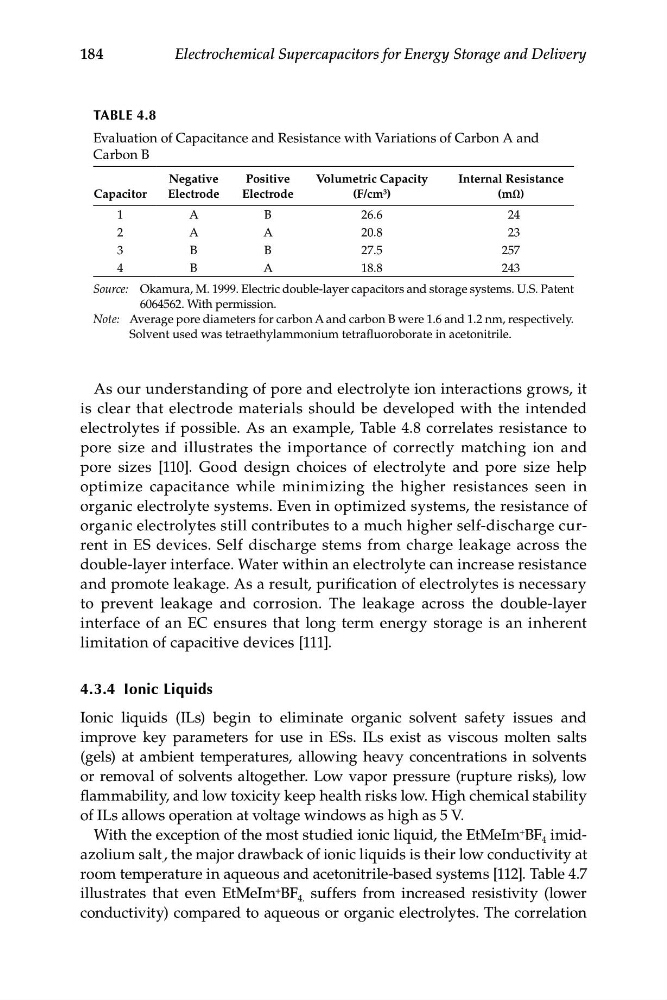
electrolytes if possible. As an example, Table 4.8 correlates resistance to
pore size and illustrates the importance of correctly matching ion and
pore sizes [110]. Good design choices of electrolyte and pore size help
optimize capacitance while minimizing the higher resistances seen in
organic electrolyte systems. Even in optimized systems, the resistance of
organic electrolytes still contributes to a much higher self-discharge current in ES devices. Self discharge stems from charge leakage across the
double-layer interface. Water within an electrolyte can increase resistance
and promote leakage. As a result, purification of electrolytes is necessary
to prevent leakage and corrosion. The leakage across the double-layer
interface of an EC ensures that long term energy storage is an inherent
limitation of capacitive devices [111].
4.3.4 Ionic Liquids
Ionic liquids (ILs) begin to eliminate organic solvent safety issues and
improve key parameters for use in ESs. ILs exist as viscous molten salts
(gels) at ambient temperatures, allowing heavy concentrations in solvents
or removal of solvents altogether. Low vapor pressure (rupture risks), low
flammability, and low toxicity keep health risks low. High chemical stability
of ILs allows operation at voltage windows as high as 5 V.
With the exception of the most studied ionic liquid, the EtMeIm + BF 4 imidazolium salt . , the major drawback of ionic liquids is their low conductivity at
room temperature in aqueous and acetonitrile-based systems [112]. Table 4.7
illustrates that even EtMeIm + BF 4. suffers from increased resistivity (lower
conductivity) compared to aqueous or organic electrolytes. The correlation
Electrochemical Supercapacitors for Energy Storage and Delivery
TABLE 4.8
Evaluation of Capacitance and Resistance with Variations of Carbon A and
Carbon B
Negative
Positive
Volumetric Capacity
Internal Resistance
Capacitor
Electrode
Electrode
(F/cm 3 )
(mΩ)
1
A
B
26.6
24
2
A
A
20.8
23
3
B
B
27.5
257
4
B
A
18.8
243
Source: Okamura, M. 1999. Electric double-layer capacitors and storage systems. U.S. Patent
6064562. With permission.
Note: Average pore diameters for carbon A and carbon B were 1.6 and 1.2 nm, respectively.
Solvent used was tetraethylammonium tetrafluoroborate in acetonitrile.
As our understanding of pore and electrolyte ion interactions grows, it
is clear that electrode materials should be developed with the intended
electrolytes if possible. As an example, Table 4.8 correlates resistance to
pore size and illustrates the importance of correctly matching ion and
pore sizes [110]. Good design choices of electrolyte and pore size help
optimize capacitance while minimizing the higher resistances seen in
organic electrolyte systems. Even in optimized systems, the resistance of
organic electrolytes still contributes to a much higher self-discharge current in ES devices. Self discharge stems from charge leakage across the
double-layer interface. Water within an electrolyte can increase resistance
and promote leakage. As a result, purification of electrolytes is necessary
to prevent leakage and corrosion. The leakage across the double-layer
interface of an EC ensures that long term energy storage is an inherent
limitation of capacitive devices [111].
4.3.4 Ionic Liquids
Ionic liquids (ILs) begin to eliminate organic solvent safety issues and
improve key parameters for use in ESs. ILs exist as viscous molten salts
(gels) at ambient temperatures, allowing heavy concentrations in solvents
or removal of solvents altogether. Low vapor pressure (rupture risks), low
flammability, and low toxicity keep health risks low. High chemical stability
of ILs allows operation at voltage windows as high as 5 V.
With the exception of the most studied ionic liquid, the EtMeIm + BF 4 imidazolium salt . , the major drawback of ionic liquids is their low conductivity at
room temperature in aqueous and acetonitrile-based systems [112]. Table 4.7
illustrates that even EtMeIm + BF 4. suffers from increased resistivity (lower
conductivity) compared to aqueous or organic electrolytes. The correlation