

169
2.0
1.0
1.5
0.5
Fe 3 O 4
–1.5
–1.0 –0.5
0.0
0.5
1.0
MnO 2
–1.5 –1.0
–0.5
0.0
0.5
1.0
1.0
0.0
0.5
0.0
I (A/g)
–0.5
–1.0
–1.0
–1.5
–2.0
–1.5
E vs. Ag/AgCl (v)
E vs. Ag/AgCl (v)
(a)
(b)
0.6
I (A/g)
–0.5
V 2 O 5
–1.5
–1.0 –0.5
0.0
0.5
1.0
0.4
0.2
0.0
–0.2
–0.4
–0.6
I (A/g)
E vs. Ag/AgCl (v)
(c)
Components and Materials for Electrochemical Supercapacitors
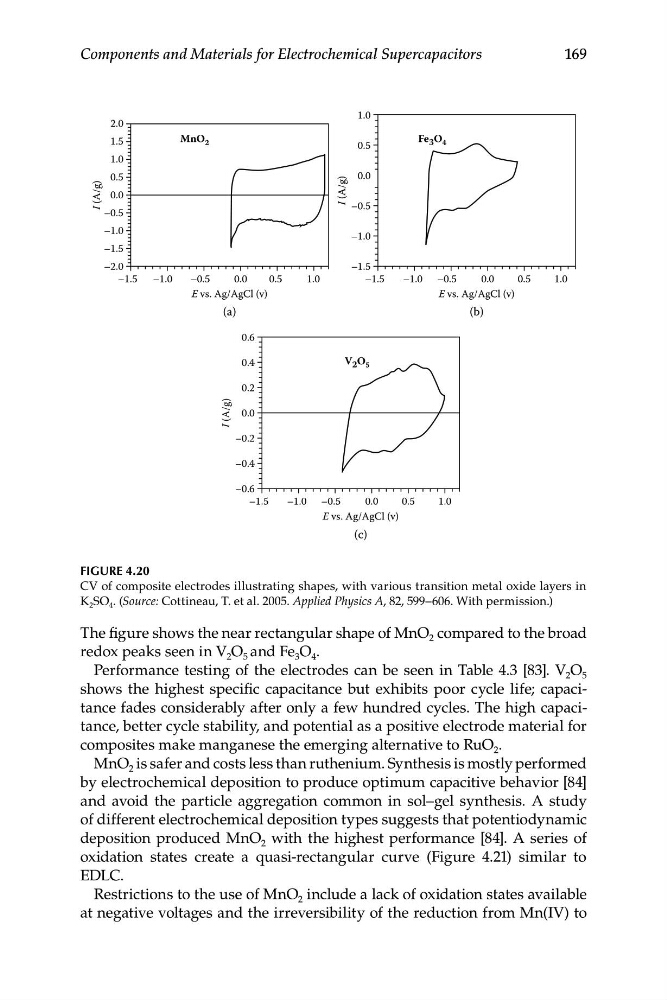
FIGURE 4.20
CV of composite electrodes illustrating shapes, with various transition metal oxide layers in
K 2 SO 4 . (Source: Cottineau, T. et al. 2005. Applied Physics A, 82, 599–606. With permission.)
The figure shows the near rectangular shape of MnO 2 compared to the broad
redox peaks seen in V 2 O 5 and Fe 3 O 4 .
Performance testing of the electrodes can be seen in Table 4.3 [83]. V 2 O 5
shows the highest specific capacitance but exhibits poor cycle life; capacitance fades considerably after only a few hundred cycles. The high capacitance, better cycle stability, and potential as a positive electrode material for
composites make manganese the emerging alternative to RuO 2 .
MnO 2 is safer and costs less than ruthenium. Synthesis is mostly performed
by electrochemical deposition to produce optimum capacitive behavior [84]
and avoid the particle aggregation common in sol–gel synthesis. A study
of different electrochemical deposition types suggests that potentiodynamic
deposition produced MnO 2 with the highest performance [84]. A series of
oxidation states create a quasi-rectangular curve (Figure 4.21) similar to
EDLC.
Restrictions to the use of MnO 2 include a lack of oxidation states available
at negative voltages and the irreversibility of the reduction from Mn(IV) to
2.0
1.0
1.5
0.5
Fe 3 O 4
–1.5
–1.0 –0.5
0.0
0.5
1.0
MnO 2
–1.5 –1.0
–0.5
0.0
0.5
1.0
1.0
0.0
0.5
0.0
I (A/g)
–0.5
–1.0
–1.0
–1.5
–2.0
–1.5
E vs. Ag/AgCl (v)
E vs. Ag/AgCl (v)
(a)
(b)
0.6
I (A/g)
–0.5
V 2 O 5
–1.5
–1.0 –0.5
0.0
0.5
1.0
0.4
0.2
0.0
–0.2
–0.4
–0.6
I (A/g)
E vs. Ag/AgCl (v)
(c)
Components and Materials for Electrochemical Supercapacitors
FIGURE 4.20
CV of composite electrodes illustrating shapes, with various transition metal oxide layers in
K 2 SO 4 . (Source: Cottineau, T. et al. 2005. Applied Physics A, 82, 599–606. With permission.)
The figure shows the near rectangular shape of MnO 2 compared to the broad
redox peaks seen in V 2 O 5 and Fe 3 O 4 .
Performance testing of the electrodes can be seen in Table 4.3 [83]. V 2 O 5
shows the highest specific capacitance but exhibits poor cycle life; capacitance fades considerably after only a few hundred cycles. The high capacitance, better cycle stability, and potential as a positive electrode material for
composites make manganese the emerging alternative to RuO 2 .
MnO 2 is safer and costs less than ruthenium. Synthesis is mostly performed
by electrochemical deposition to produce optimum capacitive behavior [84]
and avoid the particle aggregation common in sol–gel synthesis. A study
of different electrochemical deposition types suggests that potentiodynamic
deposition produced MnO 2 with the highest performance [84]. A series of
oxidation states create a quasi-rectangular curve (Figure 4.21) similar to
EDLC.
Restrictions to the use of MnO 2 include a lack of oxidation states available
at negative voltages and the irreversibility of the reduction from Mn(IV) to