

166
Electrochemical Supercapacitors for Energy Storage and Delivery
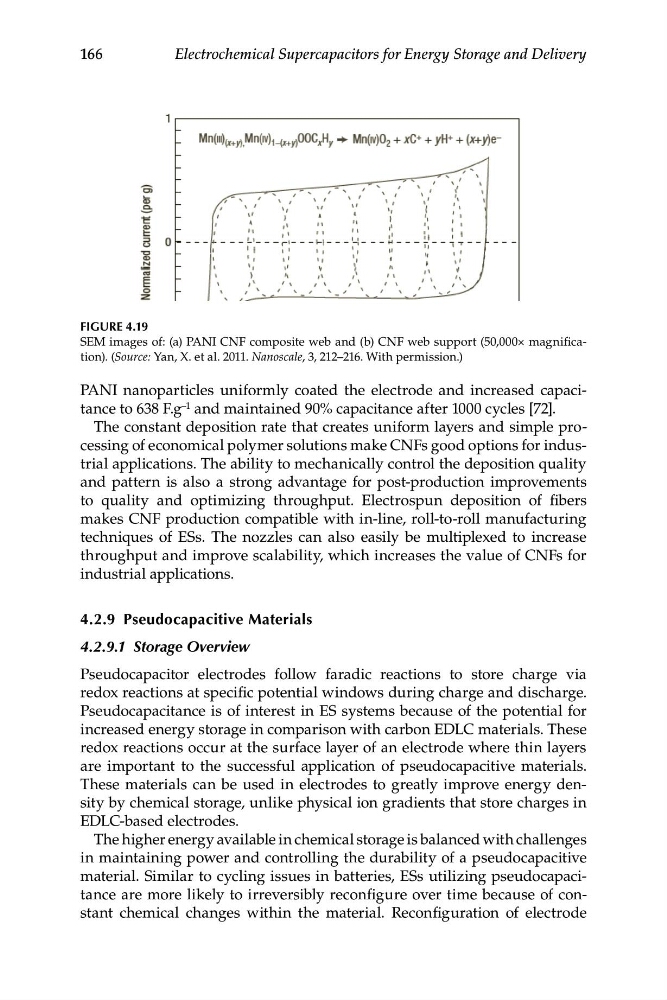
FIGURE 4.19
SEM images of: (a) PANI CNF composite web and (b) CNF web support (50,000× magnification). (Source: Yan, X. et al. 2011. Nanoscale, 3, 212–216. With permission.)
PANI nanoparticles uniformly coated the electrode and increased capacitance to 638 F.g –1 and maintained 90% capacitance after 1000 cycles [72].
The constant deposition rate that creates uniform layers and simple processing of economical polymer solutions make CNFs good options for industrial applications. The ability to mechanically control the deposition quality
and pattern is also a strong advantage for post-production improvements
to quality and optimizing throughput. Electrospun deposition of fibers
makes CNF production compatible with in-line, roll-to-roll manufacturing
techniques of ESs. The nozzles can also easily be multiplexed to increase
throughput and improve scalability, which increases the value of CNFs for
industrial applications.
4.2.9 Pseudocapacitive Materials
4.2.9.1 Storage Overview
Pseudocapacitor electrodes follow faradic reactions to store charge via
redox reactions at specific potential windows during charge and discharge.
Pseudocapacitance is of interest in ES systems because of the potential for
increased energy storage in comparison with carbon EDLC materials. These
redox reactions occur at the surface layer of an electrode where thin layers
are important to the successful application of pseudocapacitive materials.
These materials can be used in electrodes to greatly improve energy density by chemical storage, unlike physical ion gradients that store charges in
EDLC-based electrodes.
The higher energy available in chemical storage is balanced with challenges
in maintaining power and controlling the durability of a pseudocapacitive
material. Similar to cycling issues in batteries, ESs utilizing pseudocapacitance are more likely to irreversibly reconfigure over time because of constant chemical changes within the material. Reconfiguration of electrode
Electrochemical Supercapacitors for Energy Storage and Delivery
FIGURE 4.19
SEM images of: (a) PANI CNF composite web and (b) CNF web support (50,000× magnification). (Source: Yan, X. et al. 2011. Nanoscale, 3, 212–216. With permission.)
PANI nanoparticles uniformly coated the electrode and increased capacitance to 638 F.g –1 and maintained 90% capacitance after 1000 cycles [72].
The constant deposition rate that creates uniform layers and simple processing of economical polymer solutions make CNFs good options for industrial applications. The ability to mechanically control the deposition quality
and pattern is also a strong advantage for post-production improvements
to quality and optimizing throughput. Electrospun deposition of fibers
makes CNF production compatible with in-line, roll-to-roll manufacturing
techniques of ESs. The nozzles can also easily be multiplexed to increase
throughput and improve scalability, which increases the value of CNFs for
industrial applications.
4.2.9 Pseudocapacitive Materials
4.2.9.1 Storage Overview
Pseudocapacitor electrodes follow faradic reactions to store charge via
redox reactions at specific potential windows during charge and discharge.
Pseudocapacitance is of interest in ES systems because of the potential for
increased energy storage in comparison with carbon EDLC materials. These
redox reactions occur at the surface layer of an electrode where thin layers
are important to the successful application of pseudocapacitive materials.
These materials can be used in electrodes to greatly improve energy density by chemical storage, unlike physical ion gradients that store charges in
EDLC-based electrodes.
The higher energy available in chemical storage is balanced with challenges
in maintaining power and controlling the durability of a pseudocapacitive
material. Similar to cycling issues in batteries, ESs utilizing pseudocapacitance are more likely to irreversibly reconfigure over time because of constant chemical changes within the material. Reconfiguration of electrode