

Activated carbon
microsupercapacitor
Carbon onions
microsupercapacitor
63 V/200 μF
electrolytic capacitor
3.5 V/25 mF
supercapacitor
120 140 160 180 200
2 nm
Stack Capacitance (F cm –3
)
10
0
10
–1
10
–2
10
–3
10
–4
0
20 40 60 80 100
Scan Rate (Vs
–1
)
(a)
(b)
160
Electrochemical Supercapacitors for Energy Storage and Delivery
1000 m 2 .g –1 and upon electrochemical oxidation to remove the CNT tips, the
surface area can reach 2200 m 2 .g –1 [52].
Hiraoka et al. [59] illustrate that high levels of oxidation caused by temperatures beyond 500°C reduced performance by burning the CNTs and
enabling heavy bundling. An optimized process was utilized to create a
CNT device with intimate contact to the metal collector and surface area
beyond 2000 m 2 .g –1 . Minimization of bundling could lead to 80% availability of the area to electrolyte ions. The resulting CNT electrode showed high
capacitance of 115 F.g –1 (24.7 Wh.kg –1 ) in organic electrolyte at a current density of 1 A.g –1 . The maximum power density was calculated to be 98.9 kW.kg –1
and due to the dense CNT packing, maximum volumetric power density
was determined to be 60.1 kW.L –1 [59].
4.2.8.4 Carbon Onions
Onion-like carbon (OLC) is composed of quasi-spherical concentric graphitic
shells. Pech et al. investigated them for use in EC devices [60]. OLCs have
only moderate specific areas of 500 m 2 .g –1 and are produced by the detonation of diamond powders at temperatures of 1800°C. This is a low valued
compared to AC results, but the small ordered spherical particles in OLC can
avoid the porous network seen in high area AC materials. Furthermore, the
continuous curvature ensures mesoporous channels for electrolyte access
and prevents bundling problems common in CNTs. This means that surface
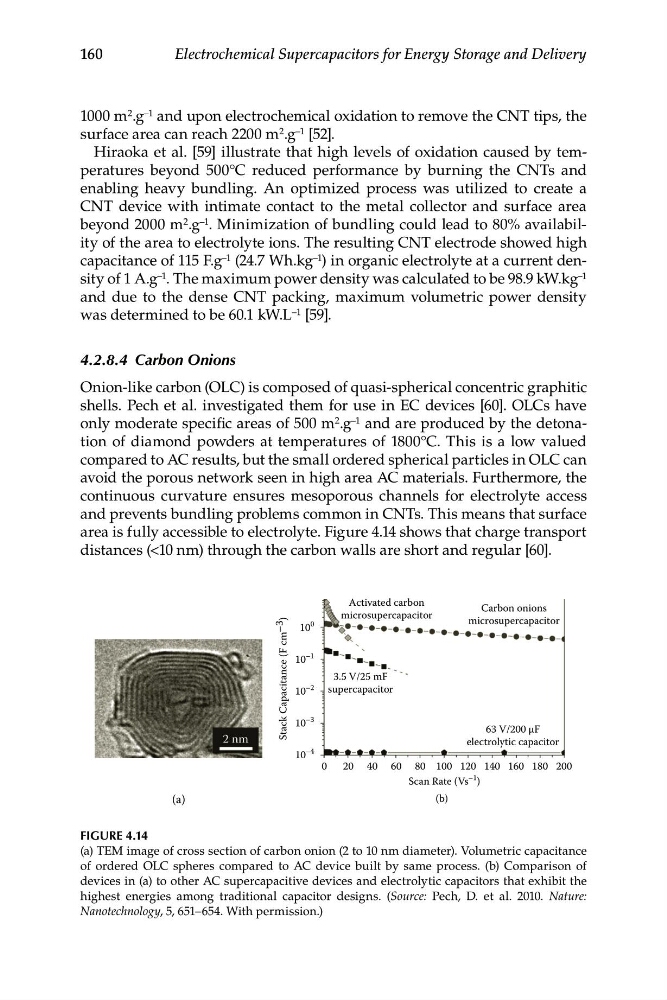
area is fully accessible to electrolyte. Figure 4.14 shows that charge transport
distances (<10 nm) through the carbon walls are short and regular [60].
FIGURE 4.14
(a) TEM image of cross section of carbon onion (2 to 10 nm diameter). Volumetric capacitance
of ordered OLC spheres compared to AC device built by same process. (b) Comparison of
devices in (a) to other AC supercapacitive devices and electrolytic capacitors that exhibit the
highest energies among traditional capacitor designs. (Source: Pech, D. et al. 2010. Nature:
Nanotechnology, 5, 651–654. With permission.)
microsupercapacitor
Carbon onions
microsupercapacitor
63 V/200 μF
electrolytic capacitor
3.5 V/25 mF
supercapacitor
120 140 160 180 200
2 nm
Stack Capacitance (F cm –3
)
10
0
10
–1
10
–2
10
–3
10
–4
0
20 40 60 80 100
Scan Rate (Vs
–1
)
(a)
(b)
160
Electrochemical Supercapacitors for Energy Storage and Delivery
1000 m 2 .g –1 and upon electrochemical oxidation to remove the CNT tips, the
surface area can reach 2200 m 2 .g –1 [52].
Hiraoka et al. [59] illustrate that high levels of oxidation caused by temperatures beyond 500°C reduced performance by burning the CNTs and
enabling heavy bundling. An optimized process was utilized to create a
CNT device with intimate contact to the metal collector and surface area
beyond 2000 m 2 .g –1 . Minimization of bundling could lead to 80% availability of the area to electrolyte ions. The resulting CNT electrode showed high
capacitance of 115 F.g –1 (24.7 Wh.kg –1 ) in organic electrolyte at a current density of 1 A.g –1 . The maximum power density was calculated to be 98.9 kW.kg –1
and due to the dense CNT packing, maximum volumetric power density
was determined to be 60.1 kW.L –1 [59].
4.2.8.4 Carbon Onions
Onion-like carbon (OLC) is composed of quasi-spherical concentric graphitic
shells. Pech et al. investigated them for use in EC devices [60]. OLCs have
only moderate specific areas of 500 m 2 .g –1 and are produced by the detonation of diamond powders at temperatures of 1800°C. This is a low valued
compared to AC results, but the small ordered spherical particles in OLC can
avoid the porous network seen in high area AC materials. Furthermore, the
continuous curvature ensures mesoporous channels for electrolyte access
and prevents bundling problems common in CNTs. This means that surface
area is fully accessible to electrolyte. Figure 4.14 shows that charge transport
distances (<10 nm) through the carbon walls are short and regular [60].
FIGURE 4.14
(a) TEM image of cross section of carbon onion (2 to 10 nm diameter). Volumetric capacitance
of ordered OLC spheres compared to AC device built by same process. (b) Comparison of
devices in (a) to other AC supercapacitive devices and electrolytic capacitors that exhibit the
highest energies among traditional capacitor designs. (Source: Pech, D. et al. 2010. Nature:
Nanotechnology, 5, 651–654. With permission.)