

180
160
140
120
100
80
pH = 10
pH = 6.4
C, F/g
0
50
100
150
200
250
Cycles
400
200
0
–0.2
0.2
0.4
0.6
0.8
1
1.2
1.4
0
–200
–400
–600
pH = 10
pH = 6.4
C, F/g
E, V vs. NHE
120
Electrochemical Supercapacitors for Energy Storage and Delivery
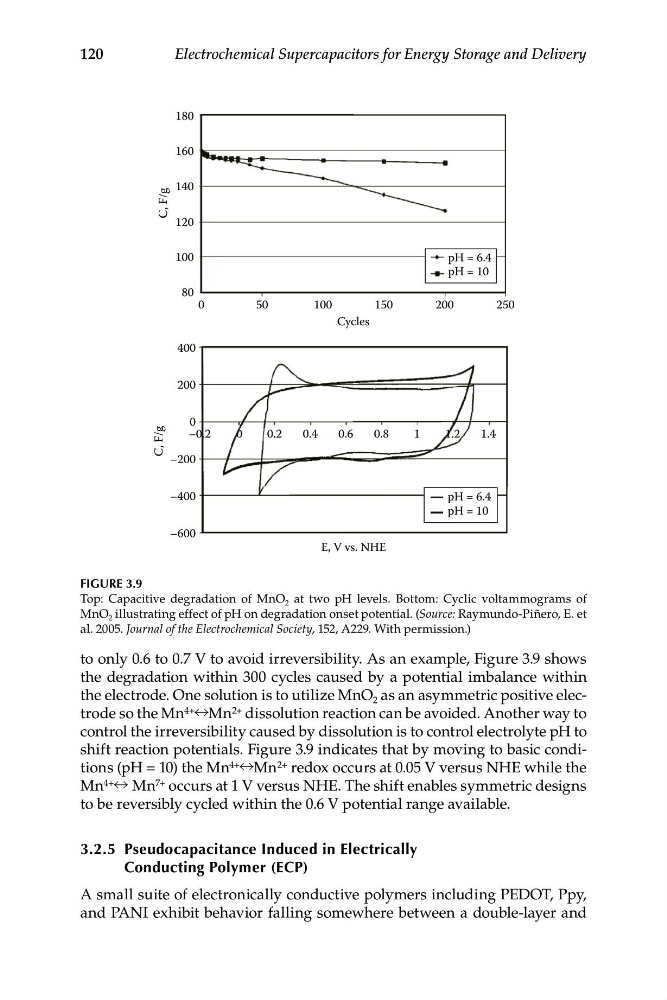
FIGURE 3.9
Top: Capacitive degradation of MnO 2 at two pH levels. Bottom: Cyclic voltammograms of
MnO 2 illustrating effect of pH on degradation onset potential. (Source: Raymundo-Piñero, E. et
al. 2005. Journal of the Electrochemical Society, 152, A229. With permission.)
to only 0.6 to 0.7 V to avoid irreversibility. As an example, Figure 3.9 shows
the degradation within 300 cycles caused by a potential imbalance within
the electrode. One solution is to utilize MnO 2 as an asymmetric positive electrode so the Mn 4+ ↔Mn 2+ dissolution reaction can be avoided. Another way to
control the irreversibility caused by dissolution is to control electrolyte pH to
shift reaction potentials. Figure 3.9 indicates that by moving to basic conditions (pH = 10) the Mn 4+ ↔Mn 2+ redox occurs at 0.05 V versus NHE while the
Mn 4+ ↔ Mn 7+ occurs at 1 V versus NHE. The shift enables symmetric designs
to be reversibly cycled within the 0.6 V potential range available.
3.2.5 Pseudocapacitance Induced in Electrically
Conducting Polymer (ECP)
A small suite of electronically conductive polymers including PEDOT, Ppy,
and PANI exhibit behavior falling somewhere between a double-layer and
160
140
120
100
80
pH = 10
pH = 6.4
C, F/g
0
50
100
150
200
250
Cycles
400
200
0
–0.2
0.2
0.4
0.6
0.8
1
1.2
1.4
0
–200
–400
–600
pH = 10
pH = 6.4
C, F/g
E, V vs. NHE
120
Electrochemical Supercapacitors for Energy Storage and Delivery
FIGURE 3.9
Top: Capacitive degradation of MnO 2 at two pH levels. Bottom: Cyclic voltammograms of
MnO 2 illustrating effect of pH on degradation onset potential. (Source: Raymundo-Piñero, E. et
al. 2005. Journal of the Electrochemical Society, 152, A229. With permission.)
to only 0.6 to 0.7 V to avoid irreversibility. As an example, Figure 3.9 shows
the degradation within 300 cycles caused by a potential imbalance within
the electrode. One solution is to utilize MnO 2 as an asymmetric positive electrode so the Mn 4+ ↔Mn 2+ dissolution reaction can be avoided. Another way to
control the irreversibility caused by dissolution is to control electrolyte pH to
shift reaction potentials. Figure 3.9 indicates that by moving to basic conditions (pH = 10) the Mn 4+ ↔Mn 2+ redox occurs at 0.05 V versus NHE while the
Mn 4+ ↔ Mn 7+ occurs at 1 V versus NHE. The shift enables symmetric designs
to be reversibly cycled within the 0.6 V potential range available.
3.2.5 Pseudocapacitance Induced in Electrically
Conducting Polymer (ECP)
A small suite of electronically conductive polymers including PEDOT, Ppy,
and PANI exhibit behavior falling somewhere between a double-layer and