

115
Fundamentals of Electrochemical Pseudocapacitors
⎛
nF
⎞
exp
⎜
(E
o
−
E
⎟
n F
2 2
o
⎝
O
RT
X /R d
⎠
C E
pc ( ) =
C O
X
2
(3.23)
RT
⎡
⎛
nF
⎞ ⎤
⎢1 +
ex xp ⎜
(E
o
O
⎣
⎝
X /R
RT
d
− E ⎟⎥
⎠⎦
where C
o
O X
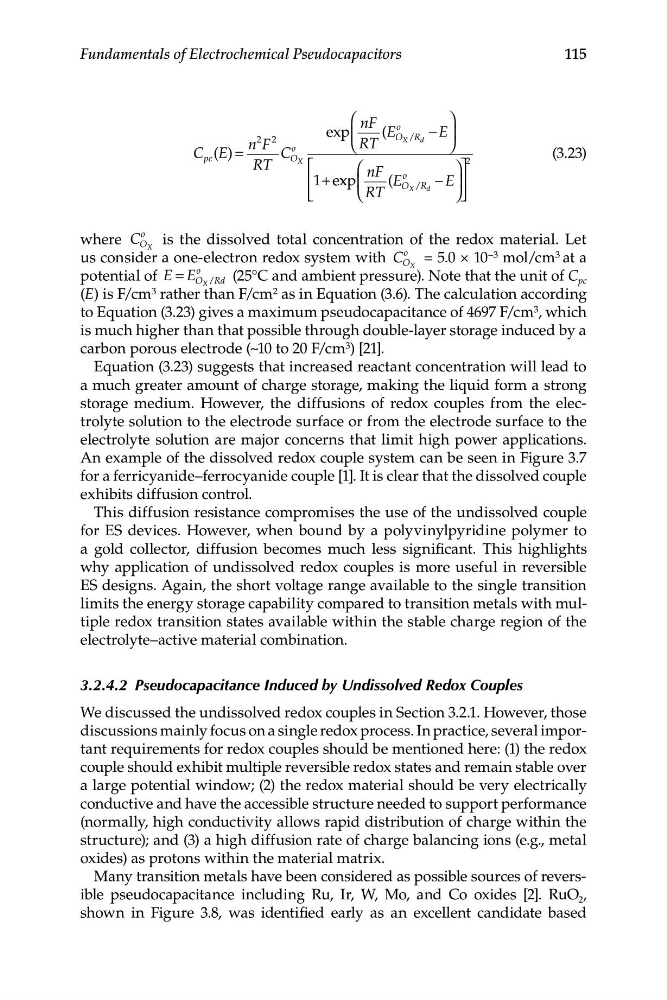
is the dissolved total concentration of the redox material. Let
us consider a one-electron redox system with C
o
O X
= 5.0 × 10 –3 mol/cm 3 at a
potential of E E
=
o
O X /Rd ( 25°C and ambient pressure). Note that the unit of C pc
(E) is F/cm 3 rather than F/cm 2 as in Equation (3.6). The calculation according
to Equation (3.23) gives a maximum pseudocapacitance of 4697 F/cm 3 , which
is much higher than that possible through double-layer storage induced by a
carbon porous electrode (~10 to 20 F/cm 3 ) [21].
Equation (3.23) suggests that increased reactant concentration will lead to
a much greater amount of charge storage, making the liquid form a strong
storage medium. However, the diffusions of redox couples from the electrolyte solution to the electrode surface or from the electrode surface to the
electrolyte solution are major concerns that limit high power applications.
An example of the dissolved redox couple system can be seen in Figure 3.7
for a ferricyanide–ferrocyanide couple [1]. It is clear that the dissolved couple
exhibits diffusion control.
This diffusion resistance compromises the use of the undissolved couple
for ES devices. However, when bound by a polyvinylpyridine polymer to
a gold collector, diffusion becomes much less significant. This highlights
why application of undissolved redox couples is more useful in reversible
ES designs. Again, the short voltage range available to the single transition
limits the energy storage capability compared to transition metals with multiple redox transition states available within the stable charge region of the
electrolyte–active material combination.
3.2.4.2 Pseudocapacitance Induced by Undissolved Redox Couples
We discussed the undissolved redox couples in Section 3.2.1. However, those
discussions mainly focus on a single redox process. In practice, several important requirements for redox couples should be mentioned here: (1) the redox
couple should exhibit multiple reversible redox states and remain stable over
a large potential window; (2) the redox material should be very electrically
conductive and have the accessible structure needed to support performance
(normally, high conductivity allows rapid distribution of charge within the
structure); and (3) a high diffusion rate of charge balancing ions (e.g., metal
oxides) as protons within the material matrix.
Many transition metals have been considered as possible sources of reversible pseudocapacitance including Ru, Ir, W, Mo, and Co oxides [2]. RuO 2 ,
shown in Figure 3.8, was identified early as an excellent candidate based
Fundamentals of Electrochemical Pseudocapacitors
⎛
nF
⎞
exp
⎜
(E
o
−
E
⎟
n F
2 2
o
⎝
O
RT
X /R d
⎠
C E
pc ( ) =
C O
X
2
(3.23)
RT
⎡
⎛
nF
⎞ ⎤
⎢1 +
ex xp ⎜
(E
o
O
⎣
⎝
X /R
RT
d
− E ⎟⎥
⎠⎦
where C
o
O X
is the dissolved total concentration of the redox material. Let
us consider a one-electron redox system with C
o
O X
= 5.0 × 10 –3 mol/cm 3 at a
potential of E E
=
o
O X /Rd ( 25°C and ambient pressure). Note that the unit of C pc
(E) is F/cm 3 rather than F/cm 2 as in Equation (3.6). The calculation according
to Equation (3.23) gives a maximum pseudocapacitance of 4697 F/cm 3 , which
is much higher than that possible through double-layer storage induced by a
carbon porous electrode (~10 to 20 F/cm 3 ) [21].
Equation (3.23) suggests that increased reactant concentration will lead to
a much greater amount of charge storage, making the liquid form a strong
storage medium. However, the diffusions of redox couples from the electrolyte solution to the electrode surface or from the electrode surface to the
electrolyte solution are major concerns that limit high power applications.
An example of the dissolved redox couple system can be seen in Figure 3.7
for a ferricyanide–ferrocyanide couple [1]. It is clear that the dissolved couple
exhibits diffusion control.
This diffusion resistance compromises the use of the undissolved couple
for ES devices. However, when bound by a polyvinylpyridine polymer to
a gold collector, diffusion becomes much less significant. This highlights
why application of undissolved redox couples is more useful in reversible
ES designs. Again, the short voltage range available to the single transition
limits the energy storage capability compared to transition metals with multiple redox transition states available within the stable charge region of the
electrolyte–active material combination.
3.2.4.2 Pseudocapacitance Induced by Undissolved Redox Couples
We discussed the undissolved redox couples in Section 3.2.1. However, those
discussions mainly focus on a single redox process. In practice, several important requirements for redox couples should be mentioned here: (1) the redox
couple should exhibit multiple reversible redox states and remain stable over
a large potential window; (2) the redox material should be very electrically
conductive and have the accessible structure needed to support performance
(normally, high conductivity allows rapid distribution of charge within the
structure); and (3) a high diffusion rate of charge balancing ions (e.g., metal
oxides) as protons within the material matrix.
Many transition metals have been considered as possible sources of reversible pseudocapacitance including Ru, Ir, W, Mo, and Co oxides [2]. RuO 2 ,
shown in Figure 3.8, was identified early as an excellent candidate based