

Advantage
Challenge
Long life, with little degradation over hundreds Low energy density
of thousands of charge cycles
Low cost per cycle
High self-discharging rate, considerably
higher than that of electrochemical battery
Good reversibility
Unlike practical batteries, voltage across
supercapacitor drops significantly as it
discharges; effective storage and recovery of
energy requires complex electronic control
and switching equipment with consequent
energy loss
Very high rates of charge and discharge.
Very low internal resistance allows extremely
rapid discharge when shorted, resulting in
spark hazard similar to other capacitors of
similar voltage and capacitance (generally
much higher than electrochemical cells)
Extremely low internal resistance (ESR),
Raw material costs are significantly high and
consequent high cycle efficiency (95% or
play important role in pricing of
more), and extremely low heating levels
supercapacitor
High output power
Adoption rates increase only gradually as
end users realize benefits
High specific power
Power only available for very short duration
Improved safety, no corrosive electrolyte, and
low toxicity of materials; environmentally
friendly
Simple charge methods; no full charge
detection needed; no danger of overcharging
When used in conjunction with rechargeable
batteries, can supply energy for short time,
reducing battery cycling duty and extending
life
94
Electrochemical Supercapacitors for Energy Storage and Delivery
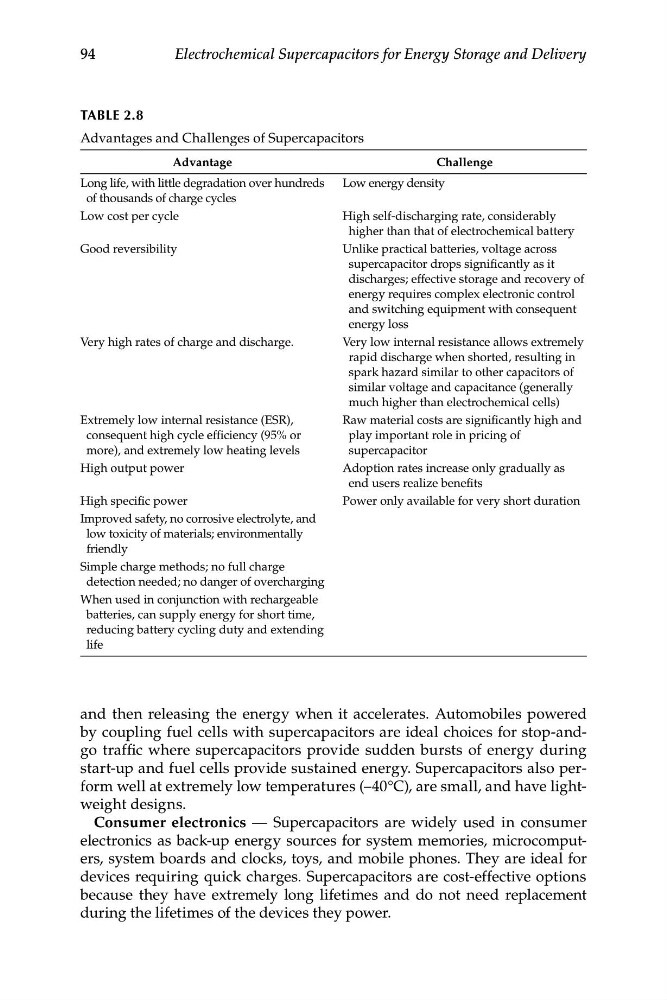
TABLE 2.8
Advantages and Challenges of Supercapacitors
and then releasing the energy when it accelerates. Automobiles powered
by coupling fuel cells with supercapacitors are ideal choices for stop-andgo traffic where supercapacitors provide sudden bursts of energy during
start-up and fuel cells provide sustained energy. Supercapacitors also perform well at extremely low temperatures (–40°C), are small, and have lightweight designs.
Consumer electronics — Supercapacitors are widely used in consumer
electronics as back-up energy sources for system memories, microcomputers, system boards and clocks, toys, and mobile phones. They are ideal for
devices requiring quick charges. Supercapacitors are cost-effective options
because they have extremely long lifetimes and do not need replacement
during the lifetimes of the devices they power.
Challenge
Long life, with little degradation over hundreds Low energy density
of thousands of charge cycles
Low cost per cycle
High self-discharging rate, considerably
higher than that of electrochemical battery
Good reversibility
Unlike practical batteries, voltage across
supercapacitor drops significantly as it
discharges; effective storage and recovery of
energy requires complex electronic control
and switching equipment with consequent
energy loss
Very high rates of charge and discharge.
Very low internal resistance allows extremely
rapid discharge when shorted, resulting in
spark hazard similar to other capacitors of
similar voltage and capacitance (generally
much higher than electrochemical cells)
Extremely low internal resistance (ESR),
Raw material costs are significantly high and
consequent high cycle efficiency (95% or
play important role in pricing of
more), and extremely low heating levels
supercapacitor
High output power
Adoption rates increase only gradually as
end users realize benefits
High specific power
Power only available for very short duration
Improved safety, no corrosive electrolyte, and
low toxicity of materials; environmentally
friendly
Simple charge methods; no full charge
detection needed; no danger of overcharging
When used in conjunction with rechargeable
batteries, can supply energy for short time,
reducing battery cycling duty and extending
life
94
Electrochemical Supercapacitors for Energy Storage and Delivery
TABLE 2.8
Advantages and Challenges of Supercapacitors
and then releasing the energy when it accelerates. Automobiles powered
by coupling fuel cells with supercapacitors are ideal choices for stop-andgo traffic where supercapacitors provide sudden bursts of energy during
start-up and fuel cells provide sustained energy. Supercapacitors also perform well at extremely low temperatures (–40°C), are small, and have lightweight designs.
Consumer electronics — Supercapacitors are widely used in consumer
electronics as back-up energy sources for system memories, microcomputers, system boards and clocks, toys, and mobile phones. They are ideal for
devices requiring quick charges. Supercapacitors are cost-effective options
because they have extremely long lifetimes and do not need replacement
during the lifetimes of the devices they power.