

89
Fundamentals of Electrochemical Double-Layer Supercapacitors
2.7 Supercapacitor Stacking
In some practical applications, supercapacitor systems with both high energy
and power are necessary. To generate more energy and power, a number of
single supercapacitors can be stacked together and several such stacks can
be connected to form an energy bank. The two options for stacking are in
series and in parallel.
2.7.1 Stacking in Series
In practical applications, the operating voltage of a supercapacitor system
must be substantially greater than the 1.2 V or 3.5 V windows provided by
aqueous and organic electrolytes, respectively, particularly in transportation applications (e.g., hybrid electric vehicles). High operating voltages are
attainable when a number of individual supercapacitor cells are arranged in
series to form a supercapacitor stack. A bank of series-stacked capacitors can
be connected in parallel to meet the power requirements of the application.
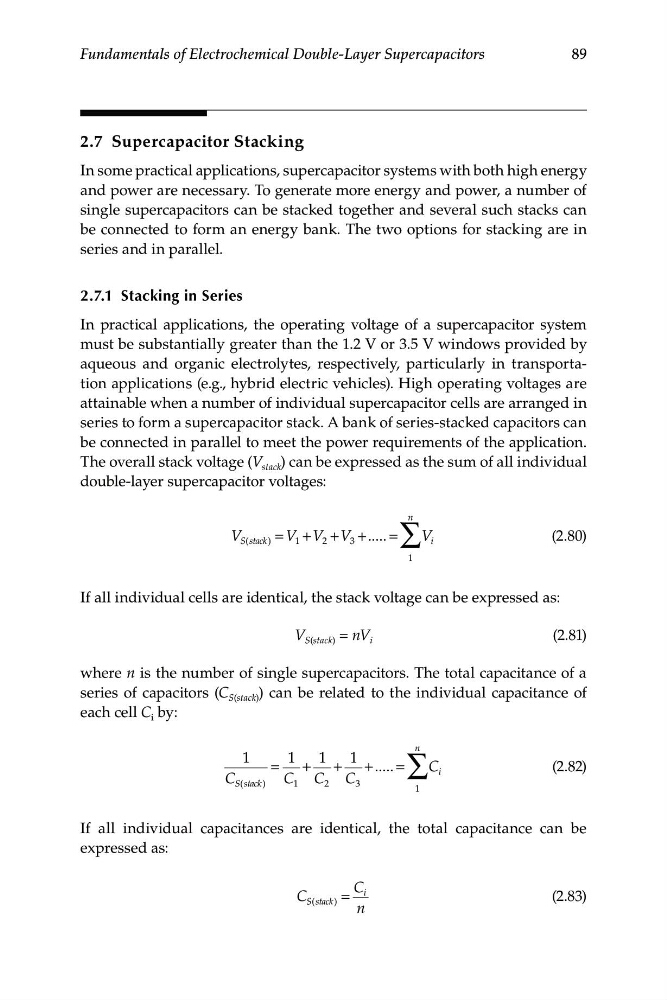
The overall stack voltage (V stack ) can be expressed as the sum of all individual
double-layer supercapacitor voltages:
n
V S stack) = V 1 + V 2 + V 3 + ..... = ∑ V i
(2.80)
(
1
If all individual cells are identical, the stack voltage can be expressed as:
V S(stack) = nV i
(2.81)
where n is the number of single supercapacitors. The total capacitance of a
series of capacitors (C S(stack) ) can be related to the individual capacitance of
each cell C i by:
1
1
1
1
n
=
+
+
+ ..... = ∑ C i
(2.82)
C
C C C
S stack)
1
2
3
(
1
If all individual capacitances are identical, the total capacitance can be
expressed as:
C i
C S s
( a k) =
(2.83)
t c
n
Fundamentals of Electrochemical Double-Layer Supercapacitors
2.7 Supercapacitor Stacking
In some practical applications, supercapacitor systems with both high energy
and power are necessary. To generate more energy and power, a number of
single supercapacitors can be stacked together and several such stacks can
be connected to form an energy bank. The two options for stacking are in
series and in parallel.
2.7.1 Stacking in Series
In practical applications, the operating voltage of a supercapacitor system
must be substantially greater than the 1.2 V or 3.5 V windows provided by
aqueous and organic electrolytes, respectively, particularly in transportation applications (e.g., hybrid electric vehicles). High operating voltages are
attainable when a number of individual supercapacitor cells are arranged in
series to form a supercapacitor stack. A bank of series-stacked capacitors can
be connected in parallel to meet the power requirements of the application.
The overall stack voltage (V stack ) can be expressed as the sum of all individual
double-layer supercapacitor voltages:
n
V S stack) = V 1 + V 2 + V 3 + ..... = ∑ V i
(2.80)
(
1
If all individual cells are identical, the stack voltage can be expressed as:
V S(stack) = nV i
(2.81)
where n is the number of single supercapacitors. The total capacitance of a
series of capacitors (C S(stack) ) can be related to the individual capacitance of
each cell C i by:
1
1
1
1
n
=
+
+
+ ..... = ∑ C i
(2.82)
C
C C C
S stack)
1
2
3
(
1
If all individual capacitances are identical, the total capacitance can be
expressed as:
C i
C S s
( a k) =
(2.83)
t c
n