

50
4 Epitaxial of III-Nitride LED Materials
On the other hand, the larger island has a tendency to absorb atoms due to its lower
chemical potential. As a result, the larger islands grow up by absorbing atoms, while
smaller islands disappear by losing atoms. Therefore, there is a net atomic flow from
the small island to the big island. The small island gradually shrinks and becomes
smaller, and eventually degrades and disappears; while the big island grows up. This
process seems like that the small island is being “eaten” gradually by the big island.
4.4.1.3 Growth Mode
The growth process of the film can be divided into three modes: Frank-vander
Merve or layer-by-layer (LBL, layered) growth, Volmer-Weber (island) growth, and
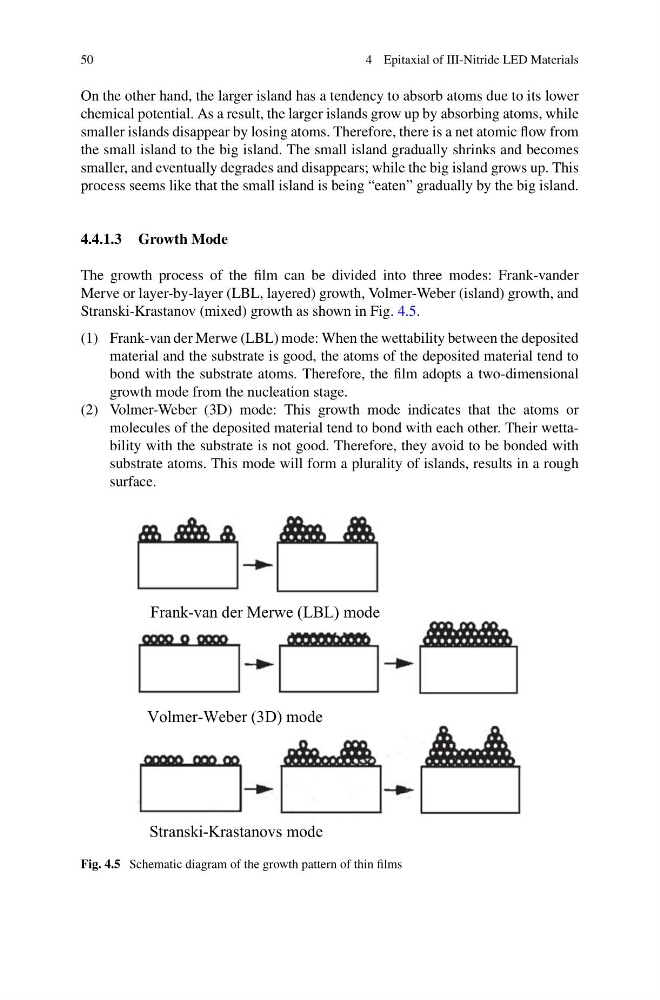
Stranski-Krastanov (mixed) growth as shown in Fig. 4.5.
(1) Frank-van der Merwe (LBL) mode: When the wettability between the deposited
material and the substrate is good, the atoms of the deposited material tend to
bond with the substrate atoms. Therefore, the film adopts a two-dimensional
growth mode from the nucleation stage.
(2) Volmer-Weber (3D) mode: This growth mode indicates that the atoms or
molecules of the deposited material tend to bond with each other. Their wettability with the substrate is not good. Therefore, they avoid to be bonded with
substrate atoms. This mode will form a plurality of islands, results in a rough
surface.
Frank-van der Merwe (LBL) mode
Volmer-Weber (3D) mode
Stranski-Krastanovs mode
Fig. 4.5 Schematic diagram of the growth pattern of thin films
4 Epitaxial of III-Nitride LED Materials
On the other hand, the larger island has a tendency to absorb atoms due to its lower
chemical potential. As a result, the larger islands grow up by absorbing atoms, while
smaller islands disappear by losing atoms. Therefore, there is a net atomic flow from
the small island to the big island. The small island gradually shrinks and becomes
smaller, and eventually degrades and disappears; while the big island grows up. This
process seems like that the small island is being “eaten” gradually by the big island.
4.4.1.3 Growth Mode
The growth process of the film can be divided into three modes: Frank-vander
Merve or layer-by-layer (LBL, layered) growth, Volmer-Weber (island) growth, and
Stranski-Krastanov (mixed) growth as shown in Fig. 4.5.
(1) Frank-van der Merwe (LBL) mode: When the wettability between the deposited
material and the substrate is good, the atoms of the deposited material tend to
bond with the substrate atoms. Therefore, the film adopts a two-dimensional
growth mode from the nucleation stage.
(2) Volmer-Weber (3D) mode: This growth mode indicates that the atoms or
molecules of the deposited material tend to bond with each other. Their wettability with the substrate is not good. Therefore, they avoid to be bonded with
substrate atoms. This mode will form a plurality of islands, results in a rough
surface.
Frank-van der Merwe (LBL) mode
Volmer-Weber (3D) mode
Stranski-Krastanovs mode
Fig. 4.5 Schematic diagram of the growth pattern of thin films