

4.3 Group III Nitride LED Epitaxial Technology
41
4.3.3.1 Principles of MOCVD
The epitaxial process of MOCVD:
1. Metal-organic such as TMGa and TMIn and non-metal hydrides are transported
into the reaction chamber through carrier gases such as N 2 and H 2 ;
2. The mixed source gas is transported on the surface of the heated substrate and
thermally decomposed;
3. Atoms from the chemical reaction are adsorbed on the surface of the substrate;
4. The reacting atomic cluster migrates to the nucleation site to form a stable
physical adsorption;
5. The by-product of the surface reaction leaves the surface of the substrate and is
pumped to the exhaust gas treatment system;
6. The source gas, which is not participating in the reaction, is taken out together
with the carrier gas to the exhaust gas treatment system.
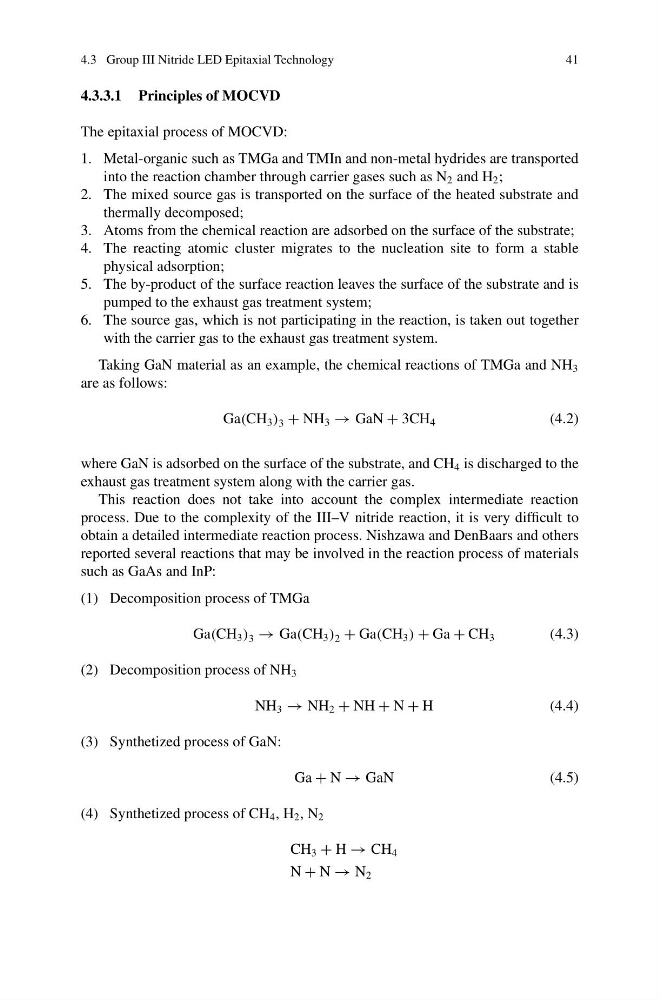
Taking GaN material as an example, the chemical reactions of TMGa and NH 3
are as follows:
Ga(CH 3 ) 3 + NH 3 → GaN + 3CH 4
(4.2)
where GaN is adsorbed on the surface of the substrate, and CH 4 is discharged to the
exhaust gas treatment system along with the carrier gas.
This reaction does not take into account the complex intermediate reaction
process. Due to the complexity of the III–V nitride reaction, it is very difficult to
obtain a detailed intermediate reaction process. Nishzawa and DenBaars and others
reported several reactions that may be involved in the reaction process of materials
such as GaAs and InP:
(1) Decomposition process of TMGa
Ga(CH 3 ) 3 → Ga(CH 3 ) 2 + Ga(CH 3 ) + Ga + CH 3
(4.3)
(2) Decomposition process of NH 3
NH 3 → NH 2 + NH + N + H
( 4 . 4 )
(3) Synthetized process of GaN:
Ga + N → GaN
(4.5)
(4) Synthetized process of CH 4 , H 2 , N 2
CH 3 + H → CH 4
N + N → N 2
41
4.3.3.1 Principles of MOCVD
The epitaxial process of MOCVD:
1. Metal-organic such as TMGa and TMIn and non-metal hydrides are transported
into the reaction chamber through carrier gases such as N 2 and H 2 ;
2. The mixed source gas is transported on the surface of the heated substrate and
thermally decomposed;
3. Atoms from the chemical reaction are adsorbed on the surface of the substrate;
4. The reacting atomic cluster migrates to the nucleation site to form a stable
physical adsorption;
5. The by-product of the surface reaction leaves the surface of the substrate and is
pumped to the exhaust gas treatment system;
6. The source gas, which is not participating in the reaction, is taken out together
with the carrier gas to the exhaust gas treatment system.
Taking GaN material as an example, the chemical reactions of TMGa and NH 3
are as follows:
Ga(CH 3 ) 3 + NH 3 → GaN + 3CH 4
(4.2)
where GaN is adsorbed on the surface of the substrate, and CH 4 is discharged to the
exhaust gas treatment system along with the carrier gas.
This reaction does not take into account the complex intermediate reaction
process. Due to the complexity of the III–V nitride reaction, it is very difficult to
obtain a detailed intermediate reaction process. Nishzawa and DenBaars and others
reported several reactions that may be involved in the reaction process of materials
such as GaAs and InP:
(1) Decomposition process of TMGa
Ga(CH 3 ) 3 → Ga(CH 3 ) 2 + Ga(CH 3 ) + Ga + CH 3
(4.3)
(2) Decomposition process of NH 3
NH 3 → NH 2 + NH + N + H
( 4 . 4 )
(3) Synthetized process of GaN:
Ga + N → GaN
(4.5)
(4) Synthetized process of CH 4 , H 2 , N 2
CH 3 + H → CH 4
N + N → N 2