

4.1 Basic Models of Epitaxial
35
4.1.3 2-D and 3-D Mixed Growth Mode (Stranski-Krastanob
Mode)
Epitaxial GaN film grown on sapphire substrate is typically of a 2-D and 3-D hybrid
growth mode. This is the intermediate state of the above two growth modes. The low
temperature nucleation layer provides a 3-D nucleation island, and the subsequent
GaN film epitaxially grows on these islands, resulting in a two-dimensional and
three-dimensional mixed growth. The high binding energy position close to the step
is a preferred position for the deposited atoms. If there is sufficient migration ability,
atom can be diffused to the step position to perform epitaxial growth with a step as
a medium.
Epitaxial GaN films on sapphire substrates generally have three steps as nucleation
sites for epitaxial growth of layered films.
1. The nucleation of the atomic group forms a step. The nucleation of the atomic
group is mainly a nucleation point formed at low temperature. In the high temperature state, the migration rate of the atomic group is high. In other words, the
atomic group is easy to decompose, and difficult to form a step for the atomic
group;
2. The internal dislocations form a step on the surface of the outcrop. In GaN
materials, the density of dislocations can be as high as 10
8 cm
−2 . The steps in
GaN materials are mainly formed by the outcrops of dislocations on the surface.
3. The offcut of the crystal forms a step. For a small offcut angle, the surface of
the substrate will form a number of steps with a certain periodic spacing. The
sapphire substrate we are using now has a certain offcut angle. When a GaN
thin film is epitaxially grown on a sapphire substrate using a (0001) plane, the
sapphire substrate is generally in the m [1010] direction where the offcut angle
is about 0.2°. The offcut angle is θ, the step height is h, and the step spacing is
L = h/ tan θ . In the GaN material, the offcut angle is 0.2°, and the step height
is assumed to be the thickness of one atomic layer, and the distance between the
steps is:
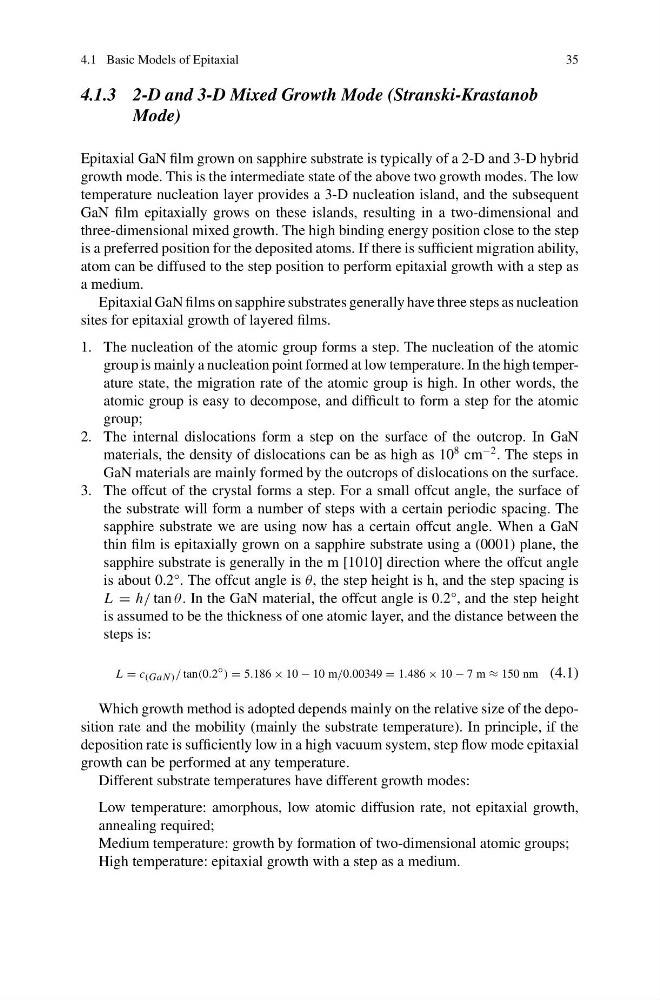
L = c (Ga N ) / tan(0.2 ◦ ) = 5.186 × 10 − 10 m/0.00349 = 1.486 × 10 − 7 m ≈ 150 nm (4.1)
Which growth method is adopted depends mainly on the relative size of the deposition rate and the mobility (mainly the substrate temperature). In principle, if the
deposition rate is sufficiently low in a high vacuum system, step flow mode epitaxial
growth can be performed at any temperature.
Different substrate temperatures have different growth modes:
Low temperature: amorphous, low atomic diffusion rate, not epitaxial growth,
annealing required;
Medium temperature: growth by formation of two-dimensional atomic groups;
High temperature: epitaxial growth with a step as a medium.
35
4.1.3 2-D and 3-D Mixed Growth Mode (Stranski-Krastanob
Mode)
Epitaxial GaN film grown on sapphire substrate is typically of a 2-D and 3-D hybrid
growth mode. This is the intermediate state of the above two growth modes. The low
temperature nucleation layer provides a 3-D nucleation island, and the subsequent
GaN film epitaxially grows on these islands, resulting in a two-dimensional and
three-dimensional mixed growth. The high binding energy position close to the step
is a preferred position for the deposited atoms. If there is sufficient migration ability,
atom can be diffused to the step position to perform epitaxial growth with a step as
a medium.
Epitaxial GaN films on sapphire substrates generally have three steps as nucleation
sites for epitaxial growth of layered films.
1. The nucleation of the atomic group forms a step. The nucleation of the atomic
group is mainly a nucleation point formed at low temperature. In the high temperature state, the migration rate of the atomic group is high. In other words, the
atomic group is easy to decompose, and difficult to form a step for the atomic
group;
2. The internal dislocations form a step on the surface of the outcrop. In GaN
materials, the density of dislocations can be as high as 10
8 cm
−2 . The steps in
GaN materials are mainly formed by the outcrops of dislocations on the surface.
3. The offcut of the crystal forms a step. For a small offcut angle, the surface of
the substrate will form a number of steps with a certain periodic spacing. The
sapphire substrate we are using now has a certain offcut angle. When a GaN
thin film is epitaxially grown on a sapphire substrate using a (0001) plane, the
sapphire substrate is generally in the m [1010] direction where the offcut angle
is about 0.2°. The offcut angle is θ, the step height is h, and the step spacing is
L = h/ tan θ . In the GaN material, the offcut angle is 0.2°, and the step height
is assumed to be the thickness of one atomic layer, and the distance between the
steps is:
L = c (Ga N ) / tan(0.2 ◦ ) = 5.186 × 10 − 10 m/0.00349 = 1.486 × 10 − 7 m ≈ 150 nm (4.1)
Which growth method is adopted depends mainly on the relative size of the deposition rate and the mobility (mainly the substrate temperature). In principle, if the
deposition rate is sufficiently low in a high vacuum system, step flow mode epitaxial
growth can be performed at any temperature.
Different substrate temperatures have different growth modes:
Low temperature: amorphous, low atomic diffusion rate, not epitaxial growth,
annealing required;
Medium temperature: growth by formation of two-dimensional atomic groups;
High temperature: epitaxial growth with a step as a medium.