

3.4 Test and Analysis of the Properties of Group III Nitride Materials
29
The elemental X-ray emission probability of the element with large atomic number
is large, but the Auger electron emission probability of the element with small atomic
number is large. The Auger electron spectroscopy method is more suitable for the
analysis of light elements.
X-ray Photoelectron Spectroscopy (XPS): X-ray photoelectron spectroscopy
uses high-energy X-rays as excitation sources to excite the photoelectron spectrum
of the inner electrons of the atom. Briefly, a beam of X-rays with a certain energy
irradiates a solid sample, where the incident photons interact with the sample. The
inner electrons absorb photon energy to overcome the binding energy and work function. The remaining energy is emitted as kinetic energy and becomes photoelectron.
This process is the photoelectric effect. Photoelectron energy is:
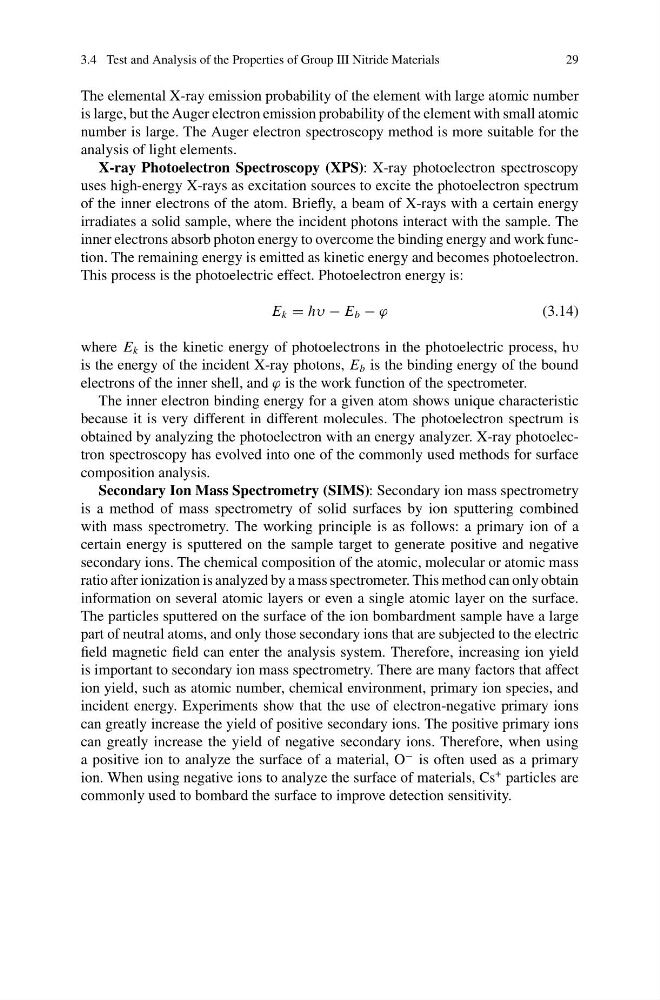
E k = hυ − E b − ϕ
(3.14)
where E k is the kinetic energy of photoelectrons in the photoelectric process, hυ
is the energy of the incident X-ray photons, E b is the binding energy of the bound
electrons of the inner shell, and ϕ is the work function of the spectrometer.
The inner electron binding energy for a given atom shows unique characteristic
because it is very different in different molecules. The photoelectron spectrum is
obtained by analyzing the photoelectron with an energy analyzer. X-ray photoelectron spectroscopy has evolved into one of the commonly used methods for surface
composition analysis.
Secondary Ion Mass Spectrometry (SIMS): Secondary ion mass spectrometry
is a method of mass spectrometry of solid surfaces by ion sputtering combined
with mass spectrometry. The working principle is as follows: a primary ion of a
certain energy is sputtered on the sample target to generate positive and negative
secondary ions. The chemical composition of the atomic, molecular or atomic mass
ratio after ionization is analyzed by a mass spectrometer. This method can only obtain
information on several atomic layers or even a single atomic layer on the surface.
The particles sputtered on the surface of the ion bombardment sample have a large
part of neutral atoms, and only those secondary ions that are subjected to the electric
field magnetic field can enter the analysis system. Therefore, increasing ion yield
is important to secondary ion mass spectrometry. There are many factors that affect
ion yield, such as atomic number, chemical environment, primary ion species, and
incident energy. Experiments show that the use of electron-negative primary ions
can greatly increase the yield of positive secondary ions. The positive primary ions
can greatly increase the yield of negative secondary ions. Therefore, when using
a positive ion to analyze the surface of a material, O
− is often used as a primary
ion. When using negative ions to analyze the surface of materials, Cs
+ particles are
commonly used to bombard the surface to improve detection sensitivity.
29
The elemental X-ray emission probability of the element with large atomic number
is large, but the Auger electron emission probability of the element with small atomic
number is large. The Auger electron spectroscopy method is more suitable for the
analysis of light elements.
X-ray Photoelectron Spectroscopy (XPS): X-ray photoelectron spectroscopy
uses high-energy X-rays as excitation sources to excite the photoelectron spectrum
of the inner electrons of the atom. Briefly, a beam of X-rays with a certain energy
irradiates a solid sample, where the incident photons interact with the sample. The
inner electrons absorb photon energy to overcome the binding energy and work function. The remaining energy is emitted as kinetic energy and becomes photoelectron.
This process is the photoelectric effect. Photoelectron energy is:
E k = hυ − E b − ϕ
(3.14)
where E k is the kinetic energy of photoelectrons in the photoelectric process, hυ
is the energy of the incident X-ray photons, E b is the binding energy of the bound
electrons of the inner shell, and ϕ is the work function of the spectrometer.
The inner electron binding energy for a given atom shows unique characteristic
because it is very different in different molecules. The photoelectron spectrum is
obtained by analyzing the photoelectron with an energy analyzer. X-ray photoelectron spectroscopy has evolved into one of the commonly used methods for surface
composition analysis.
Secondary Ion Mass Spectrometry (SIMS): Secondary ion mass spectrometry
is a method of mass spectrometry of solid surfaces by ion sputtering combined
with mass spectrometry. The working principle is as follows: a primary ion of a
certain energy is sputtered on the sample target to generate positive and negative
secondary ions. The chemical composition of the atomic, molecular or atomic mass
ratio after ionization is analyzed by a mass spectrometer. This method can only obtain
information on several atomic layers or even a single atomic layer on the surface.
The particles sputtered on the surface of the ion bombardment sample have a large
part of neutral atoms, and only those secondary ions that are subjected to the electric
field magnetic field can enter the analysis system. Therefore, increasing ion yield
is important to secondary ion mass spectrometry. There are many factors that affect
ion yield, such as atomic number, chemical environment, primary ion species, and
incident energy. Experiments show that the use of electron-negative primary ions
can greatly increase the yield of positive secondary ions. The positive primary ions
can greatly increase the yield of negative secondary ions. Therefore, when using
a positive ion to analyze the surface of a material, O
− is often used as a primary
ion. When using negative ions to analyze the surface of materials, Cs
+ particles are
commonly used to bombard the surface to improve detection sensitivity.