

274
12 Novel Nitride LED Technology
12.3.2 Principles of SP Coupling Enhanced LED
Since the DOS (density of state) of SP resonance is very high compared to vacuum
or dielectric, the energy of the radiation sources matches the SP resonance energy
when the radiation sources (the luminescent molecule or the electron-hole pair in
the LED) is in the SP’s evanescent field. The radiation source will transfer energy to
the SP through spontaneous emission at a very high speed, and then the energy
will be radiated by the SP. This process increases the radiation sources’ radiative recombination rate, which adds the competitiveness of the radiative process
to the non-radiative process, thereby improving the spontaneous emission efficiency.
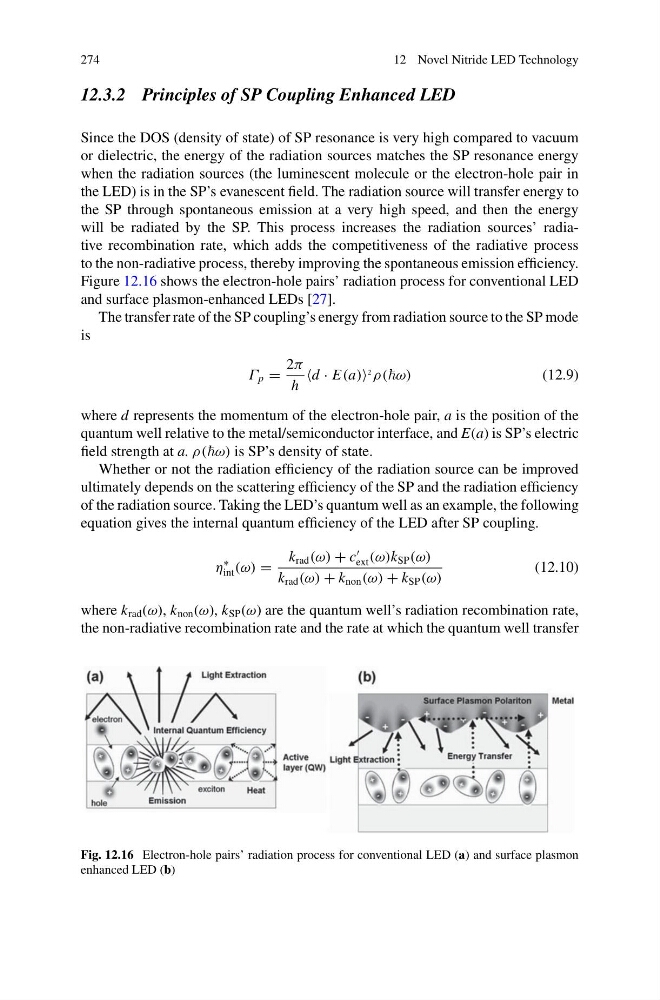
Figure 12.16 shows the electron-hole pairs’ radiation process for conventional LED
and surface plasmon-enhanced LEDs [27].
The transfer rate of the SP coupling’s energy from radiation source to the SP mode
is
Γ p =
2π
h
d · E(a)
2
ρ(ω)
(12.9)
where d represents the momentum of the electron-hole pair, a is the position of the
quantum well relative to the metal/semiconductor interface, and E(a) is SP’s electric
field strength at a. ρ(ω) is SP’s density of state.
Whether or not the radiation efficiency of the radiation source can be improved
ultimately depends on the scattering efficiency of the SP and the radiation efficiency
of the radiation source. Taking the LED’s quantum well as an example, the following
equation gives the internal quantum efficiency of the LED after SP coupling.
η
∗
int (ω) =
k rad (ω) + c
ext (ω)k SP (ω)
k rad (ω) + k non (ω) + k SP (ω)
(12.10)
where k rad (ω), k non (ω), k SP (ω) are the quantum well’s radiation recombination rate,
the non-radiative recombination rate and the rate at which the quantum well transfer
Fig. 12.16 Electron-hole pairs’ radiation process for conventional LED (a) and surface plasmon
enhanced LED (b)
12 Novel Nitride LED Technology
12.3.2 Principles of SP Coupling Enhanced LED
Since the DOS (density of state) of SP resonance is very high compared to vacuum
or dielectric, the energy of the radiation sources matches the SP resonance energy
when the radiation sources (the luminescent molecule or the electron-hole pair in
the LED) is in the SP’s evanescent field. The radiation source will transfer energy to
the SP through spontaneous emission at a very high speed, and then the energy
will be radiated by the SP. This process increases the radiation sources’ radiative recombination rate, which adds the competitiveness of the radiative process
to the non-radiative process, thereby improving the spontaneous emission efficiency.
Figure 12.16 shows the electron-hole pairs’ radiation process for conventional LED
and surface plasmon-enhanced LEDs [27].
The transfer rate of the SP coupling’s energy from radiation source to the SP mode
is
Γ p =
2π
h
d · E(a)
2
ρ(ω)
(12.9)
where d represents the momentum of the electron-hole pair, a is the position of the
quantum well relative to the metal/semiconductor interface, and E(a) is SP’s electric
field strength at a. ρ(ω) is SP’s density of state.
Whether or not the radiation efficiency of the radiation source can be improved
ultimately depends on the scattering efficiency of the SP and the radiation efficiency
of the radiation source. Taking the LED’s quantum well as an example, the following
equation gives the internal quantum efficiency of the LED after SP coupling.
η
∗
int (ω) =
k rad (ω) + c
ext (ω)k SP (ω)
k rad (ω) + k non (ω) + k SP (ω)
(12.10)
where k rad (ω), k non (ω), k SP (ω) are the quantum well’s radiation recombination rate,
the non-radiative recombination rate and the rate at which the quantum well transfer
Fig. 12.16 Electron-hole pairs’ radiation process for conventional LED (a) and surface plasmon
enhanced LED (b)