

272
12 Novel Nitride LED Technology
be stimulated by the radiation to the interface. The coupling of the SPP and photons
can be enhanced by using rough metal surface or grating structure which can increase
the scattering of the light by SPP.
In the case of metal particles, the surface plasmons cannot propagate along the
interface in the form of waves, but are localized near the surface of the particles. This
is called “LSP”, and the electrons will collectively oscillate when they resonate with
the electromagnetic waves. LSP is another different excited state compared to the
SPP. The SPP can propagate at the interface and obey the dispersion relationship.
While the LSP is restrained near the metal particles, it has one or more discrete
resonance modes and resonance energy. The energy of the LSP is determined by the
shape, size, and medium environment of the metal. LSP can resonate with energymatching photons without too many concerns about the wave vector of the excitation
light. Therefore, LSP can easily dissipate in the form of radiated photons. While only
the SPP satisfying the energy-momentum conservation can radiate photons.
LSP can also be seen as the feature of metal surface. If there are nano metal
particles on the metal surface or the metal surface is rough, SPP and LSP can coexist.
When the resonance frequency of the two is close, the LSP on the rough surface will
strongly influence the behavior of SPP. The LSP can both dissipate and excite the
SPP. Therefore, LSP can enhance the scattering and excitation of the SPP.
12.3.1.2 LSP’s Energy Dissipation
LSP’s energy dissipation can be divided into three categories: scattering, absorption,
and pure dephasing dissipation. Scattering is to radiate surface plasmons’ energy in
the form of photons. Absorption is the process of energy relaxation which converts
energy into heat energy through internal dissipation. Pure dephasing dissipation refers
to the energy dissipation caused by the elastic scattering of SP’s energy quantum.
The scattering causes the collapse of the phase relationship between SP and the
excited electromagnetic field. Experiments show that this kind of energy dissipation
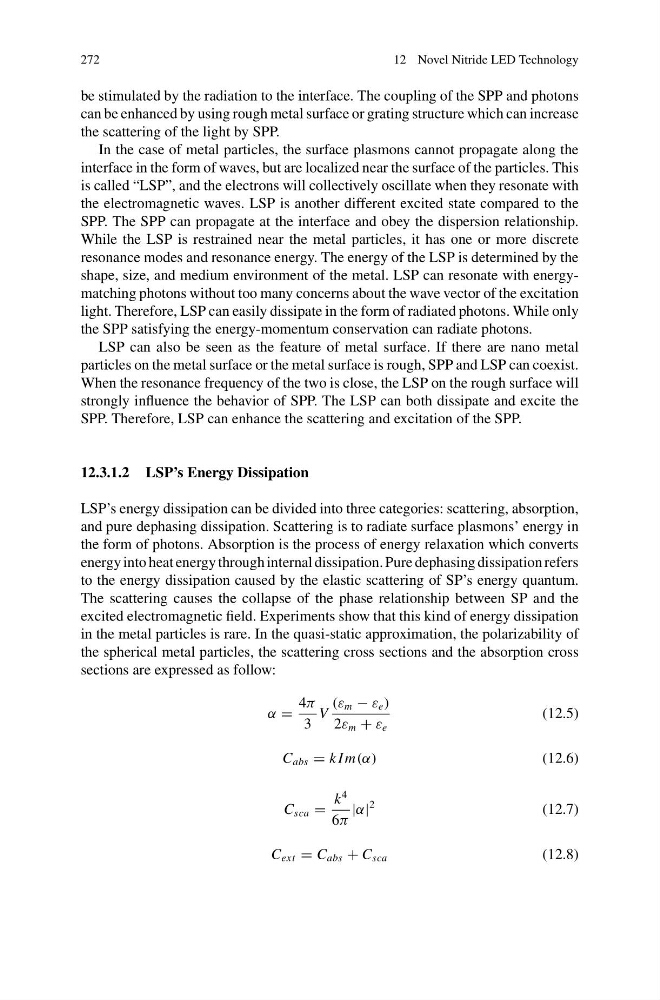
in the metal particles is rare. In the quasi-static approximation, the polarizability of
the spherical metal particles, the scattering cross sections and the absorption cross
sections are expressed as follow:
α =
4π
3
V
(ε m − ε e )
2ε m + ε e
(12.5)
C abs = k I m(α)
(12.6)
C sca =
k
4
6π
|α|
2
(12.7)
C ext = C abs + C sca
(12.8)
12 Novel Nitride LED Technology
be stimulated by the radiation to the interface. The coupling of the SPP and photons
can be enhanced by using rough metal surface or grating structure which can increase
the scattering of the light by SPP.
In the case of metal particles, the surface plasmons cannot propagate along the
interface in the form of waves, but are localized near the surface of the particles. This
is called “LSP”, and the electrons will collectively oscillate when they resonate with
the electromagnetic waves. LSP is another different excited state compared to the
SPP. The SPP can propagate at the interface and obey the dispersion relationship.
While the LSP is restrained near the metal particles, it has one or more discrete
resonance modes and resonance energy. The energy of the LSP is determined by the
shape, size, and medium environment of the metal. LSP can resonate with energymatching photons without too many concerns about the wave vector of the excitation
light. Therefore, LSP can easily dissipate in the form of radiated photons. While only
the SPP satisfying the energy-momentum conservation can radiate photons.
LSP can also be seen as the feature of metal surface. If there are nano metal
particles on the metal surface or the metal surface is rough, SPP and LSP can coexist.
When the resonance frequency of the two is close, the LSP on the rough surface will
strongly influence the behavior of SPP. The LSP can both dissipate and excite the
SPP. Therefore, LSP can enhance the scattering and excitation of the SPP.
12.3.1.2 LSP’s Energy Dissipation
LSP’s energy dissipation can be divided into three categories: scattering, absorption,
and pure dephasing dissipation. Scattering is to radiate surface plasmons’ energy in
the form of photons. Absorption is the process of energy relaxation which converts
energy into heat energy through internal dissipation. Pure dephasing dissipation refers
to the energy dissipation caused by the elastic scattering of SP’s energy quantum.
The scattering causes the collapse of the phase relationship between SP and the
excited electromagnetic field. Experiments show that this kind of energy dissipation
in the metal particles is rare. In the quasi-static approximation, the polarizability of
the spherical metal particles, the scattering cross sections and the absorption cross
sections are expressed as follow:
α =
4π
3
V
(ε m − ε e )
2ε m + ε e
(12.5)
C abs = k I m(α)
(12.6)
C sca =
k
4
6π
|α|
2
(12.7)
C ext = C abs + C sca
(12.8)