

222
10 Reliability Analysis of Group III Nitride LEDs Devices
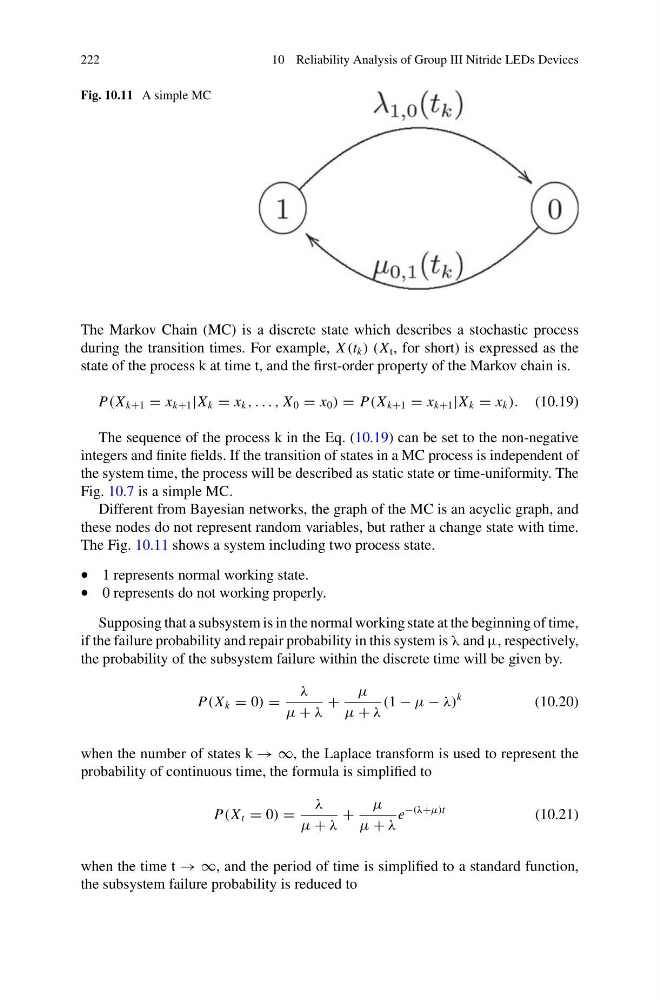
Fig. 10.11 A simple MC
The Markov Chain (MC) is a discrete state which describes a stochastic process
during the transition times. For example, X (t k ) (X t , for short) is expressed as the
state of the process k at time t, and the first-order property of the Markov chain is.
P(X k+1 = x k+1 |X k = x k , . . . , X 0 = x 0 ) = P(X k+1 = x k+1 |X k = x k ). (10.19)
The sequence of the process k in the Eq. (10.19) can be set to the non-negative
integers and finite fields. If the transition of states in a MC process is independent of
the system time, the process will be described as static state or time-uniformity. The
Fig. 10.7 is a simple MC.
Different from Bayesian networks, the graph of the MC is an acyclic graph, and
these nodes do not represent random variables, but rather a change state with time.
The Fig. 10.11 shows a system including two process state.
• 1 represents normal working state.
• 0 represents do not working properly.
Supposing that a subsystem is in the normal working state at the beginning of time,
if the failure probability and repair probability in this system is λ and μ, respectively,
the probability of the subsystem failure within the discrete time will be given by.
P(X k = 0) =
λ
μ + λ
+
μ
μ + λ
(1 − μ − λ)
k
(10.20)
when the number of states k → ∞, the Laplace transform is used to represent the
probability of continuous time, the formula is simplified to
P(X t = 0) =
λ
μ + λ
+
μ
μ + λ
e
−(λ+μ)t
(10.21)
when the time t → ∞, and the period of time is simplified to a standard function,
the subsystem failure probability is reduced to
10 Reliability Analysis of Group III Nitride LEDs Devices
Fig. 10.11 A simple MC
The Markov Chain (MC) is a discrete state which describes a stochastic process
during the transition times. For example, X (t k ) (X t , for short) is expressed as the
state of the process k at time t, and the first-order property of the Markov chain is.
P(X k+1 = x k+1 |X k = x k , . . . , X 0 = x 0 ) = P(X k+1 = x k+1 |X k = x k ). (10.19)
The sequence of the process k in the Eq. (10.19) can be set to the non-negative
integers and finite fields. If the transition of states in a MC process is independent of
the system time, the process will be described as static state or time-uniformity. The
Fig. 10.7 is a simple MC.
Different from Bayesian networks, the graph of the MC is an acyclic graph, and
these nodes do not represent random variables, but rather a change state with time.
The Fig. 10.11 shows a system including two process state.
• 1 represents normal working state.
• 0 represents do not working properly.
Supposing that a subsystem is in the normal working state at the beginning of time,
if the failure probability and repair probability in this system is λ and μ, respectively,
the probability of the subsystem failure within the discrete time will be given by.
P(X k = 0) =
λ
μ + λ
+
μ
μ + λ
(1 − μ − λ)
k
(10.20)
when the number of states k → ∞, the Laplace transform is used to represent the
probability of continuous time, the formula is simplified to
P(X t = 0) =
λ
μ + λ
+
μ
μ + λ
e
−(λ+μ)t
(10.21)
when the time t → ∞, and the period of time is simplified to a standard function,
the subsystem failure probability is reduced to