

212
10 Reliability Analysis of Group III Nitride LEDs Devices
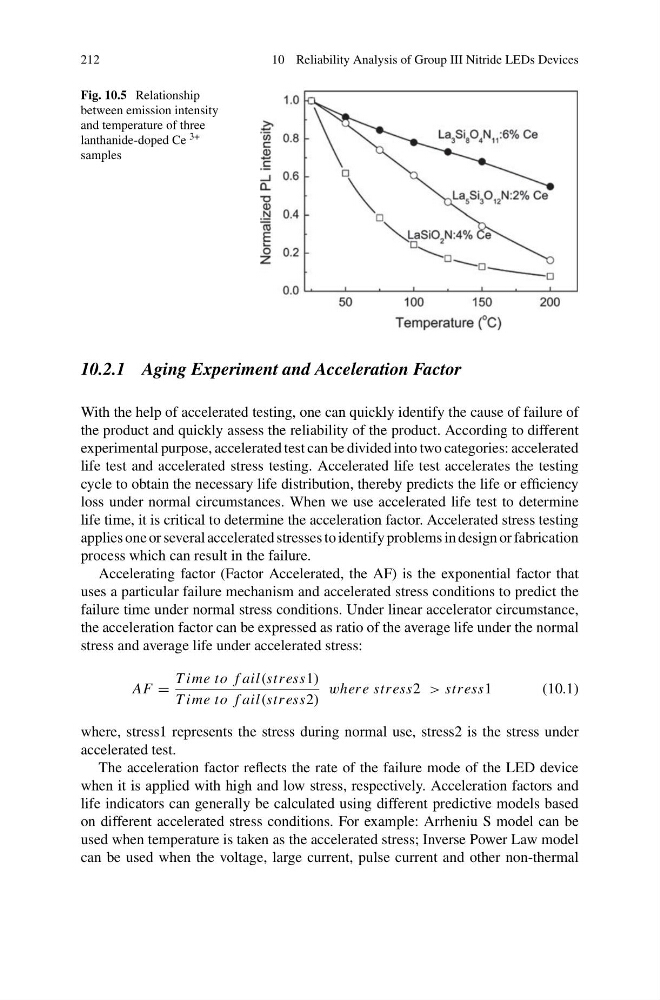
Fig. 10.5 Relationship
between emission intensity
and temperature of three
lanthanide-doped Ce 3+
samples
10.2.1 Aging Experiment and Acceleration Factor
With the help of accelerated testing, one can quickly identify the cause of failure of
the product and quickly assess the reliability of the product. According to different
experimental purpose, accelerated test can be divided into two categories: accelerated
life test and accelerated stress testing. Accelerated life test accelerates the testing
cycle to obtain the necessary life distribution, thereby predicts the life or efficiency
loss under normal circumstances. When we use accelerated life test to determine
life time, it is critical to determine the acceleration factor. Accelerated stress testing
applies one or several accelerated stresses to identify problems in design or fabrication
process which can result in the failure.
Accelerating factor (Factor Accelerated, the AF) is the exponential factor that
uses a particular failure mechanism and accelerated stress conditions to predict the
failure time under normal stress conditions. Under linear accelerator circumstance,
the acceleration factor can be expressed as ratio of the average life under the normal
stress and average life under accelerated stress:
AF =
T ime to f ail(stress1)
T ime to f ail(stress2)
where stress2 > stress1
(10.1)
where, stress1 represents the stress during normal use, stress2 is the stress under
accelerated test.
The acceleration factor reflects the rate of the failure mode of the LED device
when it is applied with high and low stress, respectively. Acceleration factors and
life indicators can generally be calculated using different predictive models based
on different accelerated stress conditions. For example: Arrheniu S model can be
used when temperature is taken as the accelerated stress; Inverse Power Law model
can be used when the voltage, large current, pulse current and other non-thermal
10 Reliability Analysis of Group III Nitride LEDs Devices
Fig. 10.5 Relationship
between emission intensity
and temperature of three
lanthanide-doped Ce 3+
samples
10.2.1 Aging Experiment and Acceleration Factor
With the help of accelerated testing, one can quickly identify the cause of failure of
the product and quickly assess the reliability of the product. According to different
experimental purpose, accelerated test can be divided into two categories: accelerated
life test and accelerated stress testing. Accelerated life test accelerates the testing
cycle to obtain the necessary life distribution, thereby predicts the life or efficiency
loss under normal circumstances. When we use accelerated life test to determine
life time, it is critical to determine the acceleration factor. Accelerated stress testing
applies one or several accelerated stresses to identify problems in design or fabrication
process which can result in the failure.
Accelerating factor (Factor Accelerated, the AF) is the exponential factor that
uses a particular failure mechanism and accelerated stress conditions to predict the
failure time under normal stress conditions. Under linear accelerator circumstance,
the acceleration factor can be expressed as ratio of the average life under the normal
stress and average life under accelerated stress:
AF =
T ime to f ail(stress1)
T ime to f ail(stress2)
where stress2 > stress1
(10.1)
where, stress1 represents the stress during normal use, stress2 is the stress under
accelerated test.
The acceleration factor reflects the rate of the failure mode of the LED device
when it is applied with high and low stress, respectively. Acceleration factors and
life indicators can generally be calculated using different predictive models based
on different accelerated stress conditions. For example: Arrheniu S model can be
used when temperature is taken as the accelerated stress; Inverse Power Law model
can be used when the voltage, large current, pulse current and other non-thermal