

10.1 Failure Mode and Failure Analysis
209
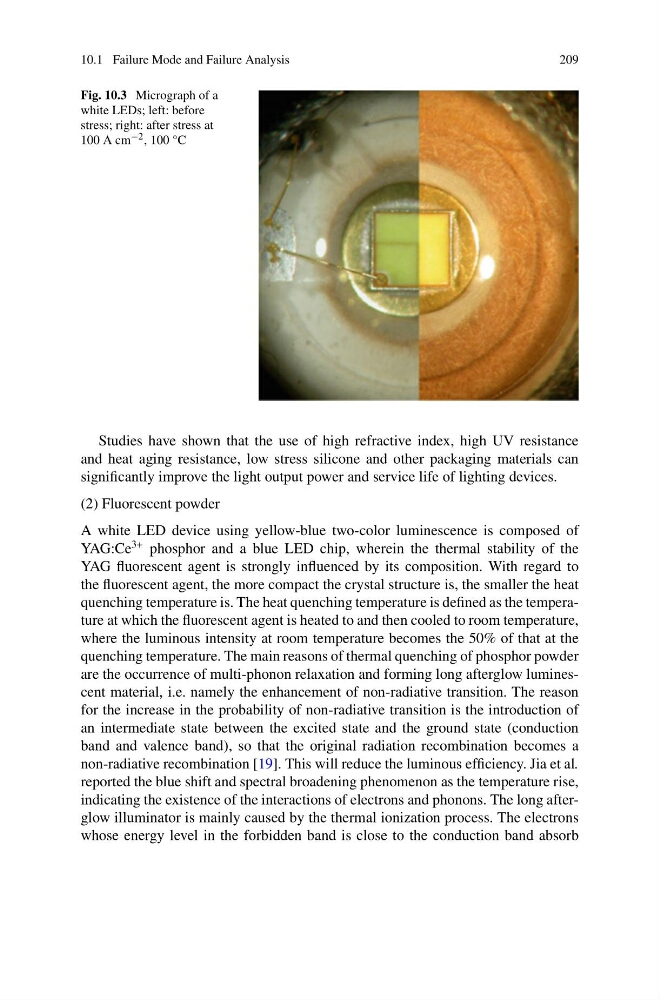
Fig. 10.3 Micrograph of a
white LEDs; left: before
stress; right: after stress at
100 A cm −2 , 100 °C
Studies have shown that the use of high refractive index, high UV resistance
and heat aging resistance, low stress silicone and other packaging materials can
significantly improve the light output power and service life of lighting devices.
(2) Fluorescent powder
A white LED device using yellow-blue two-color luminescence is composed of
YAG:Ce
3+ phosphor and a blue LED chip, wherein the thermal stability of the
YAG fluorescent agent is strongly influenced by its composition. With regard to
the fluorescent agent, the more compact the crystal structure is, the smaller the heat
quenching temperature is. The heat quenching temperature is defined as the temperature at which the fluorescent agent is heated to and then cooled to room temperature,
where the luminous intensity at room temperature becomes the 50% of that at the
quenching temperature. The main reasons of thermal quenching of phosphor powder
are the occurrence of multi-phonon relaxation and forming long afterglow luminescent material, i.e. namely the enhancement of non-radiative transition. The reason
for the increase in the probability of non-radiative transition is the introduction of
an intermediate state between the excited state and the ground state (conduction
band and valence band), so that the original radiation recombination becomes a
non-radiative recombination [19]. This will reduce the luminous efficiency. Jia et al.
reported the blue shift and spectral broadening phenomenon as the temperature rise,
indicating the existence of the interactions of electrons and phonons. The long afterglow illuminator is mainly caused by the thermal ionization process. The electrons
whose energy level in the forbidden band is close to the conduction band absorb
209
Fig. 10.3 Micrograph of a
white LEDs; left: before
stress; right: after stress at
100 A cm −2 , 100 °C
Studies have shown that the use of high refractive index, high UV resistance
and heat aging resistance, low stress silicone and other packaging materials can
significantly improve the light output power and service life of lighting devices.
(2) Fluorescent powder
A white LED device using yellow-blue two-color luminescence is composed of
YAG:Ce
3+ phosphor and a blue LED chip, wherein the thermal stability of the
YAG fluorescent agent is strongly influenced by its composition. With regard to
the fluorescent agent, the more compact the crystal structure is, the smaller the heat
quenching temperature is. The heat quenching temperature is defined as the temperature at which the fluorescent agent is heated to and then cooled to room temperature,
where the luminous intensity at room temperature becomes the 50% of that at the
quenching temperature. The main reasons of thermal quenching of phosphor powder
are the occurrence of multi-phonon relaxation and forming long afterglow luminescent material, i.e. namely the enhancement of non-radiative transition. The reason
for the increase in the probability of non-radiative transition is the introduction of
an intermediate state between the excited state and the ground state (conduction
band and valence band), so that the original radiation recombination becomes a
non-radiative recombination [19]. This will reduce the luminous efficiency. Jia et al.
reported the blue shift and spectral broadening phenomenon as the temperature rise,
indicating the existence of the interactions of electrons and phonons. The long afterglow illuminator is mainly caused by the thermal ionization process. The electrons
whose energy level in the forbidden band is close to the conduction band absorb