

10.1 Failure Mode and Failure Analysis
207
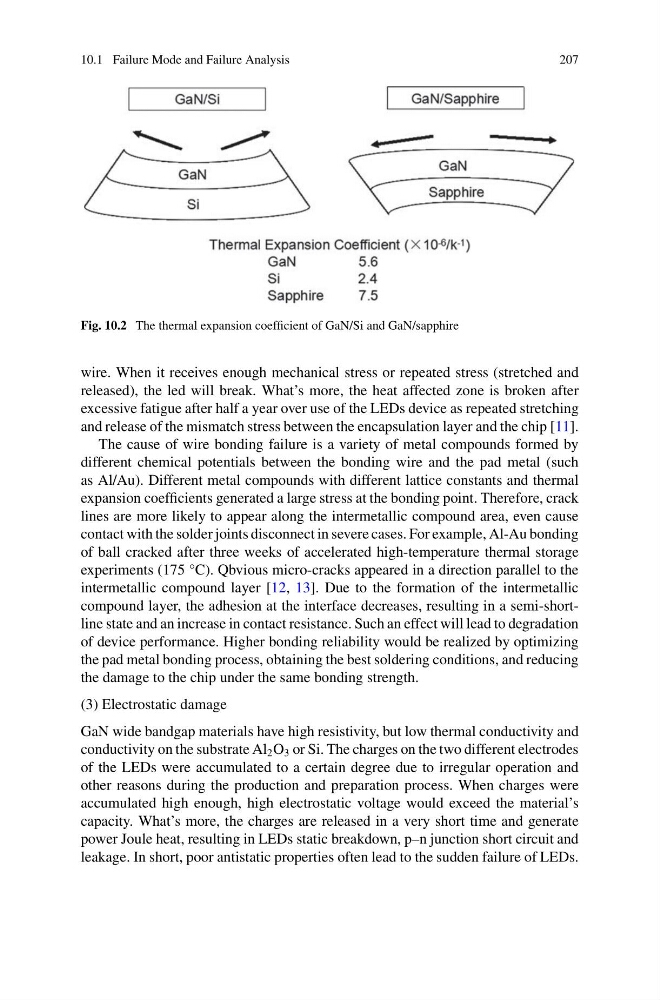
Fig. 10.2 The thermal expansion coefficient of GaN/Si and GaN/sapphire
wire. When it receives enough mechanical stress or repeated stress (stretched and
released), the led will break. What’s more, the heat affected zone is broken after
excessive fatigue after half a year over use of the LEDs device as repeated stretching
and release of the mismatch stress between the encapsulation layer and the chip [11].
The cause of wire bonding failure is a variety of metal compounds formed by
different chemical potentials between the bonding wire and the pad metal (such
as Al/Au). Different metal compounds with different lattice constants and thermal
expansion coefficients generated a large stress at the bonding point. Therefore, crack
lines are more likely to appear along the intermetallic compound area, even cause
contact with the solder joints disconnect in severe cases. For example, Al-Au bonding
of ball cracked after three weeks of accelerated high-temperature thermal storage
experiments (175 °C). Qbvious micro-cracks appeared in a direction parallel to the
intermetallic compound layer [12, 13]. Due to the formation of the intermetallic
compound layer, the adhesion at the interface decreases, resulting in a semi-shortline state and an increase in contact resistance. Such an effect will lead to degradation
of device performance. Higher bonding reliability would be realized by optimizing
the pad metal bonding process, obtaining the best soldering conditions, and reducing
the damage to the chip under the same bonding strength.
(3) Electrostatic damage
GaN wide bandgap materials have high resistivity, but low thermal conductivity and
conductivity on the substrate Al 2 O 3 or Si. The charges on the two different electrodes
of the LEDs were accumulated to a certain degree due to irregular operation and
other reasons during the production and preparation process. When charges were
accumulated high enough, high electrostatic voltage would exceed the material’s
capacity. What’s more, the charges are released in a very short time and generate
power Joule heat, resulting in LEDs static breakdown, p–n junction short circuit and
leakage. In short, poor antistatic properties often lead to the sudden failure of LEDs.
207
Fig. 10.2 The thermal expansion coefficient of GaN/Si and GaN/sapphire
wire. When it receives enough mechanical stress or repeated stress (stretched and
released), the led will break. What’s more, the heat affected zone is broken after
excessive fatigue after half a year over use of the LEDs device as repeated stretching
and release of the mismatch stress between the encapsulation layer and the chip [11].
The cause of wire bonding failure is a variety of metal compounds formed by
different chemical potentials between the bonding wire and the pad metal (such
as Al/Au). Different metal compounds with different lattice constants and thermal
expansion coefficients generated a large stress at the bonding point. Therefore, crack
lines are more likely to appear along the intermetallic compound area, even cause
contact with the solder joints disconnect in severe cases. For example, Al-Au bonding
of ball cracked after three weeks of accelerated high-temperature thermal storage
experiments (175 °C). Qbvious micro-cracks appeared in a direction parallel to the
intermetallic compound layer [12, 13]. Due to the formation of the intermetallic
compound layer, the adhesion at the interface decreases, resulting in a semi-shortline state and an increase in contact resistance. Such an effect will lead to degradation
of device performance. Higher bonding reliability would be realized by optimizing
the pad metal bonding process, obtaining the best soldering conditions, and reducing
the damage to the chip under the same bonding strength.
(3) Electrostatic damage
GaN wide bandgap materials have high resistivity, but low thermal conductivity and
conductivity on the substrate Al 2 O 3 or Si. The charges on the two different electrodes
of the LEDs were accumulated to a certain degree due to irregular operation and
other reasons during the production and preparation process. When charges were
accumulated high enough, high electrostatic voltage would exceed the material’s
capacity. What’s more, the charges are released in a very short time and generate
power Joule heat, resulting in LEDs static breakdown, p–n junction short circuit and
leakage. In short, poor antistatic properties often lead to the sudden failure of LEDs.