

10.1 Failure Mode and Failure Analysis
205
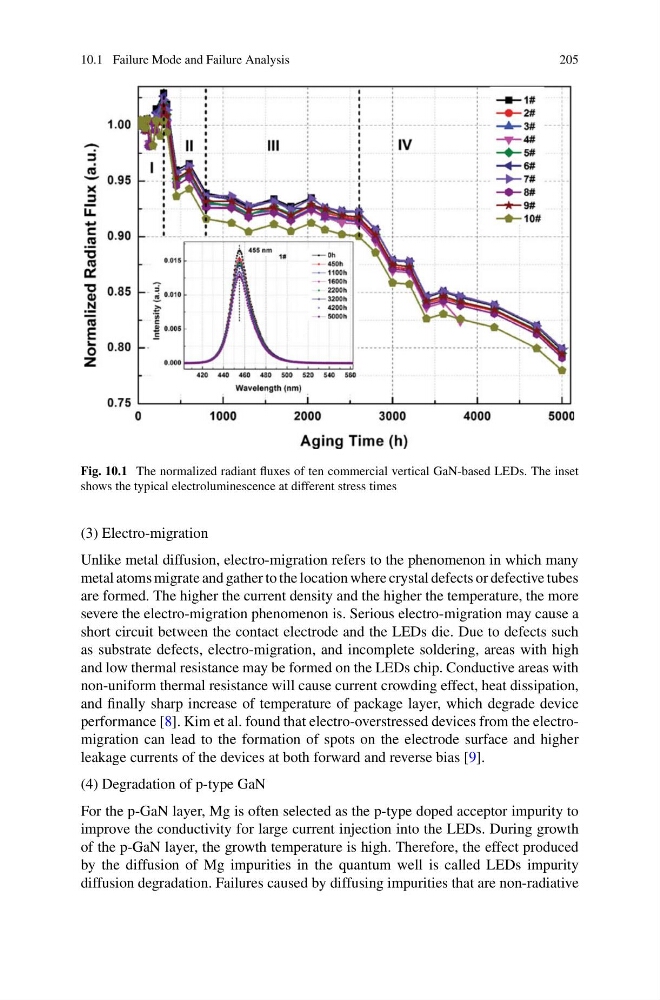
Fig. 10.1 The normalized radiant fluxes of ten commercial vertical GaN-based LEDs. The inset
shows the typical electroluminescence at different stress times
(3) Electro-migration
Unlike metal diffusion, electro-migration refers to the phenomenon in which many
metal atoms migrate and gather to the location where crystal defects or defective tubes
are formed. The higher the current density and the higher the temperature, the more
severe the electro-migration phenomenon is. Serious electro-migration may cause a
short circuit between the contact electrode and the LEDs die. Due to defects such
as substrate defects, electro-migration, and incomplete soldering, areas with high
and low thermal resistance may be formed on the LEDs chip. Conductive areas with
non-uniform thermal resistance will cause current crowding effect, heat dissipation,
and finally sharp increase of temperature of package layer, which degrade device
performance [8]. Kim et al. found that electro-overstressed devices from the electromigration can lead to the formation of spots on the electrode surface and higher
leakage currents of the devices at both forward and reverse bias [9].
(4) Degradation of p-type GaN
For the p-GaN layer, Mg is often selected as the p-type doped acceptor impurity to
improve the conductivity for large current injection into the LEDs. During growth
of the p-GaN layer, the growth temperature is high. Therefore, the effect produced
by the diffusion of Mg impurities in the quantum well is called LEDs impurity
diffusion degradation. Failures caused by diffusing impurities that are non-radiative
205
Fig. 10.1 The normalized radiant fluxes of ten commercial vertical GaN-based LEDs. The inset
shows the typical electroluminescence at different stress times
(3) Electro-migration
Unlike metal diffusion, electro-migration refers to the phenomenon in which many
metal atoms migrate and gather to the location where crystal defects or defective tubes
are formed. The higher the current density and the higher the temperature, the more
severe the electro-migration phenomenon is. Serious electro-migration may cause a
short circuit between the contact electrode and the LEDs die. Due to defects such
as substrate defects, electro-migration, and incomplete soldering, areas with high
and low thermal resistance may be formed on the LEDs chip. Conductive areas with
non-uniform thermal resistance will cause current crowding effect, heat dissipation,
and finally sharp increase of temperature of package layer, which degrade device
performance [8]. Kim et al. found that electro-overstressed devices from the electromigration can lead to the formation of spots on the electrode surface and higher
leakage currents of the devices at both forward and reverse bias [9].
(4) Degradation of p-type GaN
For the p-GaN layer, Mg is often selected as the p-type doped acceptor impurity to
improve the conductivity for large current injection into the LEDs. During growth
of the p-GaN layer, the growth temperature is high. Therefore, the effect produced
by the diffusion of Mg impurities in the quantum well is called LEDs impurity
diffusion degradation. Failures caused by diffusing impurities that are non-radiative