

166
8 III-Nitride LED Chip Fabrication Techniques
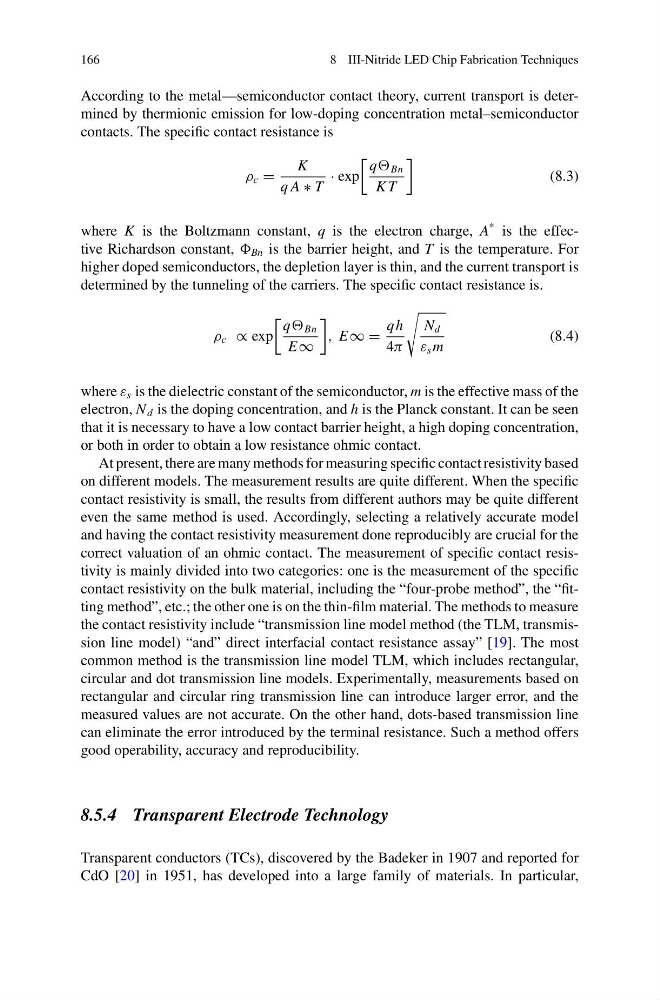
According to the metal—semiconductor contact theory, current transport is determined by thermionic emission for low-doping concentration metal–semiconductor
contacts. The specific contact resistance is
ρ c =
K
q A ∗ T
· exp
q Bn
K T
(8.3)
where K is the Boltzmann constant, q is the electron charge, A
* is the effective Richardson constant, Bn is the barrier height, and T is the temperature. For
higher doped semiconductors, the depletion layer is thin, and the current transport is
determined by the tunneling of the carriers. The specific contact resistance is.
ρ c ∝ exp
q Bn
E∞
, E∞ =
qh
4π
N d
ε s m
(8.4)
where ε s is the dielectric constant of the semiconductor, m is the effective mass of the
electron, N d is the doping concentration, and h is the Planck constant. It can be seen
that it is necessary to have a low contact barrier height, a high doping concentration,
or both in order to obtain a low resistance ohmic contact.
At present, there are many methods for measuring specific contact resistivity based
on different models. The measurement results are quite different. When the specific
contact resistivity is small, the results from different authors may be quite different
even the same method is used. Accordingly, selecting a relatively accurate model
and having the contact resistivity measurement done reproducibly are crucial for the
correct valuation of an ohmic contact. The measurement of specific contact resistivity is mainly divided into two categories: one is the measurement of the specific
contact resistivity on the bulk material, including the “four-probe method”, the “fitting method”, etc.; the other one is on the thin-film material. The methods to measure
the contact resistivity include “transmission line model method (the TLM, transmission line model) “and” direct interfacial contact resistance assay” [19]. The most
common method is the transmission line model TLM, which includes rectangular,
circular and dot transmission line models. Experimentally, measurements based on
rectangular and circular ring transmission line can introduce larger error, and the
measured values are not accurate. On the other hand, dots-based transmission line
can eliminate the error introduced by the terminal resistance. Such a method offers
good operability, accuracy and reproducibility.
8.5.4 Transparent Electrode Technology
Transparent conductors (TCs), discovered by the Badeker in 1907 and reported for
CdO [20] in 1951, has developed into a large family of materials. In particular,
8 III-Nitride LED Chip Fabrication Techniques
According to the metal—semiconductor contact theory, current transport is determined by thermionic emission for low-doping concentration metal–semiconductor
contacts. The specific contact resistance is
ρ c =
K
q A ∗ T
· exp
q Bn
K T
(8.3)
where K is the Boltzmann constant, q is the electron charge, A
* is the effective Richardson constant, Bn is the barrier height, and T is the temperature. For
higher doped semiconductors, the depletion layer is thin, and the current transport is
determined by the tunneling of the carriers. The specific contact resistance is.
ρ c ∝ exp
q Bn
E∞
, E∞ =
qh
4π
N d
ε s m
(8.4)
where ε s is the dielectric constant of the semiconductor, m is the effective mass of the
electron, N d is the doping concentration, and h is the Planck constant. It can be seen
that it is necessary to have a low contact barrier height, a high doping concentration,
or both in order to obtain a low resistance ohmic contact.
At present, there are many methods for measuring specific contact resistivity based
on different models. The measurement results are quite different. When the specific
contact resistivity is small, the results from different authors may be quite different
even the same method is used. Accordingly, selecting a relatively accurate model
and having the contact resistivity measurement done reproducibly are crucial for the
correct valuation of an ohmic contact. The measurement of specific contact resistivity is mainly divided into two categories: one is the measurement of the specific
contact resistivity on the bulk material, including the “four-probe method”, the “fitting method”, etc.; the other one is on the thin-film material. The methods to measure
the contact resistivity include “transmission line model method (the TLM, transmission line model) “and” direct interfacial contact resistance assay” [19]. The most
common method is the transmission line model TLM, which includes rectangular,
circular and dot transmission line models. Experimentally, measurements based on
rectangular and circular ring transmission line can introduce larger error, and the
measured values are not accurate. On the other hand, dots-based transmission line
can eliminate the error introduced by the terminal resistance. Such a method offers
good operability, accuracy and reproducibility.
8.5.4 Transparent Electrode Technology
Transparent conductors (TCs), discovered by the Badeker in 1907 and reported for
CdO [20] in 1951, has developed into a large family of materials. In particular,