

132
7 III-Nitride LED Quantum Efficiency Improvement Technology
R = (n 0 − n
2
1
n s )
2
(n 0 + n
2
1
n s )
2
(7.9)
The larger the n
2
1
n s , the higher the reflectivity is. In practice, however, the
refractive index is limited. The maximum achievable reflectivity of monolayer film
does not exceed 50%.
If a dielectric multilayer film of high and low refractive index is used for each
layer with thickness of λ 0
4, a higher reflectance can be obtained. This is because
the beams reflected from all interfaces of the layer have the same phase when they
return to the front surface, resulting in constructive interference. For such a group of
dielectric film systems, it is theoretically expected to get close to 100% reflectivity
[27].
If the n H and n L is the refractive index of the high and low refractive index layers,
where the outermost layer on both sides of the dielectric film is a high refractive
index layer and the thickness of each layer is λ 0
4, the maximum reflectance at
normal incidence for the center wavelength λ 0 is:
R =
1 − (n H
n L )
2S
(n
2
H
n S )
1 + (n H
n L ) 2S (n
2
H
n S )
(7.10)
Obviously, the larger the
n H
n L
ratio, or the more the number of layers, the higher
the reflectance R is. In theory, as long as the number of layers in the film system can
be increased, the reflectivity can be infinitely close to 100% [27].
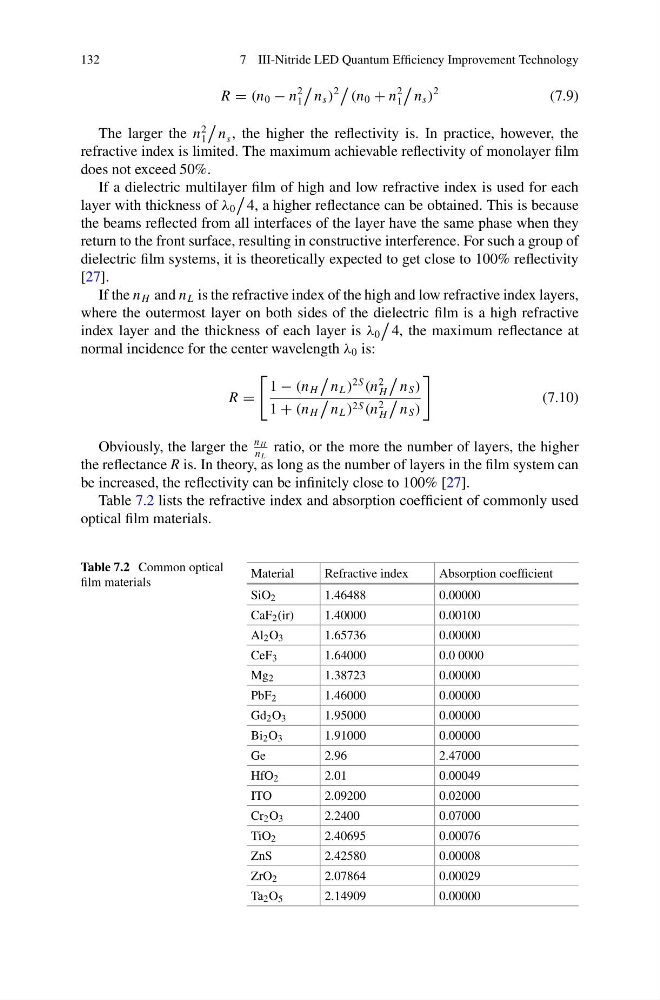
Table 7.2 lists the refractive index and absorption coefficient of commonly used
optical film materials.
Table 7.2 Common optical
film materials
Material
Refractive index
Absorption coefficient
SiO 2
1.46488
0.00000
CaF 2 (ir)
1.40000
0.00100
Al 2 O 3
1.65736
0.00000
CeF 3
1.64000
0.0 0000
Mg 2
1.38723
0.00000
PbF 2
1.46000
0.00000
Gd 2 O 3
1.95000
0.00000
Bi 2 O 3
1.91000
0.00000
Ge
2.96
2.47000
HfO 2
2.01
0.00049
ITO
2.09200
0.02000
Cr 2 O 3
2.2400
0.07000
TiO 2
2.40695
0.00076
ZnS
2.42580
0.00008
ZrO 2
2.07864
0.00029
Ta 2 O 5
2.14909
0.00000
7 III-Nitride LED Quantum Efficiency Improvement Technology
R = (n 0 − n
2
1
n s )
2
(n 0 + n
2
1
n s )
2
(7.9)
The larger the n
2
1
n s , the higher the reflectivity is. In practice, however, the
refractive index is limited. The maximum achievable reflectivity of monolayer film
does not exceed 50%.
If a dielectric multilayer film of high and low refractive index is used for each
layer with thickness of λ 0
4, a higher reflectance can be obtained. This is because
the beams reflected from all interfaces of the layer have the same phase when they
return to the front surface, resulting in constructive interference. For such a group of
dielectric film systems, it is theoretically expected to get close to 100% reflectivity
[27].
If the n H and n L is the refractive index of the high and low refractive index layers,
where the outermost layer on both sides of the dielectric film is a high refractive
index layer and the thickness of each layer is λ 0
4, the maximum reflectance at
normal incidence for the center wavelength λ 0 is:
R =
1 − (n H
n L )
2S
(n
2
H
n S )
1 + (n H
n L ) 2S (n
2
H
n S )
(7.10)
Obviously, the larger the
n H
n L
ratio, or the more the number of layers, the higher
the reflectance R is. In theory, as long as the number of layers in the film system can
be increased, the reflectivity can be infinitely close to 100% [27].
Table 7.2 lists the refractive index and absorption coefficient of commonly used
optical film materials.
Table 7.2 Common optical
film materials
Material
Refractive index
Absorption coefficient
SiO 2
1.46488
0.00000
CaF 2 (ir)
1.40000
0.00100
Al 2 O 3
1.65736
0.00000
CeF 3
1.64000
0.0 0000
Mg 2
1.38723
0.00000
PbF 2
1.46000
0.00000
Gd 2 O 3
1.95000
0.00000
Bi 2 O 3
1.91000
0.00000
Ge
2.96
2.47000
HfO 2
2.01
0.00049
ITO
2.09200
0.02000
Cr 2 O 3
2.2400
0.07000
TiO 2
2.40695
0.00076
ZnS
2.42580
0.00008
ZrO 2
2.07864
0.00029
Ta 2 O 5
2.14909
0.00000