

7.2 Internal Quantum Efficiency Improvement Technology
121
In summary, in order to improve the internal quantum efficiency of the nitride
device, it is necessary to reduce the QCSE effect of the multi-quantum structure,
improve the crystal quality and increase the carrier collection capability of the multiquantum wells.
AlInGaN barrier quantum well: AlInGaN offers more freedom to adjust the structure of the LED since it has two independently adjustable compositional parameters
of In and Al. By changing the composition and doping level of the quantum well
material, the influence of the polarization electric field in the InGaN/GaN quantum
well can be reduced. This, therefore, can improve the quantum efficiency of the LED
device. By designing InGaN/InGaAlN strain-compensated quantum wells and the
doped InGaN/GaN barrier strain-compensated quantum wells, one can manipulate
the Fermi level to obtain a higher hole concentration.
According to the simulation results, the LED quantum well using the AlInGaN
barrier can have its Fermi level (holes) in the hole potential well. This implies that a
higher hole concentration can be obtained. However, the concentration of electrons
is reduced because the Fermi level is shifted down compared to the conventional
structures. As the electron concentration in the LED (on the order of 10
18 ) is still
much larger than the hole concentration (on the order of 10
17 ), the decrease in the
electron concentration does not greatly affect the IQE. Thereby, the electron-hole
recombination efficiency in the quantum well is improved.
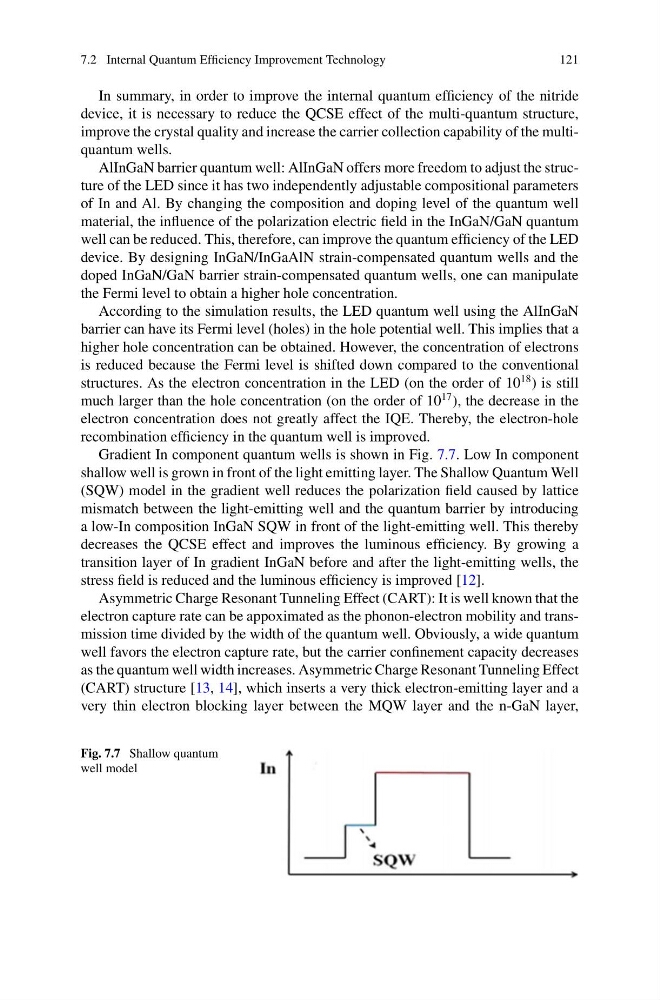
Gradient In component quantum wells is shown in Fig. 7.7. Low In component
shallow well is grown in front of the light emitting layer. The Shallow Quantum Well
(SQW) model in the gradient well reduces the polarization field caused by lattice
mismatch between the light-emitting well and the quantum barrier by introducing
a low-In composition InGaN SQW in front of the light-emitting well. This thereby
decreases the QCSE effect and improves the luminous efficiency. By growing a
transition layer of In gradient InGaN before and after the light-emitting wells, the
stress field is reduced and the luminous efficiency is improved [12].
Asymmetric Charge Resonant Tunneling Effect (CART): It is well known that the
electron capture rate can be appoximated as the phonon-electron mobility and transmission time divided by the width of the quantum well. Obviously, a wide quantum
well favors the electron capture rate, but the carrier confinement capacity decreases
as the quantum well width increases. Asymmetric Charge Resonant Tunneling Effect
(CART) structure [13, 14], which inserts a very thick electron-emitting layer and a
very thin electron blocking layer between the MQW layer and the n-GaN layer,
Fig. 7.7 Shallow quantum
well model
121
In summary, in order to improve the internal quantum efficiency of the nitride
device, it is necessary to reduce the QCSE effect of the multi-quantum structure,
improve the crystal quality and increase the carrier collection capability of the multiquantum wells.
AlInGaN barrier quantum well: AlInGaN offers more freedom to adjust the structure of the LED since it has two independently adjustable compositional parameters
of In and Al. By changing the composition and doping level of the quantum well
material, the influence of the polarization electric field in the InGaN/GaN quantum
well can be reduced. This, therefore, can improve the quantum efficiency of the LED
device. By designing InGaN/InGaAlN strain-compensated quantum wells and the
doped InGaN/GaN barrier strain-compensated quantum wells, one can manipulate
the Fermi level to obtain a higher hole concentration.
According to the simulation results, the LED quantum well using the AlInGaN
barrier can have its Fermi level (holes) in the hole potential well. This implies that a
higher hole concentration can be obtained. However, the concentration of electrons
is reduced because the Fermi level is shifted down compared to the conventional
structures. As the electron concentration in the LED (on the order of 10
18 ) is still
much larger than the hole concentration (on the order of 10
17 ), the decrease in the
electron concentration does not greatly affect the IQE. Thereby, the electron-hole
recombination efficiency in the quantum well is improved.
Gradient In component quantum wells is shown in Fig. 7.7. Low In component
shallow well is grown in front of the light emitting layer. The Shallow Quantum Well
(SQW) model in the gradient well reduces the polarization field caused by lattice
mismatch between the light-emitting well and the quantum barrier by introducing
a low-In composition InGaN SQW in front of the light-emitting well. This thereby
decreases the QCSE effect and improves the luminous efficiency. By growing a
transition layer of In gradient InGaN before and after the light-emitting wells, the
stress field is reduced and the luminous efficiency is improved [12].
Asymmetric Charge Resonant Tunneling Effect (CART): It is well known that the
electron capture rate can be appoximated as the phonon-electron mobility and transmission time divided by the width of the quantum well. Obviously, a wide quantum
well favors the electron capture rate, but the carrier confinement capacity decreases
as the quantum well width increases. Asymmetric Charge Resonant Tunneling Effect
(CART) structure [13, 14], which inserts a very thick electron-emitting layer and a
very thin electron blocking layer between the MQW layer and the n-GaN layer,
Fig. 7.7 Shallow quantum
well model