

6.3 Epitaxial Growth and Doping Techniques for AlGaN Materials
99
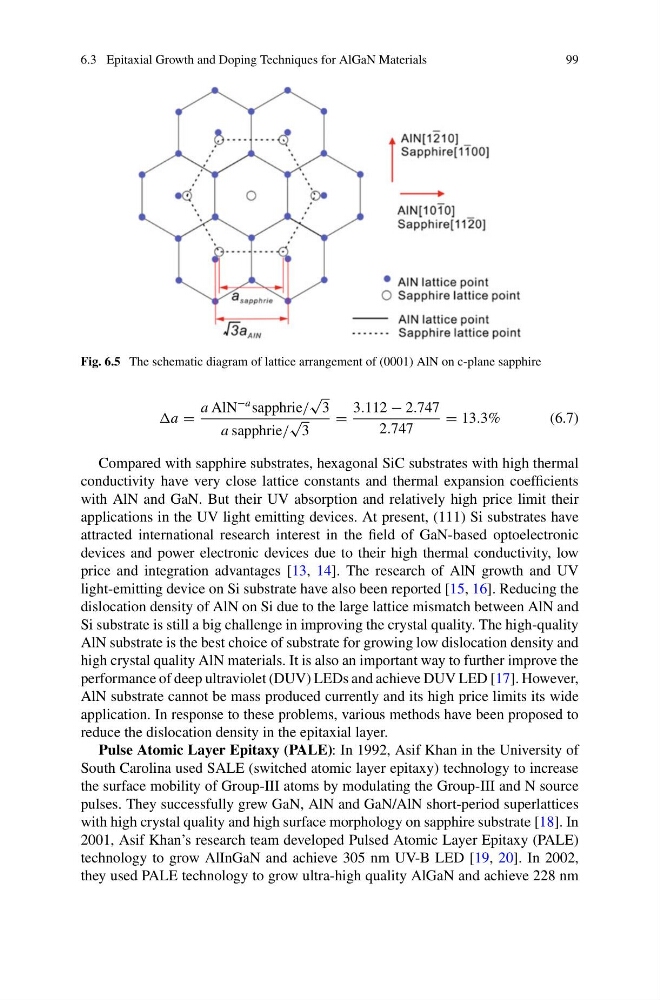
Fig. 6.5 The schematic diagram of lattice arrangement of (0001) AlN on c-plane sapphire
a =
a AlN
−a sapphrie/
√
3
a sapphrie/
√
3
=
3.112 − 2.747
2.747
= 13.3%
(6.7)
Compared with sapphire substrates, hexagonal SiC substrates with high thermal
conductivity have very close lattice constants and thermal expansion coefficients
with AlN and GaN. But their UV absorption and relatively high price limit their
applications in the UV light emitting devices. At present, (111) Si substrates have
attracted international research interest in the field of GaN-based optoelectronic
devices and power electronic devices due to their high thermal conductivity, low
price and integration advantages [13, 14]. The research of AlN growth and UV
light-emitting device on Si substrate have also been reported [15, 16]. Reducing the
dislocation density of AlN on Si due to the large lattice mismatch between AlN and
Si substrate is still a big challenge in improving the crystal quality. The high-quality
AlN substrate is the best choice of substrate for growing low dislocation density and
high crystal quality AlN materials. It is also an important way to further improve the
performance of deep ultraviolet (DUV) LEDs and achieve DUV LED [17]. However,
AlN substrate cannot be mass produced currently and its high price limits its wide
application. In response to these problems, various methods have been proposed to
reduce the dislocation density in the epitaxial layer.
Pulse Atomic Layer Epitaxy (PALE): In 1992, Asif Khan in the University of
South Carolina used SALE (switched atomic layer epitaxy) technology to increase
the surface mobility of Group-III atoms by modulating the Group-III and N source
pulses. They successfully grew GaN, AlN and GaN/AlN short-period superlattices
with high crystal quality and high surface morphology on sapphire substrate [18]. In
2001, Asif Khan’s research team developed Pulsed Atomic Layer Epitaxy (PALE)
technology to grow AlInGaN and achieve 305 nm UV-B LED [19, 20]. In 2002,
they used PALE technology to grow ultra-high quality AlGaN and achieve 228 nm
99
Fig. 6.5 The schematic diagram of lattice arrangement of (0001) AlN on c-plane sapphire
a =
a AlN
−a sapphrie/
√
3
a sapphrie/
√
3
=
3.112 − 2.747
2.747
= 13.3%
(6.7)
Compared with sapphire substrates, hexagonal SiC substrates with high thermal
conductivity have very close lattice constants and thermal expansion coefficients
with AlN and GaN. But their UV absorption and relatively high price limit their
applications in the UV light emitting devices. At present, (111) Si substrates have
attracted international research interest in the field of GaN-based optoelectronic
devices and power electronic devices due to their high thermal conductivity, low
price and integration advantages [13, 14]. The research of AlN growth and UV
light-emitting device on Si substrate have also been reported [15, 16]. Reducing the
dislocation density of AlN on Si due to the large lattice mismatch between AlN and
Si substrate is still a big challenge in improving the crystal quality. The high-quality
AlN substrate is the best choice of substrate for growing low dislocation density and
high crystal quality AlN materials. It is also an important way to further improve the
performance of deep ultraviolet (DUV) LEDs and achieve DUV LED [17]. However,
AlN substrate cannot be mass produced currently and its high price limits its wide
application. In response to these problems, various methods have been proposed to
reduce the dislocation density in the epitaxial layer.
Pulse Atomic Layer Epitaxy (PALE): In 1992, Asif Khan in the University of
South Carolina used SALE (switched atomic layer epitaxy) technology to increase
the surface mobility of Group-III atoms by modulating the Group-III and N source
pulses. They successfully grew GaN, AlN and GaN/AlN short-period superlattices
with high crystal quality and high surface morphology on sapphire substrate [18]. In
2001, Asif Khan’s research team developed Pulsed Atomic Layer Epitaxy (PALE)
technology to grow AlInGaN and achieve 305 nm UV-B LED [19, 20]. In 2002,
they used PALE technology to grow ultra-high quality AlGaN and achieve 228 nm