

5.5 Green LED and Non-polar, Semi-polar LED
87
5.5.1 Polar Surface High in Composition Green LEDs
Since 1995, Nichia Chemical Co., Ltd. has launched commercial InGaN-based green
LEDs. The United States, Japan, South Korea, the mainland China and Taiwan have
all explored the development of nitride green LED structures and optimized their
growth parameters. They also studied the effect of material quality on quantum
efficiency in the region. In view of the key scientific and technical issues such
as material quality and piezoelectric polarization field in high indium composition quantum wells materials, researchers at the Institute of Semiconductors of the
Chinese Academy of Sciences have further studied the optimization of the growth
conditions of high-indium composition and designed new active regions structures
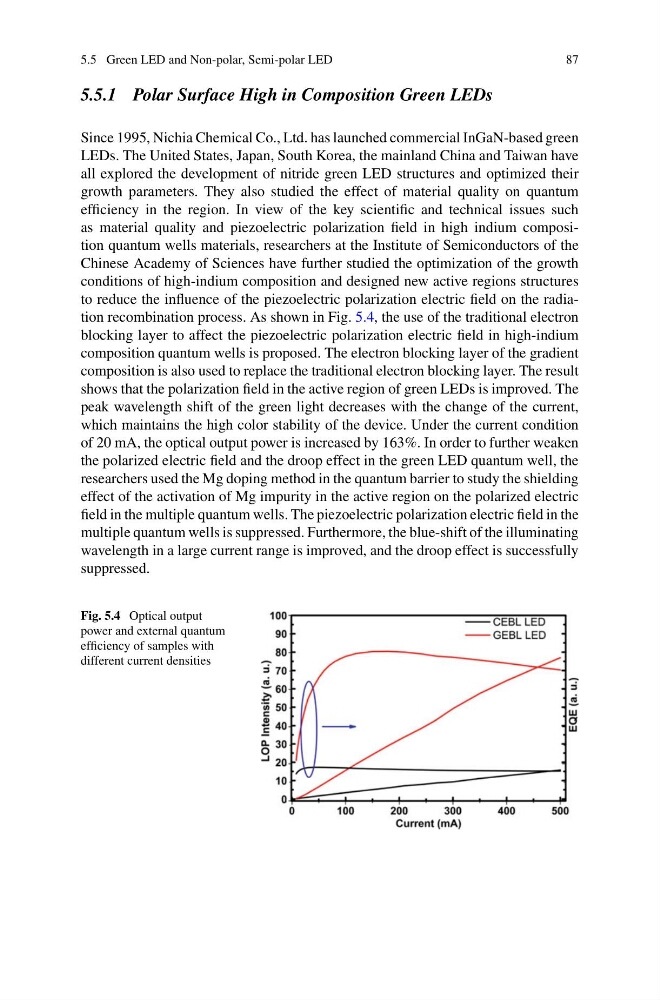
to reduce the influence of the piezoelectric polarization electric field on the radiation recombination process. As shown in Fig. 5.4, the use of the traditional electron
blocking layer to affect the piezoelectric polarization electric field in high-indium
composition quantum wells is proposed. The electron blocking layer of the gradient
composition is also used to replace the traditional electron blocking layer. The result
shows that the polarization field in the active region of green LEDs is improved. The
peak wavelength shift of the green light decreases with the change of the current,
which maintains the high color stability of the device. Under the current condition
of 20 mA, the optical output power is increased by 163%. In order to further weaken
the polarized electric field and the droop effect in the green LED quantum well, the
researchers used the Mg doping method in the quantum barrier to study the shielding
effect of the activation of Mg impurity in the active region on the polarized electric
field in the multiple quantum wells. The piezoelectric polarization electric field in the
multiple quantum wells is suppressed. Furthermore, the blue-shift of the illuminating
wavelength in a large current range is improved, and the droop effect is successfully
suppressed.
Fig. 5.4 Optical output
power and external quantum
efficiency of samples with
different current densities
87
5.5.1 Polar Surface High in Composition Green LEDs
Since 1995, Nichia Chemical Co., Ltd. has launched commercial InGaN-based green
LEDs. The United States, Japan, South Korea, the mainland China and Taiwan have
all explored the development of nitride green LED structures and optimized their
growth parameters. They also studied the effect of material quality on quantum
efficiency in the region. In view of the key scientific and technical issues such
as material quality and piezoelectric polarization field in high indium composition quantum wells materials, researchers at the Institute of Semiconductors of the
Chinese Academy of Sciences have further studied the optimization of the growth
conditions of high-indium composition and designed new active regions structures
to reduce the influence of the piezoelectric polarization electric field on the radiation recombination process. As shown in Fig. 5.4, the use of the traditional electron
blocking layer to affect the piezoelectric polarization electric field in high-indium
composition quantum wells is proposed. The electron blocking layer of the gradient
composition is also used to replace the traditional electron blocking layer. The result
shows that the polarization field in the active region of green LEDs is improved. The
peak wavelength shift of the green light decreases with the change of the current,
which maintains the high color stability of the device. Under the current condition
of 20 mA, the optical output power is increased by 163%. In order to further weaken
the polarized electric field and the droop effect in the green LED quantum well, the
researchers used the Mg doping method in the quantum barrier to study the shielding
effect of the activation of Mg impurity in the active region on the polarized electric
field in the multiple quantum wells. The piezoelectric polarization electric field in the
multiple quantum wells is suppressed. Furthermore, the blue-shift of the illuminating
wavelength in a large current range is improved, and the droop effect is successfully
suppressed.
Fig. 5.4 Optical output
power and external quantum
efficiency of samples with
different current densities