

5 Control of Crystal Size Distribution and Polymorphs …
93
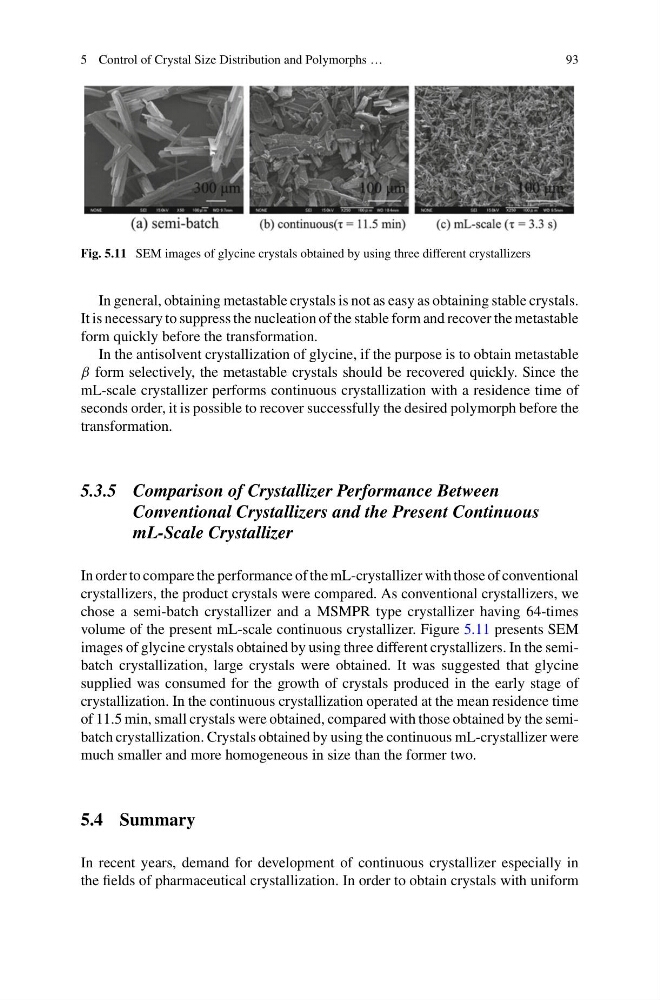
Fig. 5.11 SEM images of glycine crystals obtained by using three different crystallizers
In general, obtaining metastable crystals is not as easy as obtaining stable crystals.
It is necessary to suppress the nucleation of the stable form and recover the metastable
form quickly before the transformation.
In the antisolvent crystallization of glycine, if the purpose is to obtain metastable
β form selectively, the metastable crystals should be recovered quickly. Since the
mL-scale crystallizer performs continuous crystallization with a residence time of
seconds order, it is possible to recover successfully the desired polymorph before the
transformation.
5.3.5 Comparison of Crystallizer Performance Between
Conventional Crystallizers and the Present Continuous
mL-Scale Crystallizer
In order to compare the performance of the mL-crystallizer with those of conventional
crystallizers, the product crystals were compared. As conventional crystallizers, we
chose a semi-batch crystallizer and a MSMPR type crystallizer having 64-times
volume of the present mL-scale continuous crystallizer. Figure 5.11 presents SEM
images of glycine crystals obtained by using three different crystallizers. In the semibatch crystallization, large crystals were obtained. It was suggested that glycine
supplied was consumed for the growth of crystals produced in the early stage of
crystallization. In the continuous crystallization operated at the mean residence time
of 11.5 min, small crystals were obtained, compared with those obtained by the semibatch crystallization. Crystals obtained by using the continuous mL-crystallizer were
much smaller and more homogeneous in size than the former two.
5.4 Summary
In recent years, demand for development of continuous crystallizer especially in
the fields of pharmaceutical crystallization. In order to obtain crystals with uniform
93
Fig. 5.11 SEM images of glycine crystals obtained by using three different crystallizers
In general, obtaining metastable crystals is not as easy as obtaining stable crystals.
It is necessary to suppress the nucleation of the stable form and recover the metastable
form quickly before the transformation.
In the antisolvent crystallization of glycine, if the purpose is to obtain metastable
β form selectively, the metastable crystals should be recovered quickly. Since the
mL-scale crystallizer performs continuous crystallization with a residence time of
seconds order, it is possible to recover successfully the desired polymorph before the
transformation.
5.3.5 Comparison of Crystallizer Performance Between
Conventional Crystallizers and the Present Continuous
mL-Scale Crystallizer
In order to compare the performance of the mL-crystallizer with those of conventional
crystallizers, the product crystals were compared. As conventional crystallizers, we
chose a semi-batch crystallizer and a MSMPR type crystallizer having 64-times
volume of the present mL-scale continuous crystallizer. Figure 5.11 presents SEM
images of glycine crystals obtained by using three different crystallizers. In the semibatch crystallization, large crystals were obtained. It was suggested that glycine
supplied was consumed for the growth of crystals produced in the early stage of
crystallization. In the continuous crystallization operated at the mean residence time
of 11.5 min, small crystals were obtained, compared with those obtained by the semibatch crystallization. Crystals obtained by using the continuous mL-crystallizer were
much smaller and more homogeneous in size than the former two.
5.4 Summary
In recent years, demand for development of continuous crystallizer especially in
the fields of pharmaceutical crystallization. In order to obtain crystals with uniform