

76
T. Okutsu
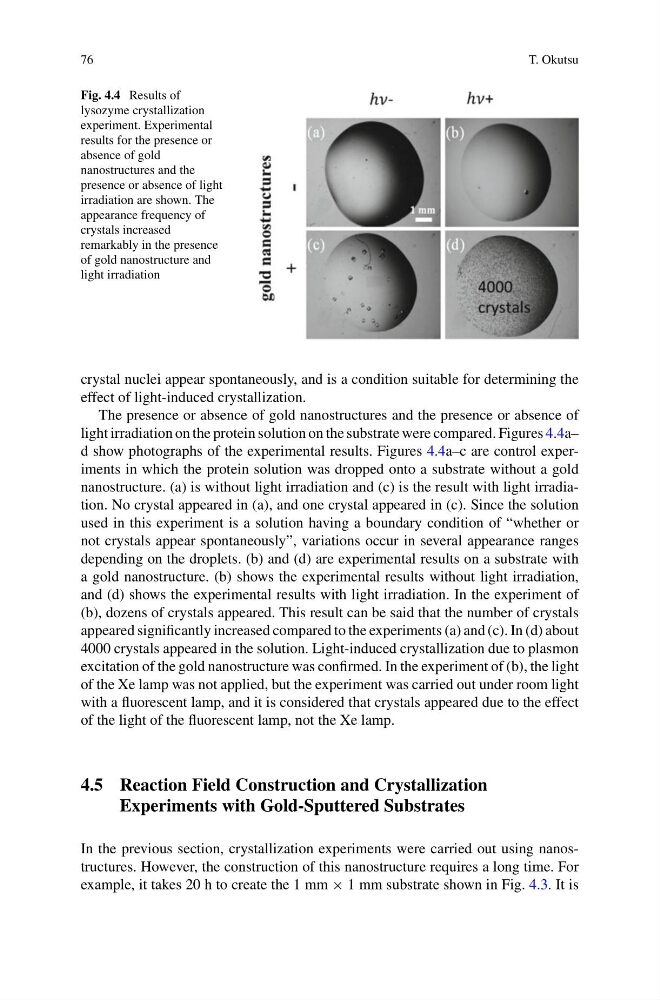
Fig. 4.4 Results of
lysozyme crystallization
experiment. Experimental
results for the presence or
absence of gold
nanostructures and the
presence or absence of light
irradiation are shown. The
appearance frequency of
crystals increased
remarkably in the presence
of gold nanostructure and
light irradiation
crystal nuclei appear spontaneously, and is a condition suitable for determining the
effect of light-induced crystallization.
The presence or absence of gold nanostructures and the presence or absence of
light irradiation on the protein solution on the substrate were compared. Figures 4.4a–
d show photographs of the experimental results. Figures 4.4a–c are control experiments in which the protein solution was dropped onto a substrate without a gold
nanostructure. (a) is without light irradiation and (c) is the result with light irradiation. No crystal appeared in (a), and one crystal appeared in (c). Since the solution
used in this experiment is a solution having a boundary condition of “whether or
not crystals appear spontaneously”, variations occur in several appearance ranges
depending on the droplets. (b) and (d) are experimental results on a substrate with
a gold nanostructure. (b) shows the experimental results without light irradiation,
and (d) shows the experimental results with light irradiation. In the experiment of
(b), dozens of crystals appeared. This result can be said that the number of crystals
appeared significantly increased compared to the experiments (a) and (c). In (d) about
4000 crystals appeared in the solution. Light-induced crystallization due to plasmon
excitation of the gold nanostructure was confirmed. In the experiment of (b), the light
of the Xe lamp was not applied, but the experiment was carried out under room light
with a fluorescent lamp, and it is considered that crystals appeared due to the effect
of the light of the fluorescent lamp, not the Xe lamp.
4.5 Reaction Field Construction and Crystallization
Experiments with Gold-Sputtered Substrates
In the previous section, crystallization experiments were carried out using nanostructures. However, the construction of this nanostructure requires a long time. For
example, it takes 20 h to create the 1 mm × 1 mm substrate shown in Fig. 4.3. It is
T. Okutsu
Fig. 4.4 Results of
lysozyme crystallization
experiment. Experimental
results for the presence or
absence of gold
nanostructures and the
presence or absence of light
irradiation are shown. The
appearance frequency of
crystals increased
remarkably in the presence
of gold nanostructure and
light irradiation
crystal nuclei appear spontaneously, and is a condition suitable for determining the
effect of light-induced crystallization.
The presence or absence of gold nanostructures and the presence or absence of
light irradiation on the protein solution on the substrate were compared. Figures 4.4a–
d show photographs of the experimental results. Figures 4.4a–c are control experiments in which the protein solution was dropped onto a substrate without a gold
nanostructure. (a) is without light irradiation and (c) is the result with light irradiation. No crystal appeared in (a), and one crystal appeared in (c). Since the solution
used in this experiment is a solution having a boundary condition of “whether or
not crystals appear spontaneously”, variations occur in several appearance ranges
depending on the droplets. (b) and (d) are experimental results on a substrate with
a gold nanostructure. (b) shows the experimental results without light irradiation,
and (d) shows the experimental results with light irradiation. In the experiment of
(b), dozens of crystals appeared. This result can be said that the number of crystals
appeared significantly increased compared to the experiments (a) and (c). In (d) about
4000 crystals appeared in the solution. Light-induced crystallization due to plasmon
excitation of the gold nanostructure was confirmed. In the experiment of (b), the light
of the Xe lamp was not applied, but the experiment was carried out under room light
with a fluorescent lamp, and it is considered that crystals appeared due to the effect
of the light of the fluorescent lamp, not the Xe lamp.
4.5 Reaction Field Construction and Crystallization
Experiments with Gold-Sputtered Substrates
In the previous section, crystallization experiments were carried out using nanostructures. However, the construction of this nanostructure requires a long time. For
example, it takes 20 h to create the 1 mm × 1 mm substrate shown in Fig. 4.3. It is