

56
H. Takiyama
Initial Conc.
C 0
Supersaturation
Undersaturation
Anti-solvent Concentration C Ant
Solute Concentration
C
0.2
0.4
0.6
0.8
1
0.2
0.4
0.6
0.8
1
0
Solution B
m B
Solution A
m A
Saturated
Conc. C*
E: Solute
X
Y
M
S
α
β
β
α
=
B
A
m
m
A: Antisolvnet
B: Original
solvnet
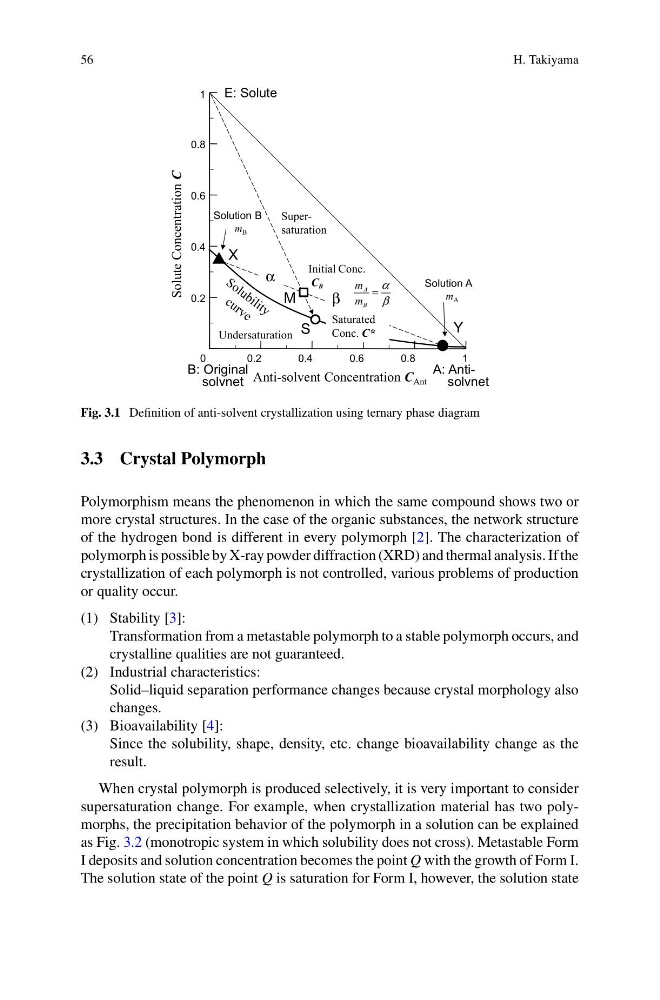
Fig. 3.1 Definition of anti-solvent crystallization using ternary phase diagram
3.3 Crystal Polymorph
Polymorphism means the phenomenon in which the same compound shows two or
more crystal structures. In the case of the organic substances, the network structure
of the hydrogen bond is different in every polymorph [2]. The characterization of
polymorph is possible by X-ray powder diffraction (XRD) and thermal analysis. If the
crystallization of each polymorph is not controlled, various problems of production
or quality occur.
(1) Stability [3]:
Transformation from a metastable polymorph to a stable polymorph occurs, and
crystalline qualities are not guaranteed.
(2) Industrial characteristics:
Solid–liquid separation performance changes because crystal morphology also
changes.
(3) Bioavailability [4]:
Since the solubility, shape, density, etc. change bioavailability change as the
result.
When crystal polymorph is produced selectively, it is very important to consider
supersaturation change. For example, when crystallization material has two polymorphs, the precipitation behavior of the polymorph in a solution can be explained
as Fig. 3.2 (monotropic system in which solubility does not cross). Metastable Form
I deposits and solution concentration becomes the point Q with the growth of Form I.
The solution state of the point Q is saturation for Form I, however, the solution state
H. Takiyama
Initial Conc.
C 0
Supersaturation
Undersaturation
Anti-solvent Concentration C Ant
Solute Concentration
C
0.2
0.4
0.6
0.8
1
0.2
0.4
0.6
0.8
1
0
Solution B
m B
Solution A
m A
Saturated
Conc. C*
E: Solute
X
Y
M
S
α
β
β
α
=
B
A
m
m
A: Antisolvnet
B: Original
solvnet
Fig. 3.1 Definition of anti-solvent crystallization using ternary phase diagram
3.3 Crystal Polymorph
Polymorphism means the phenomenon in which the same compound shows two or
more crystal structures. In the case of the organic substances, the network structure
of the hydrogen bond is different in every polymorph [2]. The characterization of
polymorph is possible by X-ray powder diffraction (XRD) and thermal analysis. If the
crystallization of each polymorph is not controlled, various problems of production
or quality occur.
(1) Stability [3]:
Transformation from a metastable polymorph to a stable polymorph occurs, and
crystalline qualities are not guaranteed.
(2) Industrial characteristics:
Solid–liquid separation performance changes because crystal morphology also
changes.
(3) Bioavailability [4]:
Since the solubility, shape, density, etc. change bioavailability change as the
result.
When crystal polymorph is produced selectively, it is very important to consider
supersaturation change. For example, when crystallization material has two polymorphs, the precipitation behavior of the polymorph in a solution can be explained
as Fig. 3.2 (monotropic system in which solubility does not cross). Metastable Form
I deposits and solution concentration becomes the point Q with the growth of Form I.
The solution state of the point Q is saturation for Form I, however, the solution state