

526
K. Sada and K. Kokado
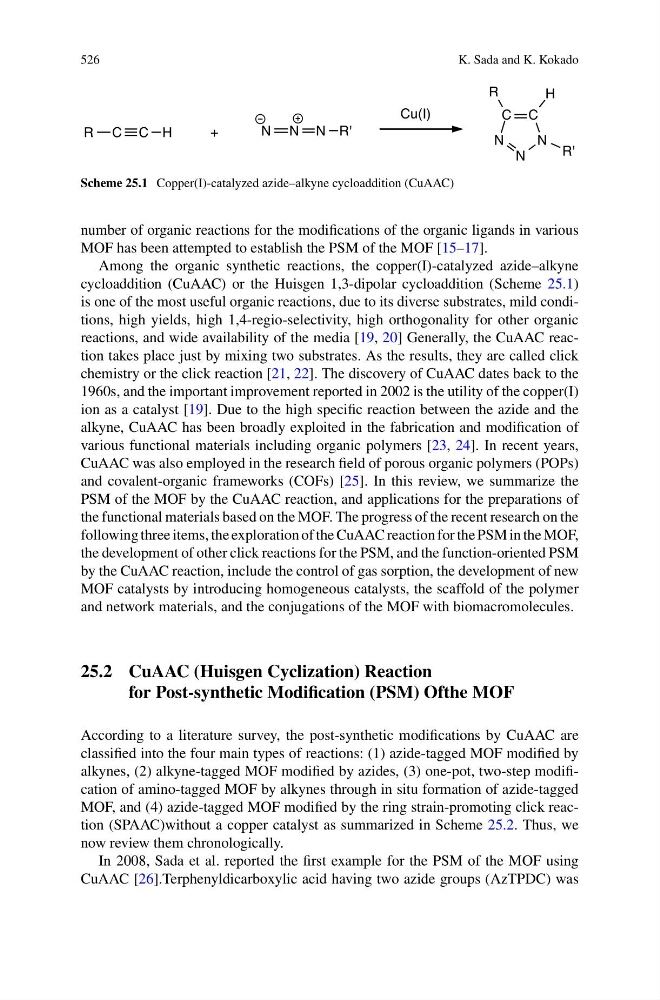
Scheme 25.1 Copper(I)-catalyzed azide–alkyne cycloaddition (CuAAC)
number of organic reactions for the modifications of the organic ligands in various
MOF has been attempted to establish the PSM of the MOF [15–17].
Among the organic synthetic reactions, the copper(I)-catalyzed azide–alkyne
cycloaddition (CuAAC) or the Huisgen 1,3-dipolar cycloaddition (Scheme 25.1)
is one of the most useful organic reactions, due to its diverse substrates, mild conditions, high yields, high 1,4-regio-selectivity, high orthogonality for other organic
reactions, and wide availability of the media [19, 20] Generally, the CuAAC reaction takes place just by mixing two substrates. As the results, they are called click
chemistry or the click reaction [21, 22]. The discovery of CuAAC dates back to the
1960s, and the important improvement reported in 2002 is the utility of the copper(I)
ion as a catalyst [19]. Due to the high specific reaction between the azide and the
alkyne, CuAAC has been broadly exploited in the fabrication and modification of
various functional materials including organic polymers [23, 24]. In recent years,
CuAAC was also employed in the research field of porous organic polymers (POPs)
and covalent-organic frameworks (COFs) [25]. In this review, we summarize the
PSM of the MOF by the CuAAC reaction, and applications for the preparations of
the functional materials based on the MOF. The progress of the recent research on the
following three items, the exploration of the CuAAC reaction for the PSM in the MOF,
the development of other click reactions for the PSM, and the function-oriented PSM
by the CuAAC reaction, include the control of gas sorption, the development of new
MOF catalysts by introducing homogeneous catalysts, the scaffold of the polymer
and network materials, and the conjugations of the MOF with biomacromolecules.
25.2 CuAAC (Huisgen Cyclization) Reaction
for Post-synthetic Modification (PSM) Ofthe MOF
According to a literature survey, the post-synthetic modifications by CuAAC are
classified into the four main types of reactions: (1) azide-tagged MOF modified by
alkynes, (2) alkyne-tagged MOF modified by azides, (3) one-pot, two-step modification of amino-tagged MOF by alkynes through in situ formation of azide-tagged
MOF, and (4) azide-tagged MOF modified by the ring strain-promoting click reaction (SPAAC)without a copper catalyst as summarized in Scheme 25.2. Thus, we
now review them chronologically.
In 2008, Sada et al. reported the first example for the PSM of the MOF using
CuAAC [26].Terphenyldicarboxylic acid having two azide groups (AzTPDC) was
K. Sada and K. Kokado
Scheme 25.1 Copper(I)-catalyzed azide–alkyne cycloaddition (CuAAC)
number of organic reactions for the modifications of the organic ligands in various
MOF has been attempted to establish the PSM of the MOF [15–17].
Among the organic synthetic reactions, the copper(I)-catalyzed azide–alkyne
cycloaddition (CuAAC) or the Huisgen 1,3-dipolar cycloaddition (Scheme 25.1)
is one of the most useful organic reactions, due to its diverse substrates, mild conditions, high yields, high 1,4-regio-selectivity, high orthogonality for other organic
reactions, and wide availability of the media [19, 20] Generally, the CuAAC reaction takes place just by mixing two substrates. As the results, they are called click
chemistry or the click reaction [21, 22]. The discovery of CuAAC dates back to the
1960s, and the important improvement reported in 2002 is the utility of the copper(I)
ion as a catalyst [19]. Due to the high specific reaction between the azide and the
alkyne, CuAAC has been broadly exploited in the fabrication and modification of
various functional materials including organic polymers [23, 24]. In recent years,
CuAAC was also employed in the research field of porous organic polymers (POPs)
and covalent-organic frameworks (COFs) [25]. In this review, we summarize the
PSM of the MOF by the CuAAC reaction, and applications for the preparations of
the functional materials based on the MOF. The progress of the recent research on the
following three items, the exploration of the CuAAC reaction for the PSM in the MOF,
the development of other click reactions for the PSM, and the function-oriented PSM
by the CuAAC reaction, include the control of gas sorption, the development of new
MOF catalysts by introducing homogeneous catalysts, the scaffold of the polymer
and network materials, and the conjugations of the MOF with biomacromolecules.
25.2 CuAAC (Huisgen Cyclization) Reaction
for Post-synthetic Modification (PSM) Ofthe MOF
According to a literature survey, the post-synthetic modifications by CuAAC are
classified into the four main types of reactions: (1) azide-tagged MOF modified by
alkynes, (2) alkyne-tagged MOF modified by azides, (3) one-pot, two-step modification of amino-tagged MOF by alkynes through in situ formation of azide-tagged
MOF, and (4) azide-tagged MOF modified by the ring strain-promoting click reaction (SPAAC)without a copper catalyst as summarized in Scheme 25.2. Thus, we
now review them chronologically.
In 2008, Sada et al. reported the first example for the PSM of the MOF using
CuAAC [26].Terphenyldicarboxylic acid having two azide groups (AzTPDC) was